
Mandala and yantra
The circle diagrams of India and Tibet, as their own traditions describe them.
What are mandalas and yantras, and how do their own traditions regard them?
What it is
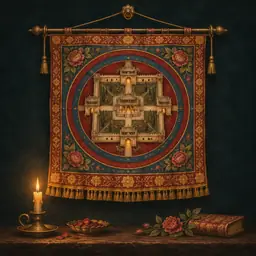
A mandala, from the Sanskrit for circle, is a diagram of a sacred enclosure: usually a square with four gates set inside rings, with a deity or a symbol at the centre. A yantra is a plainer diagram of triangles, circles and lotus petals used in Hindu worship as the seat of a deity. The best known is the Sri Yantra, nine interlocking triangles, four pointing up and five down, round a central point, enclosed by two rings of lotus petals and a gated square. In their own traditions these are objects of worship and instruments of initiation, not decoration.
The teaching
As each tantric tradition that draws them teaches it.
The palace and its rings
A mandala of the Tibetan tradition is the palace of a deity seen from above, and it is read from the outside in. The outermost ring is a ring of flames, the wisdom that burns away ignorance. Within it is a ring of vajras, the diamond thunderbolt, for what cannot be broken; in many mandalas comes a ring of the eight charnel grounds, for death and the passing of all things; and then a ring of lotus petals, for purity and rebirth.
Inside the rings stands the square palace, its walls in coloured bands and a gate in the middle of each side, facing the four directions. At its heart sits the chief deity of the mandala, with the deities of its retinue set in the courts around. To enter the mandala in meditation is to pass through the rings and the gate and come to the centre.
The five families
Many mandalas are ordered by the five Buddha families, each with a colour, a direction and a wisdom that transforms one poison of the mind. Vairocana, white, is at the centre: ignorance becomes the wisdom of the whole field of reality. Akshobhya, blue, is in the east: anger becomes mirror-like wisdom. Ratnasambhava, yellow, is in the south: pride becomes the wisdom of sameness. Amitabha, red, is in the west: desire becomes discerning wisdom. Amoghasiddhi, green, is in the north: envy becomes the wisdom that accomplishes all. In some systems Vairocana and Akshobhya change places.
Making and sweeping a sand mandala
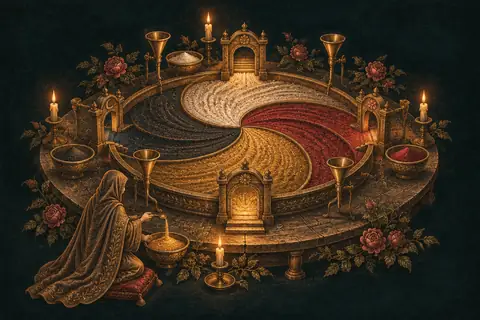
Tibetan monks make the mandala of coloured sand over many days. The ground is blessed with chant, and the lines are laid out with chalked string snapped against the board. The sand is poured from narrow metal funnels, rasped with a rod so that the grains run in a thin stream, working from the centre outward. When the rites are done the sand is swept together, part of it given to those present and the rest poured into running water to carry the blessing on. The sweeping is itself the teaching: nothing made lasts.
The two mandalas of Shingon
In Japan the Shingon school keeps a pair of great painted mandalas, hung facing each other in the temple hall: the Womb Realm, of compassion and the principle in all things, and the Diamond Realm, of the wisdom that cannot be broken. The great sun Buddha, Dainichi, sits at the centre of both. In initiation the newcomer, blindfolded, throws a flower onto the mandala, and the deity on whom it falls becomes the one to whom that person is bound.
The yantra
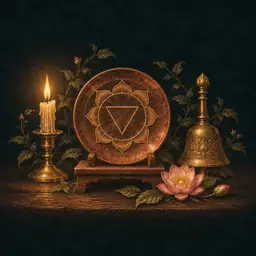
A yantra is a plainer diagram used in Hindu worship as the seat of a deity. At its centre is the bindu, the point, the deity in unmanifest form and the source from which all comes. Around it stand triangles, the downward for Shakti and the yoni, the upward for Shiva and fire; then circles, then rings of lotus petals, eight or sixteen; and outside all the bhupura, a square with four gates, the earth and the bounds of the world.
A yantra is brought to life by rite, with mantra and offerings, and is then worshipped as the deity's own body. The worshipper meditates on it from the outside in, passing the gates, the petals and the triangles to rest at last on the point.
The Sri Yantra
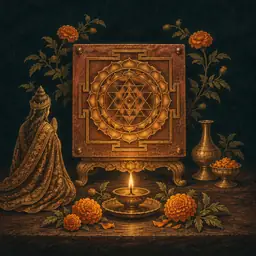
The Sri Yantra, sacred to the goddess Tripura Sundari in the Shri Vidya tradition, has nine interlocking triangles, four pointing up and five pointing down, which cross to make forty-three small triangles round the central point. Its nine enclosures, read from the outside in, are the gated square, the ring of sixteen petals, the ring of eight petals, the fourteen triangles, the outer ten, the inner ten, the eight, the single central triangle, and the point, where the goddess herself sits. Each enclosure is peopled by her powers, and worship moves inward through all nine.
Jung's circles
In the West the word came by way of Carl Jung. From 1916 he drew circular pictures, and for a time he sketched a small one each morning in a notebook, finding that it matched his inner state that day. He came to read the mandala as an image of the self, the wholeness of the psyche with its centre, and found that such circles, often divided in four, arise of themselves in his patients' drawings at times of inner disorder, as the mind's own attempt to set itself in order.
How it is practised
Within their traditions a mandala or a yantra is used under a teacher, with rites of its own, and that use is not offered here. What is open to anyone is to look and to draw. A visitor may watch monks make a sand mandala where one is shown in public. At home a reader can draw a circle, mark its centre, divide it into four or eight with compasses and fill it as the hand suggests, in the manner Jung described, then date it and keep it. Looked at over some weeks, a run of such drawings is a record of mood, and that is all it need be.
Where it comes from
Mandalas belong chiefly to the tantric Buddhism that took shape in India from about the seventh century CE and passed to Tibet, Nepal, China and Japan, where the Shingon school keeps a pair of great painted mandalas. Tibetan monks build sand mandalas grain by grain over days and sweep them away when the rite is done. The Sri Yantra belongs to the Shri Vidya tradition of goddess worship in Hinduism. In the West the word was spread by Carl Jung, who from 1916 drew circular pictures of his own, read them as images of the whole self, and found the like in his patients' drawings.
What is known, and what is not
The history of these diagrams is documented in texts, paintings and living practice. The Sri Yantra is hard to draw exactly, and mathematicians have studied how its nine triangles can be made to meet. Small trials of colouring or drawing circular designs report lower anxiety straight afterwards, about as other quiet, absorbing tasks do; they are small and short. Jung's reading of the mandala as an image of the self is his interpretation. Nothing shows that a diagram on a wall changes fortune or health.
Its words
 Mandala
- A circular diagram of a sacred enclosure in Buddhist and Hindu practice, used in worship and initiation. Jung borrowed the word for circular drawings of his own and his patients'.
 Yantra
- A diagram of triangles, circles and lotus petals used in Hindu worship as the seat of a deity.
 Sri Yantra
- The best known yantra: nine interlocking triangles round a central point, inside lotus petals and a gated square, sacred to the Shri Vidya tradition.
- Sand Mandala
- A mandala laid out by Tibetan Buddhist monks in coloured sand, grain by grain over days, and swept away when its rite is finished.
Ask the Oracle further
What is the Sri Yantra, and what do its nine triangles stand for?What did the West make of mandalas in the twentieth century?
Before you practise
The mathematics of these figures is true and can be checked. What they are held to mean is a tradition, and many popular claims of the golden ratio in buildings, bodies and paintings do not survive measurement. A figure heals, protects and attracts nothing by itself.
Its other branches
The golden ratioThe Platonic solidsThe flower of lifeThe vesica piscisPythagoras and numberMagic squaresThe whole artSearch the tree

