
The golden ratio
A real number, about 1.618, and the temples, shells and faces it is said to rule.
What is the golden ratio, and where is it truly found?
What it is
The golden ratio is a number, about 1.618, usually written with the Greek letter phi. A line is cut in the golden ratio when the whole is to the longer part as the longer part is to the shorter. Its exact value is one plus the square root of five, divided by two. It appears wherever a regular pentagon does, since a pentagon's diagonal and side stand in that ratio. The neighbouring numbers of the Fibonacci sequence, 1, 1, 2, 3, 5, 8, 13, give ratios that draw closer and closer to it without ever reaching it.
The teaching
As the lore of the cut from Euclid to Pacioli and Kepler teaches it.
The cut in extreme and mean ratio
Euclid defines it in the sixth book of the Elements: a straight line is said to have been cut in extreme and mean ratio when, as the whole line is to the greater segment, so is the greater to the less. Call the shorter part one; then the longer is the number phi, about 1.618, and the whole is phi plus one. Its exact value is one plus the square root of five, all divided by two.
The number has properties no other has. Its square is itself plus one, about 2.618, and its reciprocal is itself less one, about 0.618, so phi, its square and its reciprocal share the same endless decimal tail. Each power of phi is the sum of the two powers before it, just as each number in the sequence of Fibonacci is the sum of the two before it.
Cutting a line by compass
To cut a given line in this ratio, call its ends A and B. At B raise a line at right angles, half as long as AB, and call its top C. Join A to C. With the compass point at C and the opening CB, cut the line AC at D. Then with the point at A and the opening AD, cut AB at E. The point E divides AB in the golden ratio: AB is to AE as AE is to EB.
Euclid reaches the same point by squares in his second book: the rectangle made from the whole line and the shorter part equals the square made on the longer part. The two statements are one, the first told in proportions and the second in areas.
The pentagon and its star
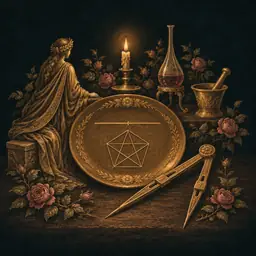
In a regular pentagon each diagonal is phi times the side, and where two diagonals cross, each cuts the other in the golden ratio. Draw all five diagonals and the pentagram appears, every line of it divided in extreme and mean ratio, with a smaller pentagon at its heart. This is why Euclid needs the cut before he can draw the pentagon at all.
Two triangles carry the ratio. The golden triangle, with a point of 36 degrees and two base angles of 72, has its long sides phi times its base; Euclid builds it in his fourth book as a triangle whose base angles are each double the angle at the top, and from it he sets the pentagon in a circle. Its companion, with angles of 108, 36 and 36, is the triangle cut from a pentagon by one diagonal.
To draw the pentagon in a circle, draw two diameters at right angles and mark the top point A. Halve the right-hand radius at M. With centre M and opening MA, swing an arc to cut the left-hand radius at N. The distance AN is the side of the pentagon: step it five times round the circle from A and join the points. The short length from the centre to N is the side of the ten-sided figure, and the radius is phi times it.
The golden rectangle and its spiral
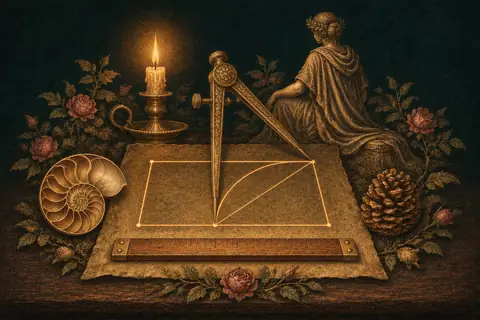
A rectangle whose sides are in the ratio is a golden rectangle. Cut a square from it and what remains is again a golden rectangle, turned on its side; cut a square from that, and so on without end, the squares winding inward toward one point. Join opposite corners of each square with a quarter circle and a spiral appears, close to the true golden spiral, which grows by phi with every quarter turn.
Fibonacci's rabbits
Leonardo of Pisa put it as a puzzle. A pair of rabbits is shut in a walled place; each month every pair old enough bears a new pair, which can breed from its second month. How many pairs will there be at the end of a year? Month by month the count runs 1, 2, 3, 5, 8, 13, 21, 34, 55, 89, 144, 233, 377, each number the sum of the two before it, and the answer is 377.
Divide each number by the one before it and the answers swing above and below phi and close in on it: 2, 1.5, 1.667, 1.6, 1.625, 1.615, 1.619. The square of any number in the run differs by exactly one from the product of its two neighbours: five squared is 25, and three times eight is 24.
Why it was called divine
Luca Pacioli named it the divine proportion and gave his reasons, each a likeness to God. It is one and only, as God is one. It joins three terms in one proportion, as the Trinity is three in one. It can be expressed by no ratio of whole numbers, as God cannot be defined in words. It is always the same, however small or great the line, as God is unchanging and whole in every place. And as God gave being to the heavens, the fifth essence, so the ratio gives being to the dodecahedron, which Plato gave to the heavens.
Kepler wrote that geometry has two great treasures, the theorem of Pythagoras and the division of a line in extreme and mean ratio; the first he likened to a measure of gold, the second to a precious jewel.
Where it truly grows
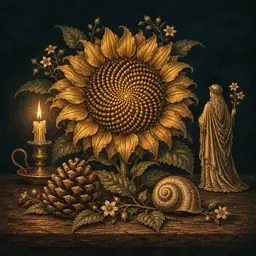
One true home of the number is in the turning of leaves and seeds. Divide a full turn in the golden ratio and the smaller part is about 137.5 degrees, the golden angle. Many plants set each new leaf or seed about this far round from the last, so that they pack evenly and no two line up, and the seeds then fall into crossing spirals whose counts are neighbouring numbers of Fibonacci, such as 34 and 55 in the head of a sunflower.
How it is practised
Draw it. With compasses and a straight edge, make a square, find the middle of its base, and swing an arc from that point through an upper corner down to the base line: the lengthened base and the side of the square are in the golden ratio. Then test a claim instead of taking it on trust. Measure a shell, a leaf or a picture frame, divide the longer length by the shorter, and write down what the ruler gives. The exercise trains the eye and the habit of checking, and it promises nothing more.
Where it comes from
Euclid defined the cut about 300 BCE as division in extreme and mean ratio, and used it to build the pentagon. Leonardo of Pisa set out his sequence in 1202 as a puzzle about breeding rabbits. Luca Pacioli called the ratio the divine proportion in 1509, in a book Leonardo da Vinci illustrated. The name golden section is first found in a German textbook by Martin Ohm in 1835, and the letter phi was chosen about 1909 by the American mathematician Mark Barr. The belief that artists and builders had always worked by it was spread by Adolf Zeising in the 1850s.
What is known, and what is not
The mathematics is proved and exact. Much of the lore is not. Measurements of the Parthenon give the ratio only when the points to measure from are chosen to give it. The slope of the Great Pyramid does fit it, but a plain builders’ rule, fourteen up for eleven along, fits as well, and no Egyptian text knows the ratio. The nautilus shell is a logarithmic spiral, but not a golden one. People asked to pick the most pleasing rectangle show no steady liking for the golden one. Sunflower heads and pine cones do show Fibonacci numbers in their spirals, which botanists explain by the way new seeds pack.
Its words
 Golden Ratio
- The number about 1.618 that cuts a line so that the whole is to the longer part as the longer is to the shorter. Real mathematics, wrapped in much legend.
 Fibonacci Sequence
- The run of numbers 1, 1, 2, 3, 5, 8, 13, each the sum of the two before it, set out by Leonardo of Pisa in 1202. Its neighbouring ratios approach the golden ratio.
- Logarithmic Spiral
- The curve that widens by the same ratio at every equal turn, as shells and horns grow. The golden spiral is one case of it; the nautilus is another.
Ask the Oracle further
Is the golden ratio really in the Parthenon and the pyramids?Why do Fibonacci numbers turn up in sunflowers and pine cones?
Before you practise
The mathematics of these figures is true and can be checked. What they are held to mean is a tradition, and many popular claims of the golden ratio in buildings, bodies and paintings do not survive measurement. A figure heals, protects and attracts nothing by itself.
Its other branches
The Platonic solidsThe flower of lifeThe vesica piscisPythagoras and numberMandala and yantraMagic squaresThe whole artSearch the tree

