
The vesica piscis
Two circles through each other’s centres: the almond the cathedral masons drew from.
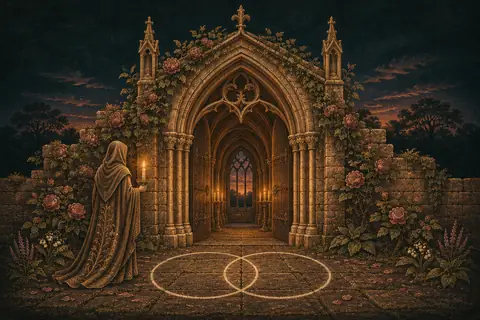
What is the vesica piscis, and what did the cathedral masons draw with it?
What it is
The vesica piscis is the almond shape made where two equal circles overlap so that each passes through the other's centre. The Latin name means the bladder of a fish. The figure is the first step of the first proposition in Euclid, since joining the two centres to a crossing point gives a triangle with three equal sides. Its height is to its width as the square root of three is to one, about 1.732. From it, with compasses and a straight edge, a builder can raise a right angle, a triangle, a hexagon and a pointed arch.
The teaching
As the lore of the almond from Euclid to the cathedral masons teaches it.
The first proposition
The Elements begin with it. The first proposition is: on a given finite straight line to construct an equilateral triangle. Let the line be AB. With centre A and distance AB draw a circle; with centre B and distance BA draw another. From a point C where the circles cross, join C to A and to B. CA equals AB, being radii of the first circle, and CB equals BA, being radii of the second; so all three sides are equal.
The almond between the two circles, the vesica piscis, is therefore the first figure of geometry, and two equilateral triangles lie within it back to back, on the line joining the centres.
Its measures
If the circles have a radius of one, the centres are one apart, the vesica is one wide from centre to centre, and from tip to tip it is the square root of three long, about 1.732. The four points, the two centres and the two tips, make a rhombus of two equilateral triangles. The ratio of length to width, root three to one, is the vesica's own number.
What can be raised from it
The vesica gives the builder his first tools. The line through its two tips cuts the line between the centres in half and at right angles, so it gives the middle of a line and the right angle, and from the right angle the square. The radius, stepped six times round either circle, gives the hexagon, and every other point of the hexagon gives the triangle.
Above all it gives the pointed arch. The two arcs of the vesica above the line of centres, each struck from the far springing point, meet at the top in the equilateral arch, whose span equals the radius of its arcs. Struck with a radius longer than the span, the arch is a lancet, tall and narrow; struck with a shorter one, it is a drop arch, low and broad.
The masons' measure
The Gothic masons set out their work at full size with cord, square and compasses, and they worked by figures more than by numbers. Two methods ruled. Ad quadratum, by the square, steps down by squares turned within squares, each smaller by the square root of two, as masons did to shape a pinnacle from its base. Ad triangulum, by the triangle, sets heights by equilateral triangles drawn on the width: the figure the vesica gives.
The mandorla
Stood upright, the almond is the mandorla, the frame of light round Christ in majesty carved over the great doors of churches, and round the Virgin taken up into heaven. The usual reading is that the two circles are heaven and earth, or God and man, and the almond where they overlap is the place where they meet, as they meet in Christ, both God and man; it is also a door, through which the one comes to the other. Bishops, abbeys and chapters cut their seals in the same pointed oval.
The fish and its number
The Latin name means the bladder of a fish, and the fish is an old sign of Christ: the Greek word for fish, ichthys, spells the first letters of Jesus Christ, Son of God, Saviour. Drawn with two arcs that cross at one end to make a tail, the fish is the almond of the vesica.
John's gospel tells that after the resurrection Simon Peter drew the net to land full of great fishes, an hundred and fifty and three. Augustine read the number as the sum of all the numbers from one to seventeen, and seventeen as ten, the law, joined to seven, the gifts of the Spirit.
Squaring the circle
The old sister problem asks for a square equal in area to a given circle, with compasses and a straight edge alone. With these tools a geometer can make only lengths reached by adding, subtracting, multiplying, dividing and taking square roots of lengths already drawn. A circle of radius one has an area of pi, so the square needs a side of the square root of pi, and pi is transcendental, the root of no equation with whole-number coefficients, so that side can never be reached. Good approximations are easy: the Rhind papyrus of Egypt takes a square on eight ninths of the diameter.
The figure has its meaning too. The circle has long stood for heaven and the square for earth: Chinese teaching speaks of a round heaven and a square earth, and Vitruvius set the human body in both, the navel at the circle's centre and the outstretched arms as wide as the body is tall. The alchemist Michael Maier made it a rule of the Work: make of the man and the woman a circle, then a square, then a triangle, then a circle, and the stone of the philosophers is made.
How it is practised
Set compasses to any opening, draw a circle, put the point on its rim and draw another. Join the two centres, then join each centre to the upper crossing point: the triangle has three equal sides. Draw a line through the two crossing points, and it cuts the first line in half at a right angle. A reader near a Gothic church can then look for the figure in its stone. The equilateral pointed arch of a doorway is two arcs of a vesica piscis, and the almond round a carved Christ over the west door is the same shape stood upright.
Where it comes from
Greek geometers knew the figure as a working step and gave it no sacred meaning. In medieval Christian art the upright almond became the mandorla, the frame of light drawn round Christ in majesty and round the Virgin, and church seals were cut in the same shape. Gothic masons used arcs struck from two centres to set out pointed arches and window tracery, as the thirteenth-century portfolio of Villard de Honnecourt shows. An old sister problem, squaring the circle, which asks for a square equal in area to a given circle by compasses and straight edge alone, was proved impossible in 1882 by Ferdinand von Lindemann.
What is known, and what is not
The constructions are proved in Euclid's first book. That medieval masons laid out arches and tracery with arcs from two centres is documented in surviving drawings. The claims that whole cathedrals were planned from one hidden vesica, or that the figure holds a secret doctrine, rest on lines drawn over plans by modern authors and are not borne out by building records. The ratio of 265 to 153 often quoted for the figure is a real ancient approximation to the square root of three, given by Archimedes; the meanings hung on the number 153 are later.
Its words
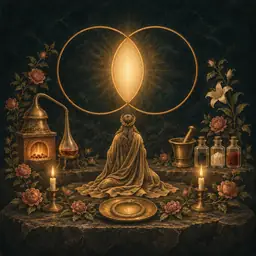 Vesica Piscis
- The almond made where two equal circles pass through each other's centres. A working step in Euclid, and the frame of light round Christ in medieval art.
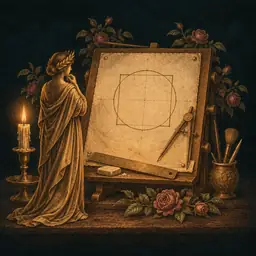 Squaring the Circle
- The ancient problem of drawing, with compasses and straight edge alone, a square equal in area to a given circle. It was proved impossible in 1882.
Ask the Oracle further
Why is the vesica piscis drawn around Christ in medieval art?Can squaring the circle be done with compasses and a straight edge?
Before you practise
The mathematics of these figures is true and can be checked. What they are held to mean is a tradition, and many popular claims of the golden ratio in buildings, bodies and paintings do not survive measurement. A figure heals, protects and attracts nothing by itself.
Its other branches
The golden ratioThe Platonic solidsThe flower of lifePythagoras and numberMandala and yantraMagic squaresThe whole artSearch the tree

