
Pythagoras and number
The tetractys, the ratios of music, and the teaching that all things are number.
What did the Pythagoreans teach about sacred number and the tetractys?
What it is
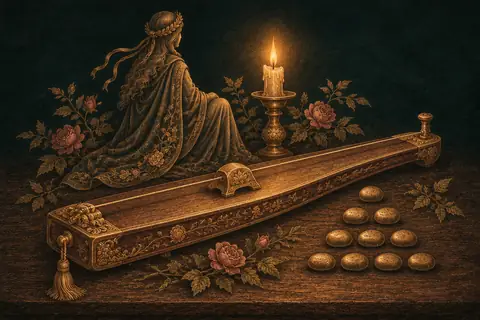
For the followers of Pythagoras number was the stuff of the world and not only a way of counting it. Their emblem was the tetractys, ten dots set in four rows of one, two, three and four, making a triangle. The rows gave them the ratios of musical harmony. On a monochord, an instrument of one string with a movable bridge, stopping the string at half its length sounds the octave, at two thirds the fifth and at three quarters the fourth. That the ear's sweetest intervals answer to the simplest whole numbers was their chief evidence that number orders things.
The teaching
As the Pythagorean school that Aristotle, Nicomachus and Plato record teaches it.
All things are number
The Pythagoreans taught that number is the principle of all things: that things are made of number, or are like numbers, and that to know the numbers of a thing is to know the thing. The elements of number are the odd and the even. The odd is limited and the even unlimited, and the one, which is both odd and even, comes from both and is the source of all the rest.
The ten pairs of opposites
Some of them set out the principles as ten pairs of opposites, in two columns: limit and the unlimited, odd and even, one and many, right and left, male and female, at rest and moving, straight and bent, light and darkness, good and bad, square and oblong. The first of each pair belongs to limit, order and the good; the second to the unlimited.
The tetractys
Their emblem is the tetractys, ten points in four rows of one, two, three and four, making a triangle. The rows climb through the kinds of magnitude: one point; two points, which make a line; three, which make a surface; four, which make a solid. The rows add to ten, the perfect number that holds all the others, and the same four numbers hold the ratios of harmony, two to one, three to two and four to three.
They swore by it: by him who gave to our soul the tetractys, the fount and root of ever-flowing nature.
Figured numbers
The Pythagoreans laid out numbers as pebbles and read their shapes. The triangular numbers, 1, 3, 6, 10, grow by rows, and the tetractys is the fourth of them. The square numbers, 1, 4, 9, 16, grow by adding the odd numbers in turn as an L-shaped border, the gnomon: one and three make four, five more make nine, seven more sixteen, and the shape stays a square.
Adding the even numbers to two instead makes the oblong numbers, 2, 6, 12, 20, whose sides always differ by one and whose shape changes as it grows. That is why square stands with limit, and oblong with the unlimited, in their table of opposites.
The numbers from one to ten
Each number of the decad has its nature. One, the monad, is unity and the source, and is not itself counted as a number. Two, the dyad, is otherness and division, the first even, female. Three, the triad, is the first true number, with a beginning, a middle and an end, the first odd, male. Four, the tetrad, is the first square, equal times equal, and so it is justice. Five, the pentad, joins the first female and the first male, two and three, and is called marriage.
Six is the first perfect number, the sum of its own parts, one, two and three. Seven is the virgin, since within the ten it neither divides any number nor is made from any by multiplying, and it is given to Athena, born of no mother. Eight is the first cube, two times two times two. Nine, three times three, is the last before ten, the boundary. Ten, the decad, holds them all and returns to one.
The ratios of the string
On the monochord the ear hears what the numbers say. Stop the string at half its length and it sounds the octave, the ratio of two to one; at two thirds, the fifth, three to two; at three quarters, the fourth, four to three. A fifth and a fourth together make the octave, since three halves times four thirds is two. The difference between them, three halves divided by four thirds, is nine to eight, the whole tone. The octave and a fifth is three to one, the double octave four to one, and all of these come from one, two, three and four.
The soul of the world in the Timaeus
Plato's Timaeus builds the soul of the cosmos from these ratios. The maker takes portions in the numbers 1, 2, 3, 4, 9, 8 and 27: the doubles 1, 2, 4 and 8, and the triples 1, 3, 9 and 27. Into each gap he sets two means, one exceeding the smaller term and falling short of the larger by the same fraction of each, the other by the same amount, and these give the ratios three to two, four to three and nine to eight. Then he fills every four to three with tones of nine to eight, and a small remainder is left over, 256 to 243.
The four arts of number
From this school the later teachers drew the four arts of number, which Boethius called the quadrivium, the fourfold way. Arithmetic is number in itself; music is number in relation to number; geometry is magnitude at rest; astronomy is magnitude in motion. Together they were the road a student walked from the things that are seen toward the order behind them.
How it is practised
Hear it. Stretch a string over a box, or take one string of a guitar. Pluck it open, then stop it at exactly half its length and pluck again: the note is an octave higher. Stop it at two thirds and at three quarters for the fifth and the fourth. Then lay out ten coins as a tetractys and find the same numbers, one to two, two to three, three to four, in its rows. Reading a number for what it has been held to mean, as four was read as justice, belongs to the history of ideas. It tells nothing about a day or a person.
Where it comes from
Pythagoras taught at Croton in southern Italy from about 530 BCE and wrote nothing. What is told of him was written down generations later, and the story that he found the ratios by hearing hammers in a smithy cannot be true as told, since hammers do not behave so. Plato took the teaching into the Timaeus. Boethius, about 500 CE, handed it to the Latin schools, where arithmetic, geometry, music and astronomy made up the quadrivium, the four number arts of the medieval curriculum. Kepler was still searching the motions of the planets for a harmony of the heavens in 1619.
What is known, and what is not
The string ratios are physics and can be repeated by anyone. A scale built from pure fifths does not close: twelve fifths overshoot seven octaves by a small interval, the comma named after Pythagoras, which is why modern instruments are tuned by a compromise. The belief that all things are number was a philosophy, fruitful for science and unprovable as stated. Number symbolism has no power to foretell, and the house does not put it to that work.
Its words
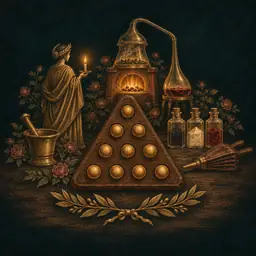 Tetractys
- The Pythagorean figure of ten dots in four rows of one, two, three and four, whose rows hold the ratios of the musical intervals.
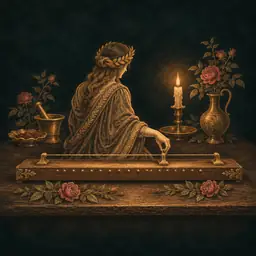 Monochord
- An instrument of one string with a movable bridge, used since antiquity to show that the musical intervals answer to simple ratios of length.
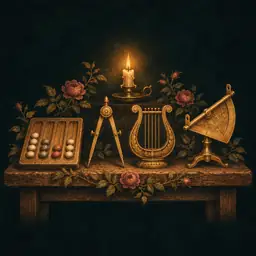 Quadrivium
- The four number arts of the medieval schools: arithmetic, geometry, music and astronomy, named by Boethius about 500 CE.
- Pythagoras
- The teacher from Samos who founded a community at Croton about 530 BCE. He wrote nothing, and most of what is credited to him belongs to his followers or to legend.
- Music of the Spheres
- The ancient idea that the heavenly bodies move in the ratios of musical harmony and so make a music that is never heard.
Ask the Oracle further
What is the tetractys, and why did the Pythagoreans swear by it?How does the tuning of a string come from the tetractys and its ratios?
Before you practise
The mathematics of these figures is true and can be checked. What they are held to mean is a tradition, and many popular claims of the golden ratio in buildings, bodies and paintings do not survive measurement. A figure heals, protects and attracts nothing by itself.
Its other branches
The golden ratioThe Platonic solidsThe flower of lifeThe vesica piscisMandala and yantraMagic squaresThe whole artSearch the tree

