
The Platonic solids
The five regular solids, proved to be the only ones, and what Plato made of them.
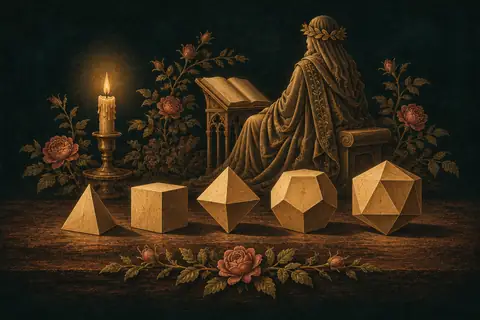
What are the five Platonic solids, and why can there be only five?
What it is
The Platonic solids are the five solids whose faces are all one regular polygon, with the same number of faces meeting at every corner. They are the tetrahedron with four triangular faces, the cube with six squares, the octahedron with eight triangles, the dodecahedron with twelve pentagons and the icosahedron with twenty triangles. That there can be no sixth is proved and not merely observed: the angles meeting at a corner must add to less than a full turn, and only five arrangements of regular faces allow it.
The teaching
As the Greek geometry of the solids from Plato's Timaeus to Euclid teaches it.
The five and their counts
A regular solid has faces that are all one regular figure, with the same number meeting at every corner. There are five. The tetrahedron has 4 triangles, 6 edges and 4 corners, three faces meeting at each. The cube has 6 squares, 12 edges and 8 corners, three at each. The octahedron has 8 triangles, 12 edges and 6 corners, four at each. The dodecahedron has 12 pentagons, 30 edges and 20 corners, three at each. The icosahedron has 20 triangles, 30 edges and 12 corners, five at each.
Why there are only five
Euclid closes the Elements with the proof. At any corner of a solid at least three faces must meet, and their angles there must add to less than a full turn of 360 degrees, or the corner would lie flat. The angle of a triangle is 60 degrees, so three, four or five triangles can meet, making 180, 240 or 300; six make 360 and lie flat. The angle of a square is 90, so three can meet, making 270; four lie flat.
The angle of a pentagon is 108, so three can meet, making 324; four would make 432. The angle of a hexagon is 120, and three already make 360. Every figure with more sides has larger angles still. So there are five ways for regular faces to meet at a corner, and five solids.
Pairs and a rule of two
Join the centres of the faces of a cube and an octahedron appears inside it; join the centres of the octahedron's faces and a cube appears. The dodecahedron and the icosahedron are paired in the same way, and the tetrahedron is paired with itself. Each pair swaps its numbers: the cube's six faces and eight corners are the octahedron's six corners and eight faces, and both have twelve edges. For every one of the five, corners less edges plus faces makes two: for the cube, 8 less 12 plus 6. Euler found the rule, and it holds for any solid without holes.
Beyond the five
Loosen the rule and more solids appear. Allow two or more kinds of regular face, with the same arrangement at every corner, and there are thirteen more, the Archimedean solids, such as the cuboctahedron of squares and triangles. Let the faces pass through one another as stars, and four more stand up, found by Kepler and by Poinsot. The five alone keep the strict rule: one face, one corner, everywhere the same.
Plato's elements
In the Timaeus the maker of the cosmos builds the four elements from two kinds of right-angled triangle: the half square, with two equal sides, and the half of an equilateral triangle, which Plato calls the most beautiful of triangles. From the half-equilateral triangles come the faces of the tetrahedron, the octahedron and the icosahedron; from the half squares come the square faces of the cube.
Each element takes the solid that fits its nature. Fire is the tetrahedron, with the fewest faces and the sharpest points, the lightest and quickest, which cuts and burns. Earth is the cube, the most stable, set firm on its broad faces. Air is the octahedron, and water the icosahedron, with the most faces, the roundest, which rolls and flows.
How the elements change into one another
Because fire, air and water share one triangle, they can break apart and join again as each other. A particle of water, twenty faces, cut up by fire, may become one particle of fire, four faces, and two of air, eight faces each; a particle of air may become two of fire. Earth is made of the other triangle and never becomes any of the three: broken up, its pieces drift until they meet and join again as earth.
The fifth figure
One solid is left over. Plato says the maker used the fifth for the whole, to decorate it with figures, and later readers took its twelve faces for the twelve signs of the zodiac. When Aristotle added a fifth element, the aether of the heavens, the dodecahedron was given to it as the quintessence.
Kepler's nest of solids
Kepler set the five one inside another between the paths of the six planets then known: the cube between Saturn and Jupiter, the tetrahedron between Jupiter and Mars, the dodecahedron between Mars and the Earth, the icosahedron between the Earth and Venus, and the octahedron between Venus and Mercury. In his Harmony of the World he kept Plato's matching of solids to elements and gave reasons for each, the sharp tetrahedron to fire and the steady cube to earth.
How it is practised
Make them. Each solid unfolds into a flat net that can be drawn on card with compasses and a straight edge, then cut, scored and glued: four triangles for the tetrahedron, six squares for the cube, and so on to the twenty triangles of the icosahedron. Handling the five shows what a picture hides, such as the pairing of cube with octahedron and of dodecahedron with icosahedron, where the corners of one sit at the centres of the other's faces. Counting on each gives the same result every time: faces plus corners come to two more than edges.
Where it comes from
Plato described them about 360 BCE in the Timaeus, where fire is made of tetrahedra, air of octahedra, water of icosahedra and earth of cubes, and the dodecahedron is given to the heavens as a whole. Ancient writers credit the mathematician Theaetetus with the first full account of all five. Euclid closed his Elements about 300 BCE by building each one and proving the list complete. In 1596 Johannes Kepler tried to fit the five between the courses of the six planets then known; the fit was rough, and his later laws of planetary motion did not need it.
What is known, and what is not
The geometry is proved in Euclid and has not changed since. Plato's matching of solids to elements is a philosophical picture, and chemistry does not use it: the elements of the modern table are not fire, air, water and earth. Kepler's scheme of nested solids failed against better measurements. Crystals and some viruses do take these shapes, for reasons of packing and symmetry that science explains. Nothing shows that a model of a solid, held in the hand or set in a room, changes mood, health or events.
Its words
 Platonic Solids
- The five regular solids, with 4, 6, 8, 12 and 20 faces. Euclid proved there can be no others; Plato matched four of them to the elements.
 Timaeus
- Plato's dialogue of about 360 BCE, in which a craftsman god builds the cosmos by number and gives the elements the shapes of regular solids.
- Euclid
- The mathematician of Alexandria who, about 300 BCE, wrote the Elements: thirteen books that prove geometry from a few assumptions and end with the five regular solids.
- Tetrahedron
- The simplest Platonic solid: four equilateral triangles, four corners and six edges. Plato gave it to fire.
- Octahedron
- The Platonic solid of eight equilateral triangles, six corners and twelve edges, the partner of the cube. Plato gave it to air.
- Dodecahedron
- The Platonic solid of twelve regular pentagons, twenty corners and thirty edges, which Plato gave to the heavens as a whole.
- Icosahedron
- The Platonic solid of twenty equilateral triangles, twelve corners and thirty edges, the partner of the dodecahedron. Plato gave it to water.
Ask the Oracle further
Why were the Platonic solids matched to fire, air, water and earth?How can I build the five Platonic solids from paper?
Before you practise
The mathematics of these figures is true and can be checked. What they are held to mean is a tradition, and many popular claims of the golden ratio in buildings, bodies and paintings do not survive measurement. A figure heals, protects and attracts nothing by itself.
Its other branches
The golden ratioThe flower of lifeThe vesica piscisPythagoras and numberMandala and yantraMagic squaresThe whole artSearch the tree

