
The flower of life
An ancient rosette of overlapping circles, and the modern name and claims it carries.
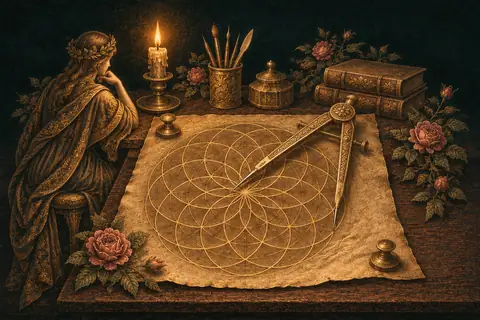
What is the flower of life, and how old is the figure really?
What it is
The flower of life is a pattern of evenly spaced, overlapping circles in which each circle's centre lies on the rim of six others, so that six-petalled rosettes fill the surface. Its smallest part, seven circles making a single rosette, is now called the seed of life. Join the centres of thirteen circles chosen from the pattern with straight lines, and the web that results is called Metatron's cube, in which outlines of the regular solids can be picked out. All three can be drawn with nothing but compasses kept at one opening.
The teaching
As the compass geometry that Drunvalo Melchizedek's books named teaches it.
Six round one
Everything in the flower of life follows from one fact: six circles fit exactly round a seventh of the same size, each passing through the centre of the middle one and through the centres of its two neighbours. The reason is the equilateral triangle. The centre of the middle circle and the centres of two neighbours make a triangle with three equal sides and three angles of sixty degrees, and six such triangles fill the full turn of 360 degrees, so the ring closes with no gap.
Coins show the same fact another way: on a table six equal coins fit round one, each touching the middle coin and both its neighbours, the closest that equal circles can be packed on a flat surface.
The seed of life
The first seven circles make the seed of life. Each pair of neighbouring circles overlaps in the almond called the vesica piscis, and inside the middle circle a rosette of six slender petals appears, their tips on its rim. Join the six tips and a regular hexagon appears; join every other tip and two triangles cross to make the six-pointed star. Every petal is bounded by arcs of circles whose centres lie on the rim, so the whole rosette comes from a single opening of the compass.
The flower and its grid
Carry on outward, setting the compass point on each new crossing, and the circles never need stop. In the full pattern every crossing is the centre of another circle, and through every centre pass six circles; the centres fall on a grid of equilateral triangles that could cover a floor without end. The flower as it is drawn today stops at nineteen whole circles, the middle one, a ring of six and a ring of twelve, inside a larger circle that cuts off the arcs beyond.
The grid shows why the pattern holds together. Equilateral triangles, squares and hexagons are the only regular figures that cover a flat surface with no gaps, and the flower carries two of them: its centres make the triangles, and the six triangles round any centre make a hexagon.
The fruit of life and Metatron's cube
From the larger pattern thirteen circles are chosen: the middle one, the six whose centres lie two steps out along the six lines through the middle, and the six that lie four steps out on the same lines. These thirteen touch without overlapping, their centres running out from the middle in six arms of two, and the set is now called the fruit of life.
Join the centre of every one of the thirteen to every other with a straight line, seventy-eight lines in all, and the web that results is Metatron's cube. In its lines one can pick out flat drawings of a cube, an octahedron and two tetrahedra crossed into a star. The figure is named for Metatron, the great angel of Jewish lore whom the tradition of the Book of Enoch makes the heavenly scribe, the patriarch Enoch transformed.
What Melchizedek teaches
Drunvalo Melchizedek, whose books and workshops gave the pattern its name, teaches that it holds the plan of creation. He calls the seed of life the Genesis pattern and reads its circles, drawn one after another, as the days of creation in the first chapter of Genesis, ending in the rest of the seventh day. He teaches that the five regular solids can be drawn from the flower through Metatron's cube, and so that one figure lies under all that is made. Readers of his school also lay the Tree of Life of the Kabbalah over the pattern, its ten centres on the centres of circles.
The figure in space
In space the rule of six becomes a rule of twelve. Equal balls pack twelve round one: six round it in a layer, three above and three below, the closest packing of all, the way a greengrocer stacks oranges. Seen from above, one layer of such balls is the seed of life again, and the flower is the plan of a whole stack.
Drawing it true
The compass is opened once and never changed, and the pencil kept hard and sharp. The drawing checks itself: every crossing inside the pattern is a point where six circles meet, and if they miss one another by a hair, the opening has slipped or a point was set off its crossing. A true flower is the proof of a steady hand.
How it is practised
Draw it with compasses kept at one opening. Make a circle; set the point anywhere on its rim and make a second; set the point where the two cross and make a third; go on round until six circles ring the first. That is the seed of life, and the petals appear by themselves. Carry on outward for the flower of life. The work is slow and unforgiving of a slipped point, which is its use: twenty minutes of steady attention with a plain result. The drawing is a drawing. It brings nothing and keeps nothing away.
Where it comes from
The rosette is old and widespread. It is carved on a stone threshold from the Assyrian palace of Ashurbanipal, of the seventh century BCE, it appears in Roman mosaics and medieval church ornament, and Leonardo da Vinci drew it in his notebooks. The examples on the Osireion at Abydos in Egypt, often called the oldest, are drawn in red ochre and not carved; Greek writing stands near them, and their date is not settled. The names are recent. Flower of life and seed of life were made current in the 1990s by the American writer Drunvalo Melchizedek, and Metatron's cube, named for an angel of Jewish lore, is a modern figure that no old Jewish source describes.
What is known, and what is not
The geometry is simple and true: six equal circles fit exactly round a seventh, which is why the pattern closes. Its age as ornament is documented from the seventh century BCE. The claims attached to it since the 1990s are another matter. Nothing supports the statements that it is a blueprint of creation, that it was a secret teaching of Egyptian priests, or that the figure has any effect on water, health or thought. The names themselves are modern, and no ancient text uses them.
Its words
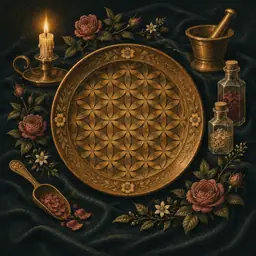 Flower of Life
- A pattern of evenly overlapping circles that makes six-petalled rosettes. The ornament is ancient; the name and the claims date from the 1980s and 1990s.
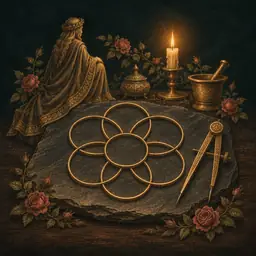 Seed of Life
- Seven equal circles, six set round one, making a single rosette: the first step in drawing the flower of life, and a modern name.
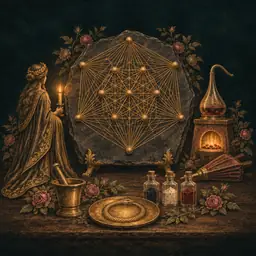 Metatron's Cube
- A modern figure made by joining the centres of thirteen circles with straight lines. It is named for an angel of Jewish lore, though no old Jewish source describes it.
Ask the Oracle further
How do I draw the seed of life with compasses?What is Metatron’s cube, and is it truly ancient?
Before you practise
The mathematics of these figures is true and can be checked. What they are held to mean is a tradition, and many popular claims of the golden ratio in buildings, bodies and paintings do not survive measurement. A figure heals, protects and attracts nothing by itself.
Its other branches
The golden ratioThe Platonic solidsThe vesica piscisPythagoras and numberMandala and yantraMagic squaresThe whole artSearch the tree

