

Mystical systems
Metatron's Cube
Direct answer
Metatron's Cube: Metatron's cube is a figure made by joining the centres of thirteen equal circles with straight lines, in which outlines of the regular solids can be traced.
$0 today, then $19/month after 7 days. Cancel anytime.
At a glance
- Also called
- metatron cube, fruit of life, metatron cube sacred geometry
- Found in
- Mystical Systems
- Related
- Flower of Life, Seed of Life, Platonic Solids, Sacred Geometry
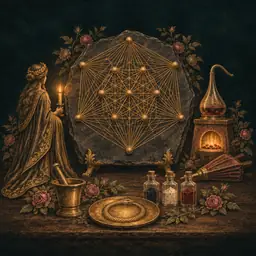

Metatron's cube is a figure made by joining the centres of thirteen equal circles with straight lines, in which outlines of the regular solids can be traced.
A lineage map for books and systems; it avoids presenting symbolic traditions as literal fact.
Understand the chapter you are in.
Your life’s turning points, measured from your birth.
Walk through Alex’s whole example first


Prefer to explore first?
 The Road of AgesThe turning points of your whole life, from your own chart
Walk my road
Is Metatron's cube ancient?
Metatron's cube starts from thirteen equal circles: one in the middle, six round it and six more beyond, a set sometimes called the fruit of life. A straight line is then drawn from the centre of every circle to the centre of every other, seventy-eight joins in all. The web holds a hexagram and the outline of a cube seen corner on, and flat views of other regular solids can be picked out of it.
The figure is named for Metatron, the great angel of some Jewish mystical texts. No Jewish source draws or describes it, and it appears to belong to the late twentieth century, when it spread with the name flower of life. It is said to hold the building blocks of creation. As geometry it is a pleasing exercise; the larger claims have nothing behind them.
On the tree of the hidden arts: Sacred geometry.
What sets Metatron's Cube apart
Unlike the rosettes it is drawn from, this figure is made of straight lines only. The circles serve as thirteen fixed points, and the figure is every line that can be ruled between two of them. In the language of mathematics that makes it a complete graph, and a crowded one, since many of its lines run on top of one another. Its fame rests on the claim that all five regular solids lie hidden in it. Three can be traced from its points; the other two are usually completed with points it does not have.
- Points: the centres of thirteen equal circles
- Lines: one between every pair of points, seventy-eight pairs in all
- Outline: a hexagram inside a hexagon, read as a cube seen corner on
- Name: after Metatron, an angel of the Talmud and the Hebrew Book of Enoch
- First known: late twentieth century writings on sacred geometry
- In Jewish sources: not drawn and not described
Often mistaken for something else: The flower of life is made of circles and is ancient as ornament; Metatron's cube is made of straight lines ruled between circle centres and is modern.
The story behind Metatron's Cube
The rosette of circles it grows from is ancient, but the cube itself has no known history before the modern literature on sacred geometry. It was made widely known in the 1990s by Drunvalo Melchizedek's books on the flower of life. The angel Metatron appears in the Babylonian Talmud and in the Hebrew Book of Enoch, a work of perhaps the fifth or sixth century CE, with no figure attached.
Why Metatron's Cube matters
Metatron's Cube shows how quickly a modern drawing can be given an ancient pedigree, and why a figure's first known date is worth asking for.
How to read Metatron's Cube
Draughtsmen construct it as an exercise with compasses and rule; sellers of jewellery and crystals attach meanings to it.
Metatron's Cube in practice: an example
A jeweller might cut it on a pendant; the buyer is often told it is an ancient angelic seal, which it is not.
Where readings of Metatron's Cube go wrong
No old Jewish text holds this figure, and wearing or displaying it protects nothing.
Sources and editorial method
This entry summarizes the tradition in the Almanac's own words; where no source is listed, it is an editorial summary rather than a primary text, and symbolic readings are named as the tradition's, not as fact.
- Source
- The Great Almanac Dictionary
- Category
- Mystical Systems
- Aliases
- metatron cube, metatrons cube meaning, fruit of life, metatron cube sacred geometry
- Last updated
- 2026-09-26
See Metatron's Cube in your personal almanac
A definition tells you what it is; your own birth chart tells you what it means for you. The Oracle casts your real chart and answers for your love, your work, and your year ahead, in conversation. It opens with the 7-day Oracle trial.
Speak with the OracleRelated terms
More in Mystical Systems
- Sedona Vortex
- Teresa of Avila
- Wheel of the Year
- Astrolatry
- Citrinitas
- Fleur-de-lis
- Index Librorum Prohibitorum
From the reference page to your own chart
Every word here
is in your own chart.
- Your life’s turning points, measured from your birth
- A practical next step to consider
- It opens with 7 days free: the AI Oracle on thirty hidden arts, and your daily horoscope
$0 today, then $19/month after 7 days. Cancel anytime.
Common questions
Is Metatron's cube ancient?
No evidence shows that it is. The pattern of circles it is drawn from is ancient, but the cube and its name are first found in writings on sacred geometry from the late twentieth century.
How many circles are in Metatron's cube?
Thirteen: one at the centre, six touching it, and six more set outward in line with the first six. The lines join the centres of all thirteen to one another.
Does Metatron's cube contain the Platonic solids?
It holds flat outlines that can be read as views of some of them. The dodecahedron and the icosahedron are usually drawn in only by adding points the figure does not have.


