

Mystical systems
Platonic Solids
Direct answer
Platonic Solids: The Platonic solids are the five solids whose faces are all the same regular polygon: the tetrahedron, cube, octahedron, dodecahedron and icosahedron.
$0 today, then $19/month after 7 days. Cancel anytime.
At a glance
- Also called
- five regular solids, regular polyhedra, tetrahedron cube octahedron dodecahedron icosahedron
- Found in
- Mystical Systems
- Related
- Sacred Geometry, Timaeus, Golden Ratio, Metatron's Cube
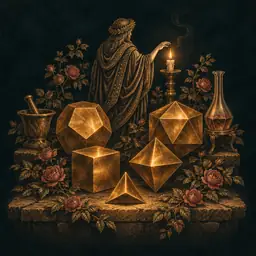

The Platonic solids are the five solids whose faces are all the same regular polygon: the tetrahedron, cube, octahedron, dodecahedron and icosahedron.
A lineage map for books and systems; it avoids presenting symbolic traditions as literal fact.
Understand the chapter you are in.
Your life’s turning points, measured from your birth.
Walk through Alex’s whole example first


Prefer to explore first?
 The Road of AgesThe turning points of your whole life, from your own chart
Walk my road
Why are there only five Platonic solids?
The Platonic solids are the tetrahedron, with four triangular faces; the cube, with six squares; the octahedron, with eight triangles; the dodecahedron, with twelve pentagons; and the icosahedron, with twenty triangles. In each, every face is the same regular polygon and the same number of faces meet at every corner.
There are five and no more, and this is proved: the angles meeting at a corner must add to less than a full turn, and only five arrangements of regular faces allow it. Plato matched four of the solids to the elements and the fifth to the heavens. Sellers of crystal sets now say that the shapes balance the energies of the body. That is a modern claim with nothing behind it.
On the tree of the hidden arts: Sacred geometry.
What sets Platonic Solids apart
Each of the five is as regular as a solid can be: one kind of face, one kind of corner, and every face, edge and corner like every other. They come in pairs. Join the centres of the faces of a cube and an octahedron appears, and the same holds between the dodecahedron and the icosahedron, while the tetrahedron pairs with itself. For all five the number of faces plus the number of corners is two more than the number of edges, a rule Leonhard Euler published in the 1750s.
- Tetrahedron: 4 triangular faces, 4 corners, 6 edges; fire in Plato
- Cube: 6 square faces, 8 corners, 12 edges; earth in Plato
- Octahedron: 8 triangular faces, 6 corners, 12 edges; air in Plato
- Dodecahedron: 12 pentagonal faces, 20 corners, 30 edges; the heavens in Plato
- Icosahedron: 20 triangular faces, 12 corners, 30 edges; water in Plato
- Proof of five: Euclid, Elements, Book XIII, about 300 BCE
Often mistaken for something else: The thirteen Archimedean solids also have regular faces and identical corners, but each mixes two or more kinds of face; a Platonic solid has only one.
The story behind Platonic Solids
The solids are named for Plato, who described them in the Timaeus about 360 BCE. Ancient sources credit Theaetetus, a mathematician of Plato's circle, with the first full study of all five. Euclid ended his Elements about 300 BCE by constructing them and proving the list complete. Johannes Kepler built a model of the planets on them in 1596, which better measurements did not bear out.
Why Platonic Solids matters
Platonic Solids are the plainest example of a truth that is proved and not counted: nobody can ever turn up a sixth.
How to read Platonic Solids
Teachers have students build them from card; Plato used them to picture the elements, and Kepler to picture the planets.
Platonic Solids in practice: an example
A six-sided die is a cube, and gaming dice with four, eight, twelve and twenty faces are the other four solids.
Where readings of Platonic Solids go wrong
Crystal sets cut in these shapes are sold with claims about energy and health. The shapes are geometry and do nothing by themselves.
Sources and editorial method
This entry summarizes the tradition in the Almanac's own words; where no source is listed, it is an editorial summary rather than a primary text, and symbolic readings are named as the tradition's, not as fact.
- Source
- The Great Almanac Dictionary
- Category
- Mystical Systems
- Aliases
- platonic solid, five regular solids, regular polyhedra, tetrahedron cube octahedron dodecahedron icosahedron
- Last updated
- 2026-09-26
See Platonic Solids in your personal almanac
A definition tells you what it is; your own birth chart tells you what it means for you. The Oracle casts your real chart and answers for your love, your work, and your year ahead, in conversation. It opens with the 7-day Oracle trial.
Speak with the OracleRelated terms
More in Mystical Systems
- Sedona Vortex
- Teresa of Avila
- Wheel of the Year
- Athanor
- Citrinitas
- Fleur-de-lis
- Index Librorum Prohibitorum
From the reference page to your own chart
Every word here
is in your own chart.
- Your life’s turning points, measured from your birth
- A practical next step to consider
- It opens with 7 days free: the AI Oracle on thirty hidden arts, and your daily horoscope
$0 today, then $19/month after 7 days. Cancel anytime.
Common questions
Why are there only five Platonic solids?
At least three faces must meet at each corner, and their angles must total less than a full turn. Only triangles, squares and pentagons can manage that, in five ways altogether.
Which element goes with which Platonic solid?
In Plato the tetrahedron is fire, the octahedron air, the icosahedron water and the cube earth. The dodecahedron he gave to the heavens as a whole.
Are the Platonic solids found in nature?
Yes, in places. Salt and pyrite form cubes, some crystals form octahedra, and many viruses have the symmetry of an icosahedron. Science explains each by how the parts pack.


