

Mystical systems
Fibonacci Sequence
Direct answer
Fibonacci Sequence: The Fibonacci sequence is the run of numbers 1, 1, 2, 3, 5, 8, 13, 21 and so on, in which each number is the sum of the two before it.
$0 today, then $19/month after 7 days. Cancel anytime.
At a glance
- Also called
- fibonacci numbers, fibonacci series, fibonacci spiral, leonardo of pisa sequence
- Found in
- Mystical Systems
- Related
- Golden Ratio, Sacred Geometry, Platonic Solids
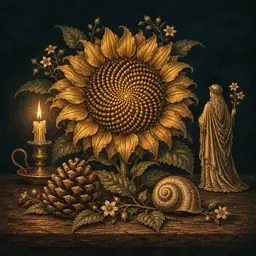

The Fibonacci sequence is the run of numbers 1, 1, 2, 3, 5, 8, 13, 21 and so on, in which each number is the sum of the two before it.
A lineage map for books and systems; it avoids presenting symbolic traditions as literal fact.
Understand the chapter you are in.
Your life’s turning points, measured from your birth.
Walk through Alex’s whole example first


Prefer to explore first?
 The Road of AgesThe turning points of your whole life, from your own chart
Walk my road
What are the first ten Fibonacci numbers?
The Fibonacci sequence begins 1, 1, 2, 3, 5, 8, 13, 21, 34, and each new number is made by adding the two before it. Divide any number in it by the one before, and the answer comes ever nearer to the golden ratio, about 1.618.
The numbers are met in living things. The spirals of seeds in a sunflower head, of scales on a pine cone and of leaves round many stems are commonly counted in neighbouring Fibonacci numbers, such as 34 one way and 55 the other. Botanists explain this by growth: each new seed forms in the largest gap left by the others, and that rule produces these counts. The pattern is common in plants and not universal, and it is absent from most of the places popular books put it.
On the tree of the hidden arts: Sacred geometry.
What sets Fibonacci Sequence apart
The rule could not be simpler, add the last two to get the next, and yet the sequence keeps surprising mathematicians: every third number is even, every fourth divides by three, and squares with these side lengths tile into a spiral. Its place in plants comes from growth and not from design. A shoot that sets each new leaf about 137.5 degrees round from the last fills space most evenly, and counting the spirals that result gives neighbouring numbers of the sequence.
- Rule: each number is the sum of the two before it
- First numbers: 1, 1, 2, 3, 5, 8, 13, 21, 34, 55, 89, 144
- In Europe: Leonardo of Pisa, Liber Abaci, 1202, the rabbit problem
- Earlier: Indian writers on verse metre, among them Virahanka and Hemachandra
- Named by: Édouard Lucas, in the 1870s
- Limit of the ratios: the golden ratio, about 1.618
Often mistaken for something else: The golden spiral grows by the golden ratio at every quarter turn; the spiral drawn through Fibonacci squares only approximates it, and a nautilus shell follows neither.
The story behind Fibonacci Sequence
Leonardo of Pisa, later called Fibonacci, set the sequence out in his Liber Abaci of 1202 as the answer to a puzzle about pairs of rabbits. The same numbers had been described earlier by Indian scholars of verse metre, from Virahanka about 700 CE to Hemachandra about 1150. The French mathematician Édouard Lucas gave the sequence its present name in the 1870s.
Why Fibonacci Sequence matters
Fibonacci Sequence is where the golden ratio is most truly seen in nature, and so the best place to learn what such a claim needs behind it.
How to read Fibonacci Sequence
Readers count the spirals on cones, sunflowers and pineapples, and compare what they find with what the books assert.
Fibonacci Sequence in practice: an example
Counting the spirals on a pine cone often gives 8 in one direction and 13 in the other, two neighbours in the sequence.
Where readings of Fibonacci Sequence go wrong
Some market traders read the numbers as forecasts. Nothing supports that, and the sequence foretells nothing.
Sources and editorial method
This entry summarizes the tradition in the Almanac's own words; where no source is listed, it is an editorial summary rather than a primary text, and symbolic readings are named as the tradition's, not as fact.
- Source
- The Great Almanac Dictionary
- Category
- Mystical Systems
- Aliases
- fibonacci numbers, fibonacci series, fibonacci spiral, leonardo of pisa sequence
- Last updated
- 2026-09-26
See Fibonacci Sequence in your personal almanac
A definition tells you what it is; your own birth chart tells you what it means for you. The Oracle casts your real chart and answers for your love, your work, and your year ahead, in conversation. It opens with the 7-day Oracle trial.
Speak with the OracleRelated terms
More in Mystical Systems
From the reference page to your own chart
Every word here
is in your own chart.
- Your life’s turning points, measured from your birth
- A practical next step to consider
- It opens with 7 days free: the AI Oracle on thirty hidden arts, and your daily horoscope
$0 today, then $19/month after 7 days. Cancel anytime.
Common questions
What are the first ten Fibonacci numbers?
Starting from one they are 1, 1, 2, 3, 5, 8, 13, 21, 34 and 55. Each is the sum of the two before it. Some lists begin with zero.
Why do sunflowers show Fibonacci numbers?
Each new seed forms in the widest gap left by the earlier ones. That simple rule of growth packs the seeds evenly and gives spiral counts that are neighbouring Fibonacci numbers.
Did Fibonacci discover the sequence?
He brought it to Europe in 1202. Indian writers on poetic metre had described the same numbers some centuries earlier, when counting the patterns of long and short syllables.


