

Mystical systems
Koan
Direct answer
Koan: A koan is a short case from the records of the Chan and Zen masters, often a brief exchange, that a teacher gives a student to work on until the student can present its point in person.
$0 today, then $19/month after 7 days. Cancel anytime.
At a glance
- Also called
- kong-an, gongan
- Found in
- Mystical Systems
- Related
- Zen, Zazen, Satori
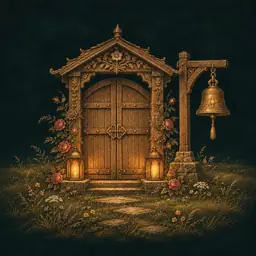

A koan is a short case from the records of the Chan and Zen masters, often a brief exchange, that a teacher gives a student to work on until the student can present its point in person.
A lineage map for books and systems; it avoids presenting symbolic traditions as literal fact.
Understand the chapter you are in.
Your life’s turning points, measured from your birth.
Walk through Alex’s whole example first


Prefer to explore first?
 The Road of AgesThe turning points of your whole life, from your own chart
Walk my road
What is a koan in Zen?
Koan is the Japanese reading of the Chinese gongan, a public case, the word for a legal precedent. In Zen it means a brief story or exchange from an old master, set before a student as a matter to be settled. The student carries it through sitting and daily work and meets the teacher privately to show an understanding. An explanation is not accepted: the teacher looks for a response that comes from the point itself.
Koans are not riddles and not nonsense. Each belongs to a teaching context, and the classic collections add verses and comments from later masters. The best known in the West, on the sound of one hand, is by the Japanese teacher Hakuin.
On the tree of the hidden arts: The mystics.
What sets Koan apart
A koan is a tool that only works inside a relationship. The case is short and public, printed in books anyone can buy, yet the work on it happens in a private room where teacher and student meet face to face, sometimes several times a day during retreats. The student may answer with a gesture, a single phrase or silence. Passing one case leads to the next, and a full Rinzai course runs to hundreds of cases over many years.
- Chinese original: gongan, a public case or legal precedent
- Famous first case: Zhaozhou's reply about a dog and buddha-nature
- Collections: Blue Cliff Record, 1125; Gateless Gate, 1228
- Japanese systematiser: Hakuin Ekaku, 1686 to 1769
- Private interview: called dokusan or sanzen
Often mistaken for something else: A riddle has a clever answer that ends it; a koan is settled by a change in the one who holds it, shown to a teacher, and no formula passes.
The story behind Koan
Chan teachers of the Song dynasty began assigning old cases to students in the eleventh and twelfth centuries, and Dahui Zonggao, who died in 1163, taught concentrating on a single key phrase. The Blue Cliff Record was compiled in 1125 and the Gateless Gate in 1228. In Japan Hakuin Ekaku, who died in 1769, arranged the cases into a graded course that Rinzai monasteries still follow. Soto teachers also comment on koans, and use them differently.
Why Koan matters
The koan shows how Zen teaches: by a problem lived with under a teacher, not by a doctrine explained and agreed to.
How to read Koan
Rinzai teachers assign cases one at a time in private interview. Outside training the term is used loosely for any puzzle, which is not its meaning.
Koan in practice: an example
A Rinzai student is given a first case and sits with it for months, returning to the teacher's room again and again until a response is accepted.
Where readings of Koan go wrong
Work on a koan is done with an authorised teacher. Books of answers exist, and teachers regard them as beside the point.
Sources and editorial method
This entry summarizes the tradition in the Almanac's own words; where no source is listed, it is an editorial summary rather than a primary text, and symbolic readings are named as the tradition's, not as fact.
- Source
- The Great Almanac Dictionary
- Category
- Mystical Systems
- Aliases
- zen koan, kong-an, gongan, koan study, koan practice
- Last updated
- 2026-09-26
See Koan in your personal almanac
A definition tells you what it is; your own birth chart tells you what it means for you. The Oracle casts your real chart and answers for your love, your work, and your year ahead, in conversation. It opens with the 7-day Oracle trial.
Speak with the OracleRelated terms
More in Mystical Systems
- Mystery Tradition
- Push Hands
- Sol Invictus
- The Star
- Abraham Abulafia
- Beguines
- Doctrine of Signatures
- Golden Ratio
From the reference page to your own chart
Every word here
is in your own chart.
- Your life’s turning points, measured from your birth
- A practical next step to consider
- It opens with 7 days free: the AI Oracle on thirty hidden arts, and your daily horoscope
$0 today, then $19/month after 7 days. Cancel anytime.
Common questions
What is a koan in Zen?
It is a short case from the old Chan and Zen masters, given by a teacher to a student as a matter to resolve. The student presents an understanding in private interview, and an explanation in ideas is not accepted.
Do koans have answers?
Teachers accept certain responses and reject others, so they are not arbitrary. But the response has to come from the student's own seeing; a memorised answer is recognised and turned away.
What are the main koan collections?
The Blue Cliff Record, compiled in 1125 with a hundred cases, and the Gateless Gate of 1228 with forty-eight are the best known. The Book of Serenity is used chiefly in the Soto school.


