
Prayer in motion
The turning of the dervishes, the walking of monks.
What are the sacred movement practices, like the whirling of the dervishes, and how do they compare with yoga?
What it is
Some prayer is done with the whole body. The best known is the sama of the Mevlevi dervishes, who turn on the left foot with the right palm raised and the left turned down. Others are quieter: the slow walk between sittings in a Zen hall, the pilgrim's path traced on a labyrinth floor, the seven circuits of the Kaaba, the circling of a Hindu shrine. In each the movement is the prayer and not a warm-up for it.
The teaching
As the Mevlevi order and the faiths that pray with the whole body teaches it.
Prayer with the whole body
Some prayer is made with the whole body, and in it the movement is the prayer, not a warm-up for it. A Muslim's daily prayer is standing, bowing, prostrating and sitting; a Jew steps back and forward and bows at set words; pilgrims circle what is holy; the dervishes of the Mevlevi order turn. Each is taught inside its own faith, by its own teachers, and each carries the meaning that faith gives it.
The order of the sema
The sema of the Mevlevi dervishes has a fixed order. It opens with a hymn in praise of the Prophet. A stroke of the drum follows, standing for the divine command by which the world was made: Be. Then the reed flute plays alone, the breath that gives life to all things; in the opening of Rumi's great poem, the Masnavi, the reed laments that it was cut from its reedbed, and the soul hears in it its own longing to return.
The dervishes then walk three times around the hall, the walk named for Rumi's son Sultan Walad, and bow to one another as they pass the sheikh's place, soul greeting soul. Then come the four salutes, the four turnings, which the Mevlevi teachers read as four stages: first, the birth of a person into truth, knowing God as Creator; second, wonder at the splendour of creation; third, that wonder turning into love, and the self passing away in the Beloved; fourth, the return to one's place in creation as a servant. The ceremony closes with a reading from the Qur'an and a prayer.
The dress and the gestures
Each part of the dress has its meaning. The tall felt hat is the tombstone of the self, and the white skirt is its shroud. The black cloak, worn at the start, is the grave, and when the dervishes let it fall they are born again to the truth.
Before turning, each stands with the arms crossed over the chest, the hands on the shoulders, making the figure of the number one, the oneness of God. Then the arms open. The right palm turns upward to receive from heaven and the left palm downward to give to the earth, so that the dervish, turning, passes on what is received. The sheikh stands in the place of Rumi.
The turn
The turn is made on the left foot, which keeps its place, while the right foot carries the body round, from right to left, around the heart. The head inclines a little to the right, the eyes stay open but rest on nothing, and the heart repeats the name of God silently with each turn. The dervishes also move slowly round the hall as they turn, so that each one's turning is part of a larger turning.
The training
The turning is not learned alone. A novice of the order served for a thousand and one days in the lodge, in its kitchen and its daily work, before taking part in the ceremony, and learned the turn under a teacher, beginning on a wooden board and pivoting on the left foot around a peg held between the first two toes.
A reader who wants to know the sema watches it with attention and reads the Masnavi. The turning itself is left to those trained in it: spinning untaught brings dizziness and falls.
Circling the holy
Pilgrims circle what is holy. At Mecca the tawaf is seven circuits of the Kaaba, made anticlockwise with the Kaaba on the left, beginning and ending at the corner of the Black Stone, which the pilgrim kisses, touches or salutes with a raised hand at each circuit. The circuits are filled with prayer and remembrance, and they end with two cycles of prayer near the Station of Abraham. In the circuits made on arrival, men walk the first three at a brisk pace.
Hindus and Buddhists circle the other way, clockwise, keeping the holy on the right hand, the side of honour. Pradakshina is made around a shrine, a temple, a sacred tree or a holy mountain such as Arunachala. Tibetan pilgrims walk the kora around Mount Kailash or around a temple, some measuring the whole way in full-length prostrations, and turn their prayer wheels clockwise as they go.
Bowing and prostration
The Muslim prayer, made five times a day, is a prayer of postures: standing to recite, bowing with the hands on the knees, rising, then prostrating with the forehead and nose, the palms, the knees and the toes on the ground, and sitting. The prostration, the forehead on the earth, is taught as the moment when the one who prays is nearest to God.
In Jewish prayer the Amidah, the standing prayer, begins with three small steps back and three forward, as of one coming before a king. The one who prays bows at the start and end of its first blessing and again at the blessing of thanks, and at the end takes three steps back. Christians kneel, bow and make the sign of the cross, and in the Orthodox churches the great prostration, the forehead to the floor, belongs to the prayers of Lent.
A way in for a reader
The gentle way in is walking. Choose a short stretch of floor or path and walk it slowly from end to end for ten minutes, the attention on the lifting and placing of each foot, and, for one who prays, a short prayer on each step or each breath. A labyrinth, where one is near, gives the same practice a shape: one path in to the centre, a pause there, and the same path out.
A person of faith who wishes to pray with the body learns its bows and prostrations from their own community. Anyone with knee, hip, back or balance trouble kneels on a cushion, bows from a chair, or keeps the prayer of the heart and lets the body rest. The turning is left to the trained.
How it is practised
The gentle way in is walking. A reader chooses a short stretch of floor or path, walks it slowly end to end for ten minutes, and keeps the attention on the lifting and placing of each foot. A labyrinth, where one is near, gives the same practice a shape. The turning itself is not for trying alone: a Mevlevi novice trained for a thousand and one days under a teacher before joining the ceremony.
Where it comes from
The Mevlevi order formed in Konya after the death of the poet Rumi in 1273 and was organised by his son Sultan Walad. In the ceremony the tall felt hat stands for the tombstone of the self and the white skirt for its shroud. Turkey closed the dervish lodges in 1925, and the turning returned in the 1950s as a public commemoration held each December. The labyrinth in the floor of Chartres cathedral dates from about 1200.
What is known, and what is not
The histories here are well documented. These are acts of worship, and those who perform them explain them within their own faith: the sama is a remembrance of God set to music, where the yoga of Patanjali aims at stilling the mind. Outside claims about trance or health are not what the practices are for, and little careful research has tested them.
Its words
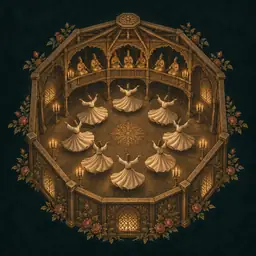 Sama
- Arabic for listening: the Sufi ceremony of music and remembrance, and in the Mevlevi order the turning known in Turkish as sema.
Ask the Oracle further
What does each part of the whirling ceremony of the dervishes stand for?Is there a form of walking meditation or sacred movement I can try without a teacher?
Before you practise
Begin short and gentle, and learn postures from a teacher who can see you. Stop at pain and never force a stretch or an inversion. Ask your doctor first if you are pregnant, recovering from an injury, or have a heart, blood-pressure, eye, spine or joint condition. A practice is not a treatment.
Its other branches
YogaThe eight limbsQigongTai chiThe whole artSearch the tree

