
Qigong
Slow movement joined to the breath, from Chinese medicine.
What is qigong, and how do I begin?
What it is
Qigong joins two words: qi, breath or vital force, and gong, work or skill. It is a family of exercises in which slow, repeated movements or held standing postures, known as zhan zhuang, are joined to a quiet breath and a resting attention. Some sets are centuries old, such as Baduanjin, the Eight Pieces of Brocade. The attention is usually kept low in the belly, at the place the tradition calls the dantian.
The teaching
As the Chinese teachers of qigong, with the Eight Pieces of Brocade teaches it.
Qi, and the work of it
Qi is breath, vapour, the vital force that moves in all things and in the body; gong is work, or skill won by long effort. Qigong is skill with the qi, gained by practice. Its teachers speak of three treasures in a person: jing, essence, the stored root of life; qi, the moving vital force; and shen, spirit, the bright awareness. The Daoist inner alchemy refines essence into qi, qi into spirit, and spirit back into emptiness. Most who practise qigong today ask far less of it: a quiet mind in a body that moves easily.
The three regulations
Teachers give every set the same three tasks. Regulate the body: upright and relaxed, the head as if lifted by a thread from the crown, the knees soft, the shoulders dropped, the tongue resting lightly on the palate behind the upper teeth. Regulate the breath: through the nose, natural at first, and in time slow, fine, even and long, without effort. Regulate the mind: quiet and attentive, resting in the body rather than in thought. When the three agree, the teachers say, the practice has begun.
The cinnabar fields
The attention is usually kept in the dantian, the cinnabar field, named after the elixir of the alchemists. The lower field lies in the belly, a little below the navel and deep inside; it is the field of essence and the root of the practice. The middle field is at the heart, the field of qi, and the upper field is between the brows, the field of spirit.
Beginners are taught to rest the attention in the lower field only, and lightly, as if the mind were sitting in the belly, while the breath is left to move the belly softly in and out.
Standing like a tree
Many schools begin with standing still, zhan zhuang, standing like a post. The feet are shoulder-width apart and parallel, the knees slightly bent, the pelvis dropped, the spine long, and the arms raised and rounded before the chest as if holding a large ball, the fingers apart and soft. The weight sinks through the feet into the ground.
The practitioner stands, breathes naturally and attends to the body: the warmth that gathers in the hands, the trembling of tired thighs, a tension that slowly lets go. Masters stand for long periods. A beginner stands for two or three minutes, lowers the arms whenever the shoulders ache, and never holds a stance through pain.
The Eight Pieces of Brocade, one to four
The first piece is holding up the sky with both hands. The fingers interlace before the belly, the hands rise past the face, turn palms upward overhead and press gently up as the body stretches and the breath comes in; then they part and float down at the sides as the breath goes out.
The second is drawing the bow to shoot the hawk. From a wide, low stance, the knees bent only as far as is comfortable, the hands cross before the chest; one hand pushes out to the side with the index finger raised, as if holding the bow, while the other draws back as if pulling the string, and the eyes follow the raised finger. Then the other side.
The third is separating heaven and earth. One hand rises overhead, palm up, pressing towards the sky, while the other presses down beside the hip, palm down, so that the body is gently stretched between them. Then the hands change.
The fourth is the wise owl gazing backward. The arms hang at the sides with the palms turning outward, and the head turns slowly to look behind over one shoulder, then returns to the front; then the other way. The head turns only as far as the neck goes easily.
The Eight Pieces of Brocade, five to eight
The fifth is swaying the head and swinging the tail. In a wide stance with the hands on the thighs, the upper body leans and circles to one side and round, the head and the tailbone moving as a pair; then the other side. Anyone with a sore back keeps the movement slow and small.
The sixth is touching the feet. The hands slide down the backs of the legs towards the feet as the body folds forward, the knees soft, and the body rises again with the arms lifting overhead. The hands go only as far down as is easy; anyone with a back injury, high blood pressure or dizziness keeps the head above the heart and stays nearly upright, or leaves this piece out.
The seventh is punching with angry eyes. From a low stance one fist pushes slowly forward, the eyes wide and fierce, the other fist drawn back to the waist; the fist opens, turns, grasps and returns. Then the other side. The fierceness is in the eyes, and the arm is never thrown hard.
The eighth is bouncing on the toes. The heels rise, the body is held tall for a moment, and the heels drop lightly to the ground, sending a soft jolt up through the body; the old name counts seven such jolts. Anyone with sore joints rises and lowers slowly, without the drop. Each old name of the Brocade also names an organ or a trouble of the body, in the language of Chinese medicine; those names belong to the tradition's own map.
The Five Animals
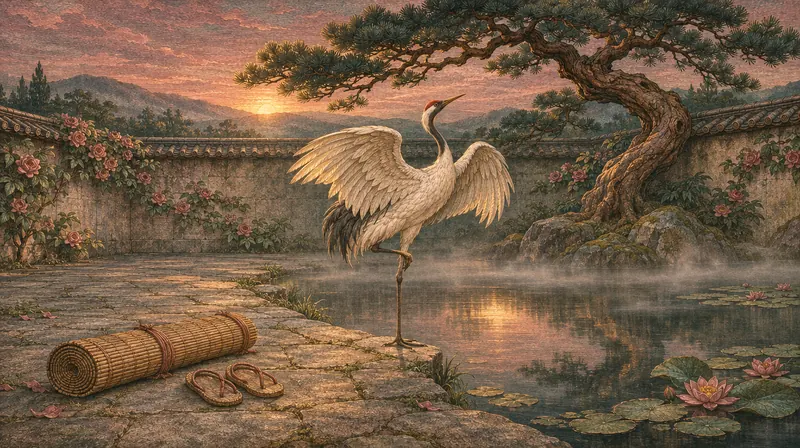
Older still is the Frolic of the Five Animals, credited to the physician Hua Tuo: the tiger, the deer, the bear, the monkey and the bird. The tiger is fierce and strong, clawing and pouncing. The deer is light, and turns its head to look back. The bear is heavy and rooted, and sways. The monkey is quick, curious and nimble. The bird, a crane, rises on one leg and spreads its wings. Each is practised as a mood as much as a movement, and teachers say the practitioner should feel like the animal, not only copy it.
Practising, and the warning against force
Qigong is learned from a teacher and begun with a few minutes a day, ten or fifteen at most at first, in a quiet place with fresh air. It is not practised on a full stomach, nor when very hungry, angry or exhausted. Each session ends by closing: the hands come to rest one over the other on the lower belly, and the practitioner stands quietly for a few breaths before walking away.
The tradition warns against forcing, above all in the inner practices that lead the attention round the body's channels. It has a name for what happens when breath and mind are pushed: zou huo ru mo, the fire running wild and the demons coming in, with heat, agitation, strange sensations and broken sleep. The remedy in every school is the same: stop, rest the attention low, walk, eat, sleep and see the teacher.
Dizziness or pain during any movement means stop and sit. A doctor is asked first where there is an injury or a heart, blood-pressure or joint condition, and the practice is never a treatment.
How it is practised
Qigong is learned from a teacher and begun with a few minutes a day. The movements are slow enough to be done without strain, standing or seated, and the breath is left natural. A reader rests the attention in the lower belly and lets the arms rise and sink with the breath. Dizziness or pain means stop and sit. The art's caution holds here as for yoga: a doctor is asked first where there is an injury or a heart, blood-pressure or joint condition.
Where it comes from
The older name is daoyin, guiding and stretching. A silk chart from the Mawangdui tomb, sealed in 168 BCE and found in 1973, shows forty-four figures bending and reaching. The physician Hua Tuo, who died about 208 CE, is credited with the Five Animal Frolics, a set that copies five animals. The word qigong in its present sense dates from the 1950s, when Liu Guizhen's sanatoria promoted the exercises as medicine. A craze followed in the 1980s, and the state reined it in after 1999.
What is known, and what is not
The vital qi and its channels are the tradition's map; anatomy has found no such vessels, and the house reports them as a way of directing attention. Studies of qigong are mostly small and of uneven quality, and the benefits they report are in line with gentle exercise. Claims made in the 1980s that masters could send out qi to heal others did not hold up when tested under controlled conditions.
Its words
- Qigong
- The modern Chinese name, fixed in the 1950s, for a wide family of slow exercises that join movement, standing, breath and attention.
- Qi (Chi)
- The Chinese word for breath or vapour, and in medicine and the martial arts for the vital force said to move through the body.
- Dantian
- The cinnabar field: in Daoist practice a centre in the lower belly, a little below the navel, where the attention is rested.
- Baduanjin
- The Eight Pieces of Brocade: a set of eight slow qigong movements known in China since the Song dynasty.
- Daoyin
- Guiding and pulling: the old Chinese name for bending, stretching and breathing exercises, painted on a silk chart sealed in a tomb in 168 BCE.
- Zhan Zhuang
- Standing like a post: holding one relaxed, upright posture without moving, kept in qigong and the Chinese martial arts as training in itself.
- Five Animal Frolics
- Wuqinxi: exercises in the manner of the tiger, deer, bear, ape and bird, credited to the physician Hua Tuo, who died about 208 CE.
Ask the Oracle further
What is the dantian in qigong, and how do I rest my attention there?Which qigong set is gentle enough for a beginner of my age?
Before you practise
Begin short and gentle, and learn postures from a teacher who can see you. Stop at pain and never force a stretch or an inversion. Ask your doctor first if you are pregnant, recovering from an injury, or have a heart, blood-pressure, eye, spine or joint condition. A practice is not a treatment.
Its other branches
YogaThe eight limbsTai chiPrayer in motionThe whole artSearch the tree

