
Tai chi
A martial art slowed into a moving meditation.
What is tai chi, and what is it good for?
What it is
Tai chi, in full tai chi chuan, is a Chinese martial art practised as a slow, continuous sequence called a form. The body stays upright and relaxed, the weight shifts from one leg to the other without a pause, and each movement has a use in fighting that the slowness hides. Partners train together in an exercise called push hands, which teaches yielding to force. Its teachers speak of sinking the vital qi to the dantian, which in plain terms means easing the chest and settling the weight. Most people today practise it for balance and calm.
The teaching
As the tai chi classics and Yang Chengfu's Ten Essentials teaches it.
The supreme ultimate
Taiji means the supreme ultimate, the turning point from which yin and yang arise; quan means fist, a martial art. The classic treatise opens with the doctrine: taiji is born of wuji, the boundless, and is the mother of yin and yang; in motion they divide, and in stillness they unite.
Every movement of the form is that teaching in the body. The weight is full in one leg and empty in the other, one hand rises as the other sinks, the body opens and closes, and each movement turns into its opposite without a break.
The Ten Essentials: the body
First, the head is upright, the crown lightly lifted as if hanging by a thread and the neck easy, so that the spirit rises without stiffness.
Second, the chest is held in a little and the back rounds slightly upward, so that the chest is never puffed out and the breath can sink.
Third, the waist is relaxed. The waist is the commander of the whole body: every turn of the form comes from it, and when it is loose the legs are strong and the stance is rooted.
Fourth, empty and full are clearly told apart. When the weight is in the right leg, the right is full and the left is empty, and the other way round; a body that cannot tell them apart is stiff and easily pushed over, and the classics call that fault double weighting.
Fifth, the shoulders sink and the elbows drop. Raised shoulders lift the breath into the chest, and elbows that sink keep the arms joined to the body.
The Ten Essentials: the whole
Sixth, use the mind and not force. The form is done without straining muscle: the intention leads, and the body follows it as water follows its channel.
Seventh, upper and lower follow each other. The movement is rooted in the feet, issued through the legs, governed by the waist and shown in the fingers, so that when one part moves, every part moves.
Eighth, inner and outer are joined. The spirit and the form move together, and the eyes, the intention and the breath go where the hands go.
Ninth, the movement is continuous and unbroken, like a great river rolling on, or like silk drawn from a cocoon, with no pause where the power is cut off.
Tenth, seek stillness in movement. However the body moves, the mind stays calm, and the slower the form, the deeper and quieter the breath.
The thirteen postures
The classics build the art on thirteen postures: eight methods of the hands and five steps. The eight are ward off, roll back, press, push, pluck, split, elbow strike and shoulder strike. The five are advance, retreat, look to the left, look to the right and central equilibrium. The classics pair the eight with the eight trigrams of the Book of Changes and the five with the five phases, and every movement of the form is made of these thirteen.
The form
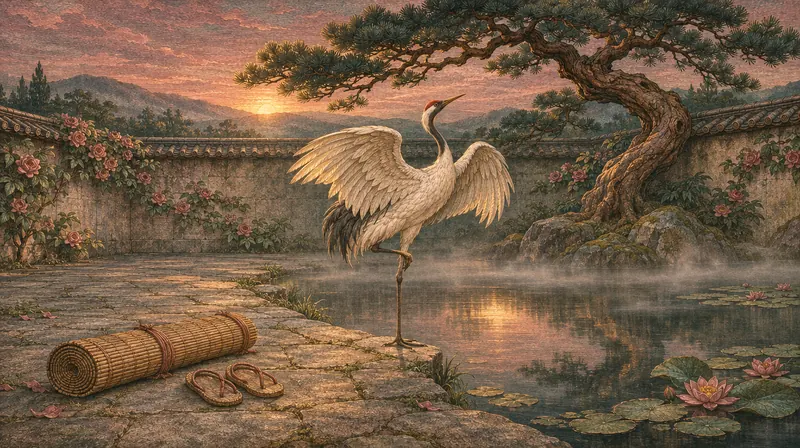
A form is a fixed sequence of movements done as one unbroken whole, from the opening posture, in which the arms float up and sink, to the closing posture, in which they settle. Its movements carry names that teach their shape: part the wild horse's mane, white crane spreads its wings, brush knee and push, grasp the bird's tail, single whip, wave hands like clouds, golden rooster stands on one leg.
The short form of twenty-four movements is the usual beginning. It is learned a few movements at a time, until each flows into the next without a seam.
Stepping like a cat
The classics say to step as a cat walks. The weight settles fully into one leg before the other foot is lifted; the free foot is placed lightly, heel first going forward and toe first going back; and only then does the weight flow across. The knee follows the line of the toes and never twists or passes beyond them. The stance is kept as high as the legs need.
The slowness is the training. It shows where balance is lost before speed can hide it.
Pushing hands
Partners train the art's principle in pushing hands. With wrists or forearms touching, they move in circles, each feeling the other's force and yielding to it. The classics give the rules: stick, adhere, connect and follow; neither let go nor resist. Force that meets no resistance can be led aside, and the classics say that four ounces can turn a thousand pounds.
The one who stiffens loses; the one who stays soft and rooted turns the other's own strength aside. Pushing hands is learned with a teacher and with a partner who is gentle.
Sinking the qi
The classics say that the qi sinks to the dantian, the field below the navel. In plain terms the chest eases, the breath settles low and quiet in the belly, and the weight drops into the legs and feet. The breath is never held and never forced to match the movement; with long practice it comes to rise with the opening movements and sink with the closing ones of its own accord.
Practising
A form is learned from a teacher, a few movements at a time, and practised for some minutes most days. The pace is slow and even. The knees are never pushed past comfort and never twisted, and a sore knee means a higher stance or a rest. There are seated forms for those who cannot stand for long. Dizziness, pain or breathlessness means stop.
A doctor is asked first by anyone pregnant, recovering from an injury, or living with a heart, blood-pressure, eye, spine or joint condition. Tai chi is a practice, not a treatment.
How it is practised
A form is learned from a teacher, a few movements at a time, and practised for some minutes most days. Beginners usually start with a short form. The pace is slow, the knees are never pushed past comfort, and the stance is kept as high as the legs need. There are seated versions for those who cannot stand for long. The slowness is the training: it shows where balance is lost before speed can cover it.
Where it comes from
Legend gives the art to Zhang Sanfeng, a Daoist immortal of Mount Wudang. The documents point elsewhere: to the Chen family village in Henan in the seventeenth century, and to Chen Wangting, as the historian Tang Hao showed in the 1930s. Yang Luchan learned there and taught in Beijing in the nineteenth century, and from him come the Yang style and, through it, the Wu and Sun styles. In 1956 a state committee published a simplified form of twenty-four movements.
What is known, and what is not
Tai chi is among the better tested of these practices. A Cochrane review of exercise for older people found that it may lower the rate of falls, and a trial published in 2012 found better balance in people with Parkinson's disease who practised it. The certainty of such findings varies, and it is not a treatment. The origin in the Chen village is documented; the Zhang Sanfeng story is legend.
Its words
- Tai Chi Chuan
- The full name of tai chi, also written taijiquan: a Chinese martial art practised as a slow, unbroken sequence of movements.
- Push Hands
- Tui shou: the partner exercise of tai chi, in which two people keep their arms in contact and test each other's balance without meeting force with force.
- Qi (Chi)
- The Chinese word for breath or vapour, and in medicine and the martial arts for the vital force said to move through the body.
- Dantian
- The cinnabar field: in Daoist practice a centre in the lower belly, a little below the navel, where the attention is rested.
Ask the Oracle further
Is the story that Zhang Sanfeng invented tai chi history or legend?What does tai chi train that ordinary exercise does not?
Before you practise
Begin short and gentle, and learn postures from a teacher who can see you. Stop at pain and never force a stretch or an inversion. Ask your doctor first if you are pregnant, recovering from an injury, or have a heart, blood-pressure, eye, spine or joint condition. A practice is not a treatment.
Its other branches
YogaThe eight limbsQigongPrayer in motionThe whole artSearch the tree

