
B. K. S. Iyengar
1918 to 2014
Who was B. K. S. Iyengar, and what is truly known of them?
What is known
Indian yoga teacher, born at Bellur in Karnataka into a poor family, a sickly child who had malaria, typhoid and tuberculosis. In 1934 he went to Mysore to live with his brother-in-law, the yoga teacher Krishnamacharya, who trained him for about two years and in 1937 sent him to teach at Pune, where he stayed for life. The violinist Yehudi Menuhin became his pupil in 1952 and brought him to Europe. Light on Yoga (1966) describes some two hundred postures with photographs of himself and became the standard manual of modern postural yoga. His method stresses exact alignment and the use of props such as blocks, belts and chairs. In 1975 he opened the institute at Pune named for his late wife Ramamani, and in 2014 he received the Padma Vibhushan.
The teaching
Taught from his own books, above all Light on Yoga (1966), Light on Pranayama (1981) and The Tree of Yoga (1988).
The tree of yoga
B. K. S. Iyengar pictures Patanjali's eight limbs as one tree. The restraints, yama, are its roots; the observances, niyama, its trunk; the postures, asana, its branches; breath control, pranayama, its leaves, which bring air to the whole; the drawing in of the senses, pratyahara, its bark, which protects it; concentration, dharana, its sap; meditation, dhyana, its flower; and absorption, samadhi, its fruit. The seed is the person. Practice of any part, rightly done, feeds the whole tree, and the fruit cannot be had without the roots. The limbs themselves are taught in the branch The eight limbs.
Precision
His method is exactness. Each posture is learned part by part: how the feet are placed and pressed down, how the legs are firmed and the kneecaps lifted, how the spine lengthens and the chest opens, how the two sides of the body are brought to equal length and equal work. The attention is spread evenly through the whole body, so that no part is dull and no part strains; he speaks of the intelligence reaching every part, and of the skin as a sense that tells the student where the body is. Aligning the body, in his teaching, aligns the breath and the mind with it.
Props
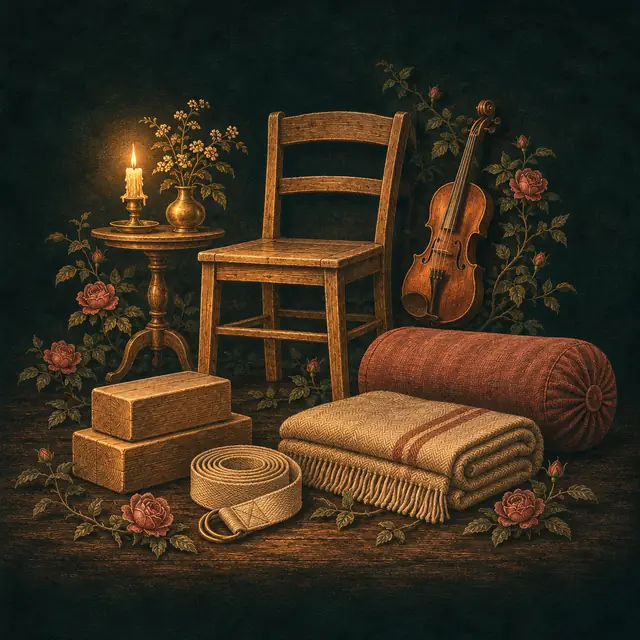
To bring the postures within reach of everyone he brought in props: wooden blocks, belts, blankets, bolsters, chairs, benches and ropes fixed to the wall. With them the stiff, the old, the weak and the injured can hold a posture rightly and long enough for it to work, and the strong can learn what they skip. The prop is a teacher too: it shows where the body sags, collapses or overworks.
Order and timing
Practice has an order. Standing postures come first, because they build the strength, steadiness and sense of alignment on which the rest depends; forward bends, twists, inversions and backbends follow as the body becomes ready. Holdings lengthen with practice, and a posture held long and attentively becomes, for him, a meditation in action. The headstand he calls the king of the postures, and the shoulderstand their mother.
These are the postures most often done badly, and the tradition's caution goes with them: inversions are learned only from a teacher, with props, and not by anyone with an injury of the neck, high blood pressure, glaucoma or a heart condition without a doctor's advice. Pain is a signal to stop, and no posture is forced.
Breath after posture
Light on Pranayama teaches that breathing is learned only after the postures are steady, because the breath needs a body that can sit still and a chest that can open. The student begins lying on the back over a folded blanket or bolster, the chest supported, at first only watching the breath and then deepening it; later the student sits with the spine erect, the chest lifted and the chin lowered toward the notch between the collarbones. The first practice is ujjayi, a long, even breath with a soft sound at the throat; then viloma, the breath taken in or let out in stages, with pauses; and only much later the practices that guide the breath with the fingers through one nostril or the other.
His cautions are the tradition's. The breath is never forced; holding it is left until long practice has prepared the body, and is not done by those with heart or blood-pressure troubles; the eyes and the brain stay soft and passive; and if the breath grows rough, the head hot or the mind agitated, the student stops and rests lying flat in the corpse posture.
From the skin to the soul
In his later books the practice is a journey inward through the five sheaths of the Upanishads: the body of food, which is the anatomical body; the body of energy, moved by the breath; the body of mind, of feeling and the senses; the body of discernment and wisdom; and the body of bliss, nearest the soul. Posture works from the outermost sheath inward and breath from the second, and when all are brought together the practitioner lives from the soul out to the skin, and from the skin in to the soul.
Effort and its ending
Reading Patanjali in the light of his practice, he teaches that a posture begins with effort and is complete only when the effort has become effortless: firmness in the body, delight in the mind and strain nowhere. That state is not reached by forcing but by long, attentive repetition, practice joined with detachment from its results. A posture done this way, with the whole attention, is already a meditation.
Orders and memberships
None; he was a householder of the Sri Vaishnava community and no monk. Teachers of the Iyengar method are certified by his institute and by its national associations.
The legend
That particular postures treat particular diseases, as the long lists in his books say. Clinical trials have found benefit from yoga practice for some conditions, chronic pain in the lower back among them; they do not bear out the lists, and no posture has been shown to cure a disease. His severity as a teacher, which some pupils praised and others described as rough handling, is on the record in their own accounts.
Their works
- Light on YogaBook, 1966
His manual of some two hundred postures with photographs of himself, with notes on breathing. It became the standard book of modern postural yoga. Its lists of postures for illnesses are not borne out by clinical trials.
Ask the Oracle about it - Ramamani Iyengar Memorial Yoga InstituteBuilding, 1975
His institute at Pune, named for his late wife Ramamani. It became the centre of his method, with its use of props and exact alignment. Teachers from many countries train there.
Ask the Oracle about it - Light on PranayamaBook, 1981
His manual of the breathing practices of yoga, set out step by step with the postures in which to sit and the stages through which a student should go. It is the companion to Light on Yoga. Teachers of his method still use it.
Ask the Oracle about it - The Tree of YogaBook, 1988
A gentler book on yoga as a whole way of life, likening its parts to the roots, trunk and branches of a tree. It is drawn from his talks. It shows him as a teacher of more than postures.
Ask the Oracle about it - Light on the Yoga Sutras of PatanjaliCommentary, 1993
His translation and commentary on the Yoga Sutras, the classic text of Indian yoga. It reads the old text in the light of his practice. It is widely read by his students.
Ask the Oracle about it - Light on LifeBook, 2005
A late book on the inner journey of yoga, written with the help of his students. It speaks of the body, the mind and the soul. It is the most personal of his books.
Ask the Oracle about it
How the house tells a life
This life is told from the record, with what is documented, what is legend and what was forged kept apart. A membership in an order is stated only where documents show it. A person’s chart explains none of their deeds.
The arts it feeds
Lives near it in time
Thinkers and teachers
Shunryu SuzukiNeville GoddardMircea EliadeAlan WattsDavid BohmIan StevensonIdries ShahCarlos CastanedaLouise HayThich Nhat HanhRam DassRobert GreeneThe whole tree

