Sky science
Precession of the Equinoxes
Direct answer
Precession of the Equinoxes is the slow shift of Earth’s rotational axis and equatorial coordinate grid relative to the stars.
It moves celestial poles and equinox points over millennia.
$0 today, then $12/month after 7 days. Cancel anytime.
At a glance
- Found in
- Astronomy & Skywatching
- Related
- J2000 Epoch, Equinox of Date, Astronomical Nutation, Annual Aberration
It moves celestial poles and equinox points over millennia.
A scientific orientation to scale, light, or motion; the article supplies the precise definition.
What does your own chart say about you?
Choose love, work or purpose. Your reading is written from your chart. Your reading uses your own birth details.
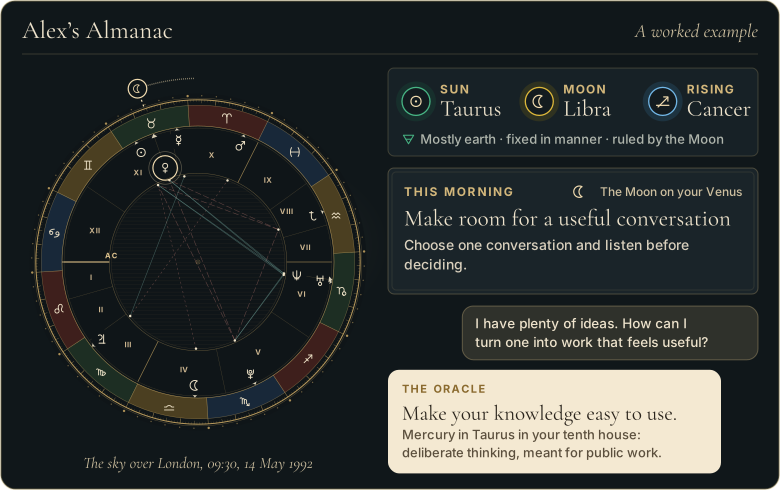
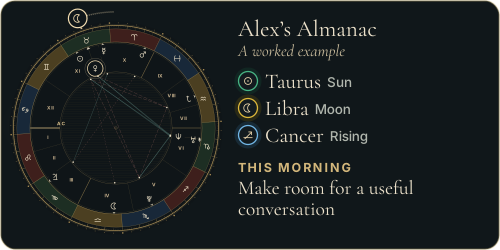
Walk through Alex’s whole example first
 The Road of AgesSee the turning points of your whole life, from your birth date
See your road's shape
The Road of AgesSee the turning points of your whole life, from your birth date
See your road's shape
Prefer to explore first?
 The Road of AgesThe turning points of your whole life, from your own chart
Walk my road
The Road of AgesThe turning points of your whole life, from your own chart
Walk my road
Free, by email
Your daily Almanac letter
One short letter at 7 each morning: the day’s theme read for your own chart, and one thing to do with it.
The rate, and how it gives the circuit
The equinox points move at about 50.3 arcseconds a year, which is about 1 degree every 72 years. A full circle is 1,296,000 arcseconds, so the circuit takes about 25,770 years. The older round figure of 25,920 years comes from 72 years a degree times 360.
Sources differ because they used different rates. Hill used about 50.25 arcseconds and 71 2/3 years a degree. Tara Mata quotes Hipparchus at 50 2/3 arcseconds, which would give a circuit of about 25,580 years, and Sri Yukteswar's 24,000-year cycle assumes the rate is not constant. The astronomical value is the first of these, and it is the only one measured directly.
A one-minute story
The Wandering Stars
How the moving planets were watched, named and found, and what a transit is.

Two zodiacs drifting apart
Precession is the reason there are two zodiacs. The tropical zodiac starts at the March equinox and moves with it. The sidereal zodiac is fixed to the stars. Tara Mata uses the Hindu fixed zodiac, whose reference star for 0 degrees of Aries is Revati, Zeta Piscium, and a belt about 16 degrees wide. She states that the two zodiacs last coincided in 498 CE, which is also her lowest point of the yuga cycle.
The gap grows by about one degree every 72 years. That is why a modern star chart and an ancient one cannot be compared without a precession correction, and why the constellation of the same name no longer sits in the sign of that name.
From precession to ages and yugas
Astrologers divide the circuit into twelve ages of about 2,150 years each, one per sign. Sri Yukteswar's school divides it instead into four yugas in two halves. The astronomy is the same and the interpretation differs. See Great Year for the length, Age of Pisces and Age of Aquarius for the usual ages, and Kali Yuga for the yuga dates.
Hipparchus described precession in the second century BCE, and the rate has been refined many times since.
The story behind Precession of the Equinoxes
Hipparchus recognized precession by comparing observations separated in time.
Why Precession of the Equinoxes matters
Precession of the Equinoxes explains why ancient and modern star coordinates cannot be compared directly.
Precession of the Equinoxes in practice: an example
Polaris will not remain the nearest bright north-pole star forever.
Where readings of Precession of the Equinoxes go wrong
Precession is not the same as the yearly seasons or short-period nutation.
Sources and editorial method
Research references used for this entry include:
- U.S. Naval Observatory: Astronomical Almanac Glossary - Definitions for astronomical coordinates, time, reference systems, and observable phenomena.
- International Astronomical Union: Standards of Fundamental Astronomy - IAU-maintained standards and algorithms for astronomical reference systems and coordinate transformations.
- Source
- The Great Almanac Dictionary
- Category
- Astronomy & Skywatching
- Last updated
- 2026-09-26
Follow the long turning of Earth’s axis
A definition tells you what it is; your own birth chart tells you what it means for you. The Oracle casts your real chart and answers for your love, your work, and your year ahead, in conversation. It opens with the 7-day Seeker trial.
Speak with the OracleRelated terms
More in Astronomy & Skywatching
- Roche Limit
- Stellar Black Hole
- Zodiacal Light
- Astronomical Seeing
- Celestial Sphere
- Eyepiece
- Occultation
From the reference page to your own chart
Every word here
is in your own chart.
- A personal reading about love, work or purpose, written from your chart
- A practical next step to consider
- It opens with 7 days free, with the AI Oracle and daily guidance
$0 today, then $12/month after 7 days. Cancel anytime.
Common questions
What is Precession of the Equinoxes?
Precession of the Equinoxes is the slow shift of Earth’s rotational axis and equatorial coordinate grid relative to the stars.
What do people get wrong about Precession of the Equinoxes?
Precession is not the same as the yearly seasons or short-period nutation.
Free, by email
The Almanac, in your inbox at 7
One short letter at 7 each morning: the day’s theme read for your own chart, and one thing to do with it.