
Feng shui and vastu
Two old arts of placing a house and its rooms, told as their own traditions tell them.
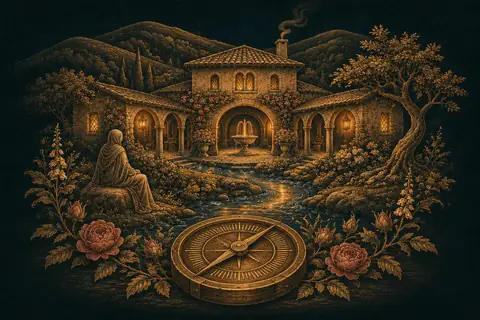
What are feng shui and vastu, and what do they say about arranging a house?
What it is
Feng shui, Chinese for wind and water, is an old art of choosing and arranging a site so that a house, a grave or a city sits well in its land. Its older school reads the form of the ground: hills behind, open space in front, water that curves and does not rush. Its later school works with a compass and the bagua, the eight trigrams of the I Ching, each tied to a direction. Vastu shastra is India's tradition of building, with rules for the plot, the door and each room, laid out on a square grid set to the four directions. Both are told here as their own traditions tell them: as arts of placement, not as machines for luck.
The teaching
As the Chinese art of wind and water, with the vastu manuals of India teaches it.
Qi, the breath of the land
Feng shui teaches that the land breathes. Qi, the vital breath that moves through all things, runs through the earth as blood runs through the body, along the ridges of mountains and the courses of water. The Book of Burial gives the art its name: qi rides the wind and is scattered, and is held where it meets water; the ancients gathered it so that it would not scatter and guided it so that it would come to rest, and so the art is called wind and water. Of the two, the book says, water comes first, and shelter from the wind next.
The book was written for graves. A body laid where qi gathers receives it into its bones, and because parents and children share one qi, the book teaches that the blessing passes to the living descendants. Feng shui therefore speaks of yin dwellings, the tombs, and yang dwellings, the houses of the living, and reads both by the same rules.
The four emblems and the dragon's lair
The older school, the school of forms, reads the shape of the ground. Mountain ranges are dragons, and the ridges that run down from them are the dragon's veins, along which qi travels until it pools at a spot the masters call the lair. The ideal site has four guardians named after the four animals of the sky. Behind it, to the north, rises the Black Tortoise, high ground that gives a back to lean on. Before it, to the south, lies the Red Bird, low and open ground with a clear view, and a level space in front called the bright hall. To the left, the east, runs the Azure Dragon, a ridge that should stand a little higher than the White Tiger, the lower ridge on the right, to the west.
Water should approach slowly and wind before the site, holding it in its curve like a belt of jade, and leave without rushing straight away. The whole is likened to an armchair: a high back, arms on either side, and an open seat facing the sun.
Living breath and killing breath
Qi that meanders, gathers and is held is called living breath; qi that rushes is killing breath, sha. Sha comes along straight lines and from sharp points: a road aimed straight at a door, the corner of a neighbouring roof pointed at a window, a river running fast and straight past a site, a front door in line with the back door so that the breath runs through the house and out. The masters call such lines hidden arrows. The remedies the books give are screens and walls, curving paths, trees and water, so that the breath is slowed and turned.
Yin, yang and the five phases
Everything in the art is weighed in yin and yang, the dark and the bright, the still and the moving, which must stand in balance: a site all mountain and no water, or all water and no hill, is out of balance. Within that the five phases, wood, fire, earth, metal and water, turn in two cycles. In the cycle of giving birth, wood feeds fire, fire makes earth of its ash, earth bears metal, metal gathers water, and water feeds wood. In the cycle of mastering, wood breaks earth, earth dams water, water quenches fire, fire melts metal and metal cuts wood. Each phase has its direction and colour: wood the east and green, fire the south and red, metal the west and white, water the north and black, and earth the centre and yellow.
The compass school and the luopan
The later school, the school of the compass, reads direction and time. Its instrument is the luopan, a wooden plate set with rings of characters around a magnetic needle at the centre, called the heaven pool. One ring holds the eight trigrams; another the twenty-four mountains, the directions of the horizon, each fifteen degrees wide, named from the twelve earthly branches, eight of the ten heavenly stems and four of the trigrams. The master sets the plate level in the doorway or at the back of a house, reads which way it sits and which way it faces, and from these the school reckons the character of each part of the building.
The eight trigrams
The trigrams are the eight figures of three lines, whole or broken, from the Book of Changes, and in the arrangement called the Later Heaven each holds a direction and a member of the family. Li, fire, is the south and the middle daughter; Kan, water, the north and the middle son; Zhen, thunder, the east and the eldest son; Dui, the lake, the west and the youngest daughter; Xun, wind, the south-east and the eldest daughter; Kun, earth, the south-west and the mother; Qian, heaven, the north-west and the father; and Gen, the mountain, the north-east and the youngest son.
On the trigrams rest the house schools. In the school of the eight mansions, houses and people alike fall into an eastern group, of Kan, Li, Zhen and Xun, and a western group, of Qian, Kun, Gen and Dui, a person's trigram being reckoned from the year of birth, and each has four good directions for door, bed and desk. The school of flying stars lays the magic square of Luo over the plan of the house: the nine numbers that legend says a turtle carried out of the Luo river on its shell, four, nine and two along the top, three, five and seven across the middle, eight, one and six along the bottom, so that every line adds to fifteen; and it moves its stars through the rooms by periods of twenty years.
A simpler school, taught in America by Lin Yun, sets the trigrams not by the compass but by the front door: a grid of nine squares is laid over the plan with the door on the near side, and each square stands for a part of life, career in the middle of the near side, wealth in the far left corner, fame in the middle of the far side and love in the far right corner, with health at the centre.
Vastu: the body of the plot
Vastu shastra begins with a story. Once a great being with no form arose and filled the space between earth and sky. The gods seized him and pressed him face down on the ground, and each god sat upon a part of him, with Brahma, the creator, at his centre. The being, Vastu Purusha, begged for food, and Brahma granted that he would receive the offerings of all who build. So every plot of land is his body, lying with his head to the north-east and his feet to the south-west, and every building is set out upon him.
The plot is laid out as a mandala, a square grid of eight squares by eight or nine by nine, each god holding his own squares. The centre, the place of Brahma, is kept open: in the old houses it is a courtyard open to the sky, and in a modern home a clear space with nothing heavy upon it.
The guardians of the eight directions
Each direction has its guardian, and the rooms follow them. The east belongs to Indra, king of the gods, and to the morning sun, and the main door is best toward it or toward the north. The south-east is Agni's, the fire, and there the kitchen goes, with the cook facing east. The south is Yama's, lord of death, and the south-west Nirriti's, and these sides are built heavy and high, with the master bedroom and the stores in the south-west. The west is Varuna's, the waters; the north-west Vayu's, the wind, a place for guest rooms and the granary. The north belongs to Kubera, keeper of riches, and the north-east to Ishana, a form of Shiva, the most sacred corner, kept low, light and open for the shrine and for water.
The land itself should rise to the south and west and fall away to the north and east, where water should run and the morning light come in, and a sleeper lies with the head to the south or the east, not to the north. The two arts differ in their roots: feng shui reads the flow of breath through land and time, while vastu sets the house on the fixed square of a body and the four quarters of the sky.
How it is practised
Tried as its traditions describe it, this is the art of looking at a room on purpose. Stand in the doorway and notice what the eye meets first, where the light falls, and whether the way through is clear. The classical advice is modest: a bed or a desk placed where the door can be seen, a solid wall behind, clutter cleared from the entrance, plants and daylight where a room feels dead. Move one thing and live with it for a week. Spend nothing on remedies, mirrors or charms, and be wary of a consultant who finds a costly fault. No school asks anyone to give up a safe home.
Where it comes from
The words wind and water come from the Book of Burial, credited to Guo Pu, who died in 324 CE; it says that the breath of the land scatters on the wind and gathers at water. The geomancer's compass, the luopan, was in use by the Song dynasty. The art was condemned as superstition in China after 1949 and lived on in Hong Kong, Taiwan and overseas, and a simplified form that fixes the bagua to the front door was taught in America from the 1980s. The rules of vastu are found in Indian texts of the first millennium CE, among them a sixth-century work of Varahamihira and the later manuals of the builders, and they shaped temples above all.
What is known, and what is not
The texts, the schools and their history are well documented. No controlled study shows that either art changes fortune, health or wealth, and consultants of different schools give different advice for the same house. Some of the advice agrees with what studies of buildings find for ordinary reasons: daylight, order and a seat with a view of the door do make rooms easier to be in. The claims made for directions, numbers and birth dates rest on tradition alone.
Its words
 Feng Shui
- The Chinese art of siting and arranging a house, a grave or a city so that it sits well in its land. The name means wind and water.
 Vastu Shastra
- India's tradition of building: rules for the plot, the door and each room, laid out on a square grid set to the four directions.
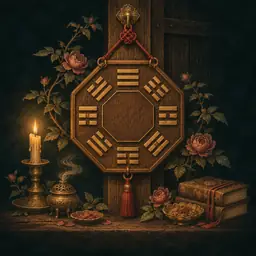 Bagua
- The eight trigrams of the I Ching set in a ring, each tied to a direction. The compass school of feng shui lays it over a house plan.
Ask the Oracle further
What does feng shui say about where to put a bed or a desk?How does vastu differ from feng shui in laying out a house?
Before you practise
The Oracle tells what is known of a sacred place, who built it and when, and names what is only claimed of it. No instrument has found the “energy” of ley lines or vortices. A holy place of a living faith has rules of its own for visitors. Do not trespass, and do not go to a remote place alone.
Its other branches
Stonehenge and the stone circlesThe pyramids of GizaDelphiThe labyrinth of ChartresThe pilgrim roadsLey linesThe whole artSearch the tree

