
Stonehenge and the stone circles
Raised in stages from about 3000 BCE and set to the midsummer sunrise: what is known of it.
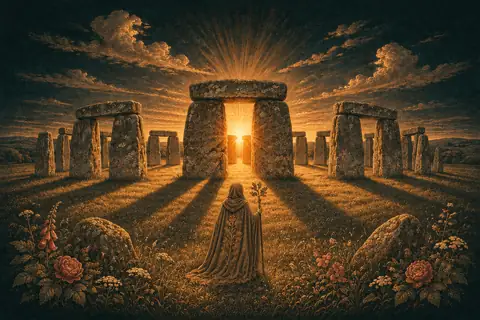
Who built Stonehenge and the stone circles, and what were they for?
What it is
Stonehenge stands on Salisbury Plain in the south of England: a ring of dressed sandstone blocks, the sarsens, with lintels laid across their tops, and inside it a horseshoe of five great stone doorways and a setting of smaller bluestones. It is one of thousands of megaliths, the great stone monuments of prehistory, which run from the dolmen, a chamber under one capstone, to the long stone rows of Carnac in Brittany. Britain and Ireland have about a thousand stone circles, and Avebury, a day's walk to the north, is the widest of them. A henge, strictly, is the round bank and ditch that encloses such ground. Stonehenge is set on a line: at midsummer the Sun rises over its entrance, and at midwinter it sets on the opposite side.
The teaching
As Mike Parker Pearson's Stonehenge (2012), with the old legends of the stones teaches it.
The plan, from the bank to the centre
Stonehenge is learned from the outside in. Its outer edge is a round ditch about 110 metres across, its main bank on the inner side, so that strictly it is no henge, since a henge keeps its bank outside the ditch. Just inside the bank runs a ring of fifty-six pits, the Aubrey Holes, named after the antiquary John Aubrey, and two small sarsens survive of the four Station Stones. At the centre stand a ring of great sarsens joined at the top by lintels; inside it a ring of smaller bluestones; inside that a horseshoe of five huge stone doorways, the trilithons; within that a horseshoe of bluestones; and at the focus the Altar Stone.
The way in is from the north-east, where a gap in the bank opens onto the Avenue. In the gap lies the Slaughter Stone, a fallen sarsen that once stood across the entrance; visitors named it for the red pools on its surface, which come from rainwater acting on iron in the stone. Further out, within the Avenue, stands the Heel Stone, a great boulder left rough.
The sarsen ring
The outer ring was laid out as thirty upright sarsens, each about four metres tall and some twenty-five tonnes, carrying thirty lintels that made one unbroken band of stone in the air, about thirty metres across. The builders worked the stone as a carpenter works wood: each upright ends in two knobs, tenons, that fit into hollows, mortises, in the underside of the lintels, and each lintel locks to the next by a tongue and groove. The lintels are curved to follow the ring, and every face was shaped by pounding with hammerstones of sarsen.
The five trilithons
Inside the ring stand the trilithons, named from the Greek for three stones: two uprights and a lintel, each making a tall, narrow doorway. The five are ranged in a horseshoe that opens to the north-east, rising in height toward the closed end, where the Great Trilithon once stood more than seven metres high; one of its uprights still stands, and its lintel lies fallen across the Altar Stone. These are the heaviest stones of the monument, up to fifty tonnes.
The horseshoe is the heart of the design: its open mouth faces the midsummer sunrise and its closed end the midwinter sunset, so that whoever stands within it faces the turning points of the year. Long after the stones were raised, people carved on them the tools they prized, a dagger and fourteen axe-heads on stone 53 of the horseshoe, and more axe-heads on stones of the ring.
The bluestones and the Altar Stone
Between the sarsen ring and the horseshoe, and again inside the horseshoe, stand the bluestones, slimmer pillars of spotted dolerite and other hard rocks about two metres tall, blue grey when wet. Up to eighty were set here and forty-three can be traced today, and some bear the same joints as the sarsens, as though they once made doorways of their own.
At the focus lies the Altar Stone, a slab of greenish sandstone about five metres long, brought from far off and now mostly buried beneath the fallen Great Trilithon; nothing shows that it was ever an altar.
Two readings of the place turn on these stones. The first, drawn from the ashes of the dead buried in the ditch and the holes, holds that Stonehenge was a monument to the ancestors, built of stone because stone lasts. The second follows the old belief that these stones heal, and holds that the sick came here to be made well. Both make the bluestones the holiest stones of the place.
The Heel Stone and the line of the year
The whole monument is built on one line. Stand at the centre on the longest day and look out through the entrance: the Sun rises just to the left of the Heel Stone. A stone hole beside it shows that it once had a partner, and the rising Sun would then have stood framed between the two. On the shortest day the Sun sets at the other end of the same line, behind the Great Trilithon, whose uprights once stood close together and framed it for anyone coming up the Avenue.
The builders found the line already in the ground: along the first stretch of the Avenue, natural ridges in the chalk, left by the frosts of the ice age, run on the very axis of the solstices, and the banks were laid along them.
The timber circle of the living
The Avenue runs for nearly three kilometres to the River Avon. Upriver, some three kilometres north-east of the stones, lies Durrington Walls, a henge far larger than Stonehenge, which once held circles of great timber posts and a crowd of small houses with central hearths; the pigs whose bones fill its pits were killed at midwinter, for great feasts.
From these finds the stones' excavators read the whole landscape as one. Wood, which rots, belongs to the living; stone, which endures, to the ancestors. At midwinter the living feasted in the timber circles of Durrington, then went down the river and up the Avenue to the stone circle of the dead, to watch the last Sun of the old year sink behind the Great Trilithon.
Merlin and the Giants' Dance
The oldest story of the stones is in Geoffrey of Monmouth's History of the Kings of Britain, and it is legend. When the Saxons had treacherously slain the British nobles at a peace meeting near Amesbury, King Aurelius Ambrosius wished to raise a memorial over their graves. Merlin told him to fetch the Giants' Dance from Mount Killaraus in Ireland, a ring of stones that giants had carried from the farthest parts of Africa, every one with a healing virtue: the giants poured water over the stones and bathed their sick in it. Uther Pendragon sailed with fifteen thousand men and beat the Irish, but no rope or ladder could stir the stones, until Merlin, laughing at their efforts, took them down by his own arts.
Raised again round the graves, the story goes on, the stones became the burial place of Aurelius himself, then of Uther, and in time of Constantine, who wore the crown after Arthur. So the tale is the first to call the place a monument to the dead, and the first to say its stones heal.
The Devil, the friar and the Druids
Country people told another tale. The Devil bought the stones from a woman in Ireland and carried them off to Salisbury Plain, dropping one into the River Avon on the way, and as he set the last one up he boasted that nobody would ever know how they came there. A friar hidden nearby answered that he would; the Devil flung a stone at him, which struck him on the heel and stuck fast in the ground, and there it stands, they said, as the Friar's Heel.
Antiquaries later gave the stones to the Druids, the priests of the Celtic Britons, and Druid orders of modern times made the place their own. Many thousands keep the solstices there now: at midsummer and midwinter the keepers open the stones to all who come, the crowd waits through the night for the dawn, Druids in white robes hold their rites of greeting, and many touch the stones, which on other days the rope forbids.
Avebury and the circles of Britain
Britain and Ireland hold about a thousand stone circles. Avebury, a day's walk north, is the widest: nearly a hundred great unworked stones in a ring more than three hundred metres across, within a vast bank and ditch, with two smaller circles inside and part of a village among them. Close by rise Silbury Hill, the largest mound raised by hand in prehistoric Europe, and the long barrow of West Kennet, a tomb of stone chambers.
The legends of the circles often turn on people made stone. At the Rollright Stones in Oxfordshire a king marching to conquer England met a witch, who told him that if after seven long strides he could see Long Compton he would be king of England. A long mound rose and hid the village, and she turned him into the King Stone, his men into the ring called the King's Men and herself into an elder tree. In Cornwall the nineteen stones of the Merry Maidens are girls who danced on a Sunday, and the two Pipers who played for them stand in the next field.
Newgrange and the light of midwinter
In the Boyne valley in Ireland the passage tomb of Newgrange turns to the sunrise of the shortest day. It is a great round mound about eighty-five metres across, ringed by ninety-seven kerbstones carved with spirals, circles and lozenges, the richest of them across the entrance. A passage about nineteen metres long runs into a chamber shaped like a cross, and in one of its recesses a triple spiral is carved.
Above the doorway the builders left a slot, the roof box. For a few mornings around the winter solstice the rising Sun shines through it, and a band of light runs along the floor of the passage into the chamber for some minutes before it draws back. A few people chosen each year by a lot, drawn by local schoolchildren, wait in the chamber at dawn on those mornings, and everyone else may stand outside.
The old Irish tales call the place Brú na Bóinne, the dwelling on the Boyne, a house of the gods. It was the home of the Dagda, the good god, until his son Aengus asked to hold it for a day and a night and then would not leave, for all time, he said, is made of days and nights; in another telling it was Elcmar whom Aengus outwitted so.
How it is practised
Stonehenge is in the care of English Heritage and is visited by ticket; the stones are roped off on ordinary days and opened at the solstices, when the keepers set the rules. A reader who goes should walk the wider ground first: the long earthwork called the Avenue, the burial mounds on the ridges, and Durrington Walls, where the builders lived and feasted at midwinter. Smaller circles stand open in fields across Britain and Ireland, often on private land, so ask before crossing a fence. Go early or late in the day, when the place is open or from a public path, stand at the entrance, and look to the horizon the builders looked to. Take nothing, move nothing and leave nothing behind.
Where it comes from
The first Stonehenge was a round ditch and bank dug about 3000 BCE, with cremated dead buried in it. The great sarsens went up about 2500 BCE. Most came from West Woods, some 25 kilometres to the north, as a chemical study showed in 2020; the bluestones came about 240 kilometres from the Preseli Hills in Wales. Newgrange in Ireland is older still, a passage tomb of about 3200 BCE whose inner chamber the midwinter sunrise lights for a few minutes. Far older than either is Göbekli Tepe in Turkey, where carved pillars were raised from about 9500 BCE. The Druids, often named as the builders, are first recorded more than two thousand years after the sarsens were set.
What is known, and what is not
The dates rest on radiocarbon from antler picks and bone left in the ditches and stone holes, and the sources of the stones on their chemistry. The alignment to the solstice sunrise and sunset is measured and not in dispute. What the builders believed is not known, for they left no writing. Reading the circle as a calendar or an eclipse computer, proposed in the 1960s, goes beyond what the stones can show. Claims that the place gives off an energy have never been borne out by an instrument.
Its words
 Megalith
- A large stone set up by prehistoric people, alone or as part of a tomb, a row or a circle. The word is Greek for great stone.
 Henge
- A round earthwork of the late Stone Age in Britain and Ireland: a ditch with its bank on the outside, enclosing ground set apart.
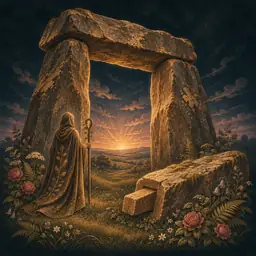 Stonehenge
- The ring of great dressed stones on Salisbury Plain in England, built in stages from about 3000 BCE and set to the solstice Sun.
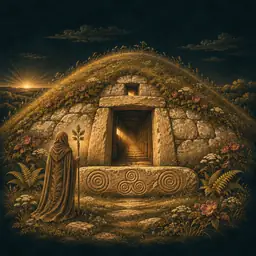 Newgrange
- A passage tomb of about 3200 BCE in the Boyne valley of Ireland, whose inner chamber the midwinter sunrise lights for a few minutes.
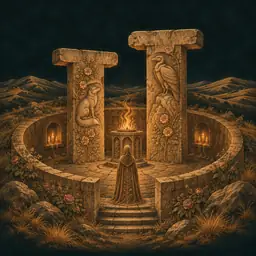 Göbekli Tepe
- A hill in south-eastern Turkey where carved stone pillars were raised in rings from about 9500 BCE, before farming and pottery.
- Avebury
- A great henge in Wiltshire whose bank and ditch hold the widest stone circle in Britain, raised between about 2850 and 2200 BCE, with part of a village inside it.
- Carnac Stones
- About three thousand standing stones set in long rows across the heath near Carnac in Brittany, raised over many generations from about 4600 BCE.
- Dolmen
- A stone chamber of prehistory: a few uprights with a great slab laid over them. Most were tombs, once covered by a mound that has since gone.
Ask the Oracle further
How were the great stones of Stonehenge moved and raised?What is known of Newgrange and its midwinter sunrise?
Before you practise
The Oracle tells what is known of a sacred place, who built it and when, and names what is only claimed of it. No instrument has found the “energy” of ley lines or vortices. A holy place of a living faith has rules of its own for visitors. Do not trespass, and do not go to a remote place alone.
Its other branches
The pyramids of GizaDelphiThe labyrinth of ChartresThe pilgrim roadsLey linesFeng shui and vastuThe whole artSearch the tree

