
The pyramids of Giza
Royal tombs of about 2500 BCE, built by Egyptian crews whose town and logbook have been found.
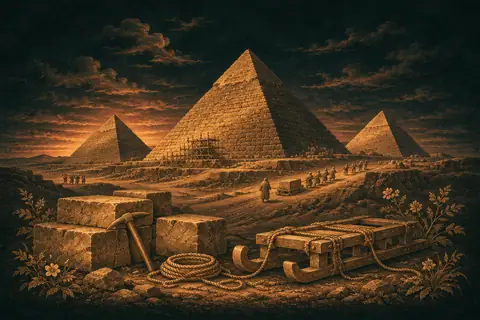
Who built the pyramids of Giza, how, and what is only claimed of them?
What it is
Three royal pyramids stand on the plateau of Giza at the edge of Cairo, built for three kings of Egypt's Fourth Dynasty: Khufu, his son Khafre, and Menkaure. The Great Pyramid, Khufu's, is the oldest and largest. It rose about 146 metres, from some 2.3 million blocks, most of them local limestone, with granite from Aswan for the king's chamber. Its sides face the four directions almost exactly. Each pyramid was a tomb and part of a larger work: a temple by the river, a causeway, a temple against the pyramid's face, pits for boats, and smaller tombs for queens and officials. The Sphinx, carved from a knoll of the same rock, is generally given to Khafre's works.
The teaching
As Mark Lehner's The Complete Pyramids (1997), with the Egyptians' own texts teaches it.
Akhet Khufu, the horizon of Khufu
The Egyptians called the Great Pyramid Akhet Khufu, the Horizon of Khufu: the place where the king, like the Sun at dawn and dusk, passes between this world and the next. A pyramid never stood alone. Each royal pyramid at Giza crowned a complex: a valley temple at the edge of the floodplain, reached by a canal; a causeway climbing the plateau; a pyramid temple against the east face, where priests made offerings every day; the pyramid itself within an enclosure wall; a small cult pyramid beside it; pits for boats; and the tombs of queens, princes and officials laid out in streets, so that the court went on serving its king in death.
The mound of the first morning
The shape comes from the Egyptian story of creation. Before anything was, there was only Nun, the dark and endless water. Out of it rose the first mound of earth, and on it the creator Atum came into being and made the world. At Heliopolis, the city of the Sun across the river, the benben, a sacred stone with a pointed top, stood for that first ground, and the bennu bird, a heron, was said to have alighted on it; the capstone of a pyramid was called the benbenet after it. A pyramid is the first mound made in stone, the place where life began, and so the place where the dead king may begin again.
The sloping faces carry a second meaning. The Pyramid Texts, spells carved inside the pyramids of later kings of the Old Kingdom, tell of the king going up to the sky on the rays of the Sun as on a ramp, and the faces, once cased in fine white limestone that shone in the light, are read as those rays made solid.
True to the four quarters
The sides of the Great Pyramid face north, south, east and west so exactly that the error is about a twentieth of a degree. Egyptian temple scenes show the rite by which a sacred building was laid out, the stretching of the cord: the king and Seshat, goddess of writing and measure, drive in two stakes and stretch a cord between them, sighting on the stars of the north. The pyramid was set true to the turning sky because the king it held was to take his place in that sky.
The way in
The entrance is in the north face, well above the ground, on the side of the stars that never set. From it the Descending Passage runs down through the masonry into the bedrock, to a rough chamber left unfinished. Partway down, a second passage climbs upward; its lower end is still blocked by granite plugs slid down to seal it after the burial, and visitors go round them by a tunnel that tradition says the men of the caliph al-Ma'mun forced. The climbing passage opens into the Grand Gallery, some forty-seven metres long and nearly nine high, its walls stepping inward course by course until they almost meet beneath the roof. At its foot a level passage leads to the so-called Queen's Chamber, which held no queen; at its top lies the chamber of the king.
The King's Chamber and the rooms above it
The burial chamber is built wholly of red granite brought down the Nile from Aswan: a plain room about ten metres by five, roofed with nine great granite beams, holding nothing now but a lidless granite coffer at its west end. The coffer is a little wider than the passage that leads in, so it was set in place while the pyramid was still rising. Above the flat roof the builders stacked five low compartments, with a pointed roof of huge limestone slabs on top, to turn the weight of the stone mountain away from the chamber. In those sealed spaces the work gangs left marks in red paint, among them their own names, such as Friends of Khufu, and the king's name in its oval ring.
Roads for the soul
Two narrow shafts run from the King's Chamber to the outer faces, one north and one south, and two more from the Queen's Chamber stop short behind small stone doors with copper pins. The Pyramid Texts tell where such roads lead. The king's spirit goes up to join the Imperishable Ones, the stars of the north that circle the pole and never sink below the horizon; and it goes south to Orion, the star form of Osiris, lord of the dead, with whom the king becomes one. In Khufu's day the northern shaft pointed toward the circling stars and the southern toward the belt of Orion, and so the shafts are read as ways for the king's soul to rise.
Ka, ba and akh
The Egyptians held that a person lives on in several parts. The ka, the life force, stays near the body and needs food; the ba, the soul that travels, is shown as a bird with a human head; and the akh, the shining spirit, joins the gods and the stars. A pyramid served all three. It housed and guarded the body; in its temple the ka was fed for ever, by priests serving in groups that took turns, who burned incense and spoke the offering formula over bread, beer and meat from estates set aside across Egypt; and from it the ba and the akh rose into the sky.
The king's boat
Beside the pyramid lay pits shaped like boats. In one, sealed under great limestone blocks on the south side, a real boat was found taken apart into more than twelve hundred pieces of cedar and other wood, with its ropes. Rebuilt, it is some forty-three metres long, its planks sewn together with rope through holes in the wood, without a nail. It may have carried the king's body to his tomb, or have been meant to carry him across the sky in the company of the Sun, whose daily voyage in a boat the Egyptians told of; either way it belongs to the journey the pyramid was built to make.
Khafre, Menkaure and the Sphinx
Khufu's son Khafre built the second pyramid on higher ground, so that it looks the taller, and a cap of its white casing still clings near the top, showing how all three once shone. The third, Menkaure's, is far smaller, and its lowest courses were cased in red granite. Beside the foot of Khafre's causeway lies the Great Sphinx, carved from a knoll of rock the quarrymen left standing: a lion's body with the head of a king in the striped royal headcloth, facing due east to the rising Sun.
Later Egyptians worshipped the Sphinx as Horemakhet, Horus in the Horizon, the Sun at its rising. Between its paws stands the Dream Stele of Thutmose IV, which tells how the young prince, out hunting, slept at noon in its shadow, and the god spoke to him in a dream: if he would clear away the sand that choked its body, he would be king. Thutmose did come to the throne, and the stele is his thanks.
The tales of Khufu
Egyptians told stories of the builder, and they are tales, not records. In the Westcar Papyrus Khufu's sons entertain him with the wonders of magicians, and one brings before him Djedi, a man of a hundred and ten who eats five hundred loaves a day and can join a severed head back to its body. Khufu calls for a prisoner to test him; Djedi refuses to do it to a human being and shows the wonder on a goose. Khufu then asks him the number of the hidden chambers of the sanctuary of Thoth, which he wishes to copy for his horizon, and Djedi answers that it will be brought to him by the eldest of three children not yet born, who will one day be kings.
The Greeks told it darker. Herodotus heard that Cheops, as he calls him, shut the temples and drove all Egypt to labour, and that an inscription on the pyramid recorded what the workers ate in radishes, onions and garlic, at a cost of sixteen hundred talents of silver. Arab writers of the Middle Ages told of Surid, a king before the Flood, who dreamed that the world would be drowned and raised the pyramids to keep his treasures and the learning of his priests safe from the waters. All of these are legend; the walls of the Great Pyramid carry no words but the builders' marks.
How it is practised
A visitor to Giza can look for the evidence in the open. The quarries lie beside the pyramids, their cut faces still showing. Unfinished blocks keep the marks of copper chisels and stone pounders, and the names the gangs daubed in red survive in the sealed chambers above the king's. Stand at a corner of the Great Pyramid and sight along a side to see how true it runs. Climbing the pyramids is forbidden by Egyptian law, and the inner passages are steep, hot and close, so they are no place for anyone unwell or uneasy in tight spaces. Hire a licensed guide, carry water in the heat, and treat the claims of sellers at the gate as stories.
Where it comes from
The Great Pyramid was finished about 2560 BCE, in a reign of more than twenty years. The men who built it are known. From 1988 Mark Lehner excavated a town of the builders of the next two reigns south of the plateau, with its bakeries, breweries and sleeping galleries, and the tombs of workers and overseers were found beside it in 1990. In 2013 a French team at Wadi al-Jarf on the Red Sea found the oldest inscribed papyri known, among them the logbook of an inspector named Merer, who ferried limestone to Giza in Khufu's last years. The Greek writer Herodotus, some two thousand years later, told of a hundred thousand men driven to the work. The digging shows organised, housed and well fed crews, far fewer in number.
What is known, and what is not
The date, the king and the method rest on many finds that agree: the workers' town, the tools, the quarries, the logbook, and ramps of the same age found at other Egyptian quarries. Claims that the pyramids are far older, or were raised by a lost people or by visitors, have no find behind them and take the work from the Egyptians who did it. A theory of 1994 that the three pyramids copy the belt of Orion is rejected by Egyptologists. The pyramid power of the 1970s, said to sharpen blades and keep food fresh, failed when tested.
Its words
 Great Pyramid of Giza
- The tomb of the Egyptian king Khufu, finished about 2560 BCE: the oldest and largest of the three pyramids at Giza.
Ask the Oracle further
How did the builders of Giza move and raise the stones of the pyramids?Who were the workers who built the pyramids, and how did they live?
Before you practise
The Oracle tells what is known of a sacred place, who built it and when, and names what is only claimed of it. No instrument has found the “energy” of ley lines or vortices. A holy place of a living faith has rules of its own for visitors. Do not trespass, and do not go to a remote place alone.
Its other branches
Stonehenge and the stone circlesDelphiThe labyrinth of ChartresThe pilgrim roadsLey linesFeng shui and vastuThe whole artSearch the tree

