
The pilgrim roads
The Camino, the Kumbh Mela, the Shikoku circuit and the hajj: the roads and their customs.
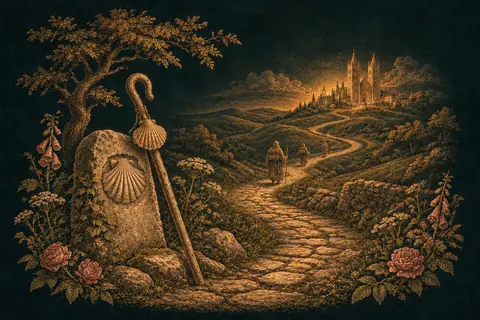
What are the great pilgrim roads, and what does a pilgrimage ask of the one who walks it?
What it is
A pilgrimage is a journey made for the sake of a holy place, and nearly every religion keeps one. The hajj to Mecca is asked of every Muslim who is able, once in a lifetime, and the city is open to Muslims alone. Hindus gather in tens of millions to bathe at the Kumbh Mela, held in turn at four river towns of India, and go in every season to Varanasi on the Ganges and round Mount Kailash in Tibet. Christians have walked for a thousand years to the shrine of the apostle James in Spain by the Camino de Santiago. In Japan a circuit of eighty-eight temples rings the island of Shikoku. The forms differ, and the parts are shared: leaving home, a set road, hardship borne willingly, an arrival, and a return.
The teaching
As each road's own tradition, from the Codex Calixtinus to the customs of Shikoku teaches it.
The Way of Saint James
The Camino begins with a story. James, son of Zebedee and brother of John, preached the gospel in Spain, the tradition says, and went back to Jerusalem, where King Herod had him put to the sword. His disciples laid his body in a boat, which an angel guided across the sea to Galicia, and there they buried him, and the tomb was forgotten. Long afterwards a hermit named Pelayo saw lights and heard singing over a wood; the bishop found the tomb beneath, and the king came to venerate it. Popular tradition reads Compostela as campus stellae, the field of the star.
The scallop shell, which pilgrims of old picked up on the Galician shore at the end of the road, is the badge of the Way, its ridges gathering like the many roads that meet at the tomb.
The scrip and the staff
The Codex Calixtinus holds a sermon, Veneranda dies, that teaches the pilgrim's gear as a lesson. The scrip, the pilgrim's bag, is narrow, because the pilgrim trusts in God and carries little; it is made from the hide of a dead beast, because the pilgrim should put to death the vices of the flesh; and its mouth is never tied shut, because the pilgrim shares what he has with the poor and is ready to receive. The staff is a third foot to lean on and stands for faith in the Trinity; with it the pilgrim drives off wolves and dogs, which are the snares of the devil. In the old rite of setting out, the priest blessed scrip and staff and gave them to the pilgrim, as a knight receives his arms.
Arriving at Santiago
A pilgrim today carries a credencial, a card stamped at churches, hostels and inns along the way; walked on foot over at least the last hundred kilometres, or ridden by bicycle over the last two hundred, it earns the Compostela, a certificate in Latin. Behind the high altar a narrow stair leads up to the jewelled statue of the seated apostle, which pilgrims embrace from behind, and in the crypt below a silver casket holds the relics.
At some Masses the great censer, the botafumeiro, is swung from the crossing: eight men in red robes haul on its rope until it flies in a high arc across the transept, pouring incense over the crowd. In a Holy Year, when the feast of Saint James on 25 July falls on a Sunday, the Holy Door is opened, and many walk on to Finisterre, once held to be the end of the earth, to watch the Sun go down into the ocean.
The house that Ibrahim raised
The hajj, the pilgrimage to Mecca, is one of the five pillars of Islam, owed once in a lifetime by every Muslim able in body and in means, and its rites retell the story of Ibrahim. At God's command Ibrahim left his wife Hajar and their infant son Ismail in the barren valley of Mecca. When their water ran out Hajar ran seven times between the low hills of Safa and Marwa, searching for help, until the spring of Zamzam burst from the ground beside the child. Later Ibrahim and Ismail raised the walls of the Kaaba as a house for the worship of the one God, and Ibrahim called all people to it.
The days of the hajj
At the boundary of the sacred land the pilgrim enters ihram, the state of consecration. Men put on two plain white unsewn cloths, women modest everyday dress with face and hands uncovered, and for those days no one cuts hair or nails, wears perfume, quarrels, hunts or comes together as husband and wife. The pilgrim calls again and again the talbiya, labbayk Allahumma labbayk, here I am, O God, here I am, and in Mecca walks seven times round the Kaaba from the corner of the Black Stone, then seven times between Safa and Marwa, as Hajar ran.
On the eighth day of the month of Dhu al-Hijja the pilgrims go out to the tent city of Mina. On the ninth comes the heart of the hajj, the standing at Arafat: from noon until sunset they stand and sit on the plain around the Mount of Mercy, where the Prophet gave his farewell sermon, praying and asking forgiveness, for, in a saying of his, the hajj is Arafat. At nightfall they move to Muzdalifah, pray under the open sky and gather small pebbles.
On the tenth they throw seven pebbles at the largest of the three pillars at Mina, where tradition says Ibrahim drove off Satan, who tempted him to disobey God. They sacrifice an animal, as Ibrahim offered a ram in place of his son, and Muslims everywhere keep the day as the Feast of the Sacrifice; men shave their heads or cut their hair, women cut a lock, and all return to circle the Kaaba again. For two or three more days they stone all three pillars, and before leaving make a farewell circuit. When the hajj falls in summer the heat is fierce, so pilgrims drink often and keep to the shade, and those too weak to stone may send another in their place.
The pot of nectar
The Kumbh Mela takes its name from a pot, kumbha, and its story from the Puranas. To win back their strength, the gods joined their rivals the asuras to churn the ocean of milk for amrita, the nectar of immortality, with Mount Mandara as the churning stick, the serpent Vasuki as the rope, and Vishnu, as the tortoise Kurma, bearing the mountain on his back. The churning brought up a deadly poison, which Shiva drank to save the world, so that his throat turned blue; then came many wonders, and last of all Dhanvantari, physician of the gods, carrying the pot of amrita.
Gods and asuras fought over the pot, and as it was carried away across the sky drops of the nectar fell at four places: Prayag, where the Ganga and the Yamuna meet the unseen Saraswati; Haridwar on the Ganga; Ujjain on the Shipra; and Nashik on the Godavari. The Kumbh Mela is held at each when the Sun and Jupiter stand in the signs that mark it, so that each returns about every twelve years.
Bathing at the Kumbh
Pilgrims come to bathe, for a dip in the river on the chief days is held to wash away sins. The first baths belong to the akharas, the orders of ascetics, who march to the water in a fixed order with banners and drums, the naked Naga sadhus smeared with ash going first, before the millions follow. Many householders keep kalpavas at Prayag through the month of Magh, living in tents on the sands, eating once a day and bathing at dawn. The crowds on the chief days are among the largest on earth, and people have been crushed in them, so a newcomer does well to bathe on a quieter day, keep with companions and follow the police lines.
Walking with the Daishi
The Shikoku pilgrimage is a ring of eighty-eight temples, about twelve hundred kilometres round the island where Kukai, honoured as Kobo Daishi, the great teacher of the Shingon school, was born. Pilgrims hold that the Daishi walks the route with each of them, and their hats bear the words dogyo ninin, we two, travelling together. Most go clockwise from Temple 1, Ryozenji, to Temple 88, Okuboji, and many then go on to Mount Koya, where the Daishi is held to remain in meditation.
The four provinces are four stages of the way: Awa, now Tokushima, the place of awakening the resolve; Tosa, now Kochi, of ascetic training; Iyo, now Ehime, of enlightenment; and Sanuki, now Kagawa, of nirvana. The pilgrim wears a white jacket, the colour of the dead, as one ready to die on the road, and carries a staff that is the Daishi himself: each night its foot is washed before the pilgrim's own, and it is not tapped on bridges, for the Daishi, it is said, once slept under a bridge when no house would take him in.
At each temple
At every temple the pilgrim rings the bell, rinses hands and mouth, and goes to two halls, that of the temple's Buddha and that of the Daishi, lighting a candle and incense at each, leaving a slip with name and prayer, and chanting the Heart Sutra and the Daishi's mantra, namu Daishi henjo kongo. The temple office then writes the temple's name in ink in the pilgrim's book and stamps its red seals. People along the road give pilgrims settai, gifts of food, money or a bed, and the pilgrim does not refuse but gives a name slip in thanks, for the gift wins merit for the giver and the pilgrim carries the giver's prayer.
Emon Saburo
The first pilgrim, the story says, was Emon Saburo, the richest man in Shikoku. A begging monk came to his door; he refused him, broke his bowl and drove him away. Then his eight sons fell ill and died one after another, and he understood that the monk had been the Daishi. He walked the island round twenty times seeking forgiveness without meeting him, then walked it the other way, until he collapsed near Temple 12; there the Daishi appeared and forgave him, and Emon asked to be born again in a family that could restore a temple. He died holding a stone, and soon a baby was born with a stone in his fist that read, Emon Saburo is reborn; grown, he restored the temple that keeps the stone today, Ishiteji, the temple of the stone hand. So the road gives alms, and is a road of forgiveness.
How it is practised
A walking pilgrimage asks more of the feet than of belief. On the Camino those who walk the whole French Way cover twenty to twenty-five kilometres a day for about five weeks, carrying a pack of a tenth of their weight or less. Train with the loaded pack beforehand, wear shoes already broken in, tend a sore spot the hour it starts, carry water, and take a rest day each week. The last hundred kilometres on foot earn the certificate. Anyone with a heart, joint or other health condition should ask a doctor before a long walk. A pilgrim of one faith at the shrine of another is a guest: follow its rules of dress and entry, and do not go where only its own people may.
Where it comes from
The tomb held to be that of James was reported in Galicia in the ninth century, and by the twelfth the road across northern Spain had bridges, hospices and a guidebook, the fifth book of the Codex Calixtinus. It nearly died out after the Reformation and was revived from the 1980s; several hundred thousand people a year now collect the certificate at Santiago. Muslims hold that the hajj goes back to Ibrahim, who raised the Kaaba, and its rites are set out in the Qur'an and in the practice of the Prophet, who led it in 632 CE. Hindu tradition holds the bathing festivals at the rivers to be very old; the Kumbh Mela under that name is clearly recorded in recent centuries. The Shikoku circuit is tied to the monk Kukai, who died in 835.
What is known, and what is not
The roads, the numbers and the customs are documented, by the pilgrim offices and by centuries of records. Studies of pilgrims after the Camino report lower stress and a lasting sense of meaning; they rely on what walkers say of themselves, and people who choose such a walk are not a fair sample of everyone. Whether a relic or a tomb is what tradition says is a matter of faith and of history, and historians doubt that the bones at Santiago are the apostle's. At Lourdes the Church has recognised some seventy cures out of thousands reported. The good a long walk does the body is ordinary and well established.
Its words
 Pilgrimage
- A journey made for the sake of a holy place. Nearly every religion keeps one, each with its own road, rules and customs.
 Camino de Santiago
- The Way of Saint James: the pilgrim roads across Europe to the shrine of the apostle at Santiago de Compostela in north-west Spain.
 Kumbh Mela
- The great Hindu bathing pilgrimage, held in turn at four river towns of India, where tens of millions gather on the chief days.
- Hajj
- The pilgrimage to Mecca on set days of the last month of the Islamic year, asked once in a lifetime of every Muslim who is able.
- Varanasi
- The city of Shiva on the Ganges, also called Kashi and Banaras, where Hindus come to bathe, to worship and to pass their last days beside the river.
- Mount Kailash
- A peak of 6,638 metres in western Tibet, holy to Hindus, Buddhists, Jains and followers of Bon. Pilgrims walk round it, and no one climbs it.
- Lourdes
- The Catholic shrine in the French Pyrenees where Bernadette Soubirous reported visions of Mary in 1858. The sick are brought to its spring, and reported cures are examined by doctors.
- Uluru
- The great sandstone rock of central Australia, sacred to the Anangu, its owners, who ask visitors to walk round it and not to climb. The climb closed in 2019.
Ask the Oracle further
How should I prepare my body for walking the Camino de Santiago?What is the Kumbh Mela, and why do pilgrims bathe there?
Before you practise
The Oracle tells what is known of a sacred place, who built it and when, and names what is only claimed of it. No instrument has found the “energy” of ley lines or vortices. A holy place of a living faith has rules of its own for visitors. Do not trespass, and do not go to a remote place alone.
Its other branches
Stonehenge and the stone circlesThe pyramids of GizaDelphiThe labyrinth of ChartresLey linesFeng shui and vastuThe whole artSearch the tree

