
The labyrinth of Chartres
One winding path laid in a cathedral floor about 1200, and how it is walked today.
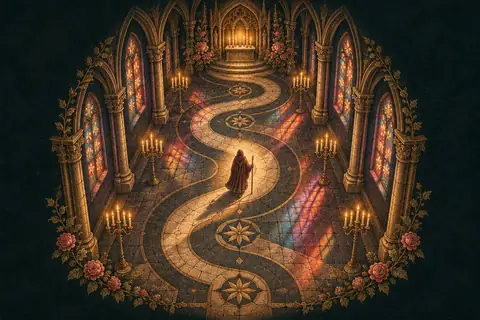
What is the labyrinth of Chartres, and how do people walk a labyrinth today?
What it is
Set in the floor of the nave of Chartres Cathedral, south-west of Paris, is a labyrinth of dark and pale stone almost thirteen metres across. It is not a maze. A maze has choices and dead ends; a labyrinth has one path, which here winds through eleven rings and four quarters, turning back on itself again and again before it reaches a six-petalled centre. The path is about 260 metres long. A walker cannot get lost in it, only stop. Other French cathedrals had such floors, at Reims, Sens and Auxerre, and most were torn up in the seventeenth and eighteenth centuries. The one at Chartres survives whole.
The teaching
As the tradition of the church labyrinth, from Chartres to today's walkers teaches it.
The figure on the floor
The labyrinth of Chartres is laid in the floor of the nave in pale stone, its path edged by bands of dark marble, and it opens toward the west doors through which the faithful enter. The single path makes eleven circuits about the centre. Its turns, where the path doubles back on itself, are lined up along four arms, so that the whole figure shows a cross laid over a ring. Round the outer edge runs a band of small cusps like the teeth of a wheel, and at the centre is a rose of six rounded petals.
Walking it, one learns its shape with the body. The path heads in toward the centre and then turns aside; it swings back and forth through all four quarters, now close to the rose, now out at the farthest ring, until after some 260 metres the last turn opens into the centre. No choice is ever offered and no turning is ever wrong. A maze is a puzzle for the mind; a labyrinth is a road for the feet, and whoever keeps walking arrives.
The house of the Minotaur
The figure takes its name from the oldest story of a labyrinth, the Greek myth of Crete. King Minos asked Poseidon for a sign and was sent a white bull from the sea, which he should have sacrificed and kept instead. In punishment his queen Pasiphae was made to desire the bull, and she bore the Minotaur, a man with a bull's head. Minos had the craftsman Daedalus build the labyrinth, a dwelling so winding that whatever was shut inside could never find its way out, and there he kept the Minotaur, feeding it with seven youths and seven maidens sent from Athens as tribute.
Theseus, son of the king of Athens, sailed with the third tribute to end it. Ariadne, daughter of Minos, fell in love with him and gave him a ball of thread, as Daedalus advised. He tied one end at the door, unwound it as he went in, killed the Minotaur at the heart of the labyrinth, and followed the thread back to the light. A clay tablet from Knossos itself, written in the oldest Greek script, records a jar of honey offered to the Mistress of the Labyrinth.
Seven rings and eleven
The labyrinth the ancients drew, found carved and painted from Crete to Scandinavia, has seven rings. Its path enters the third ring, then the second, then the first, crosses to the fourth, then runs the seventh, the sixth and the fifth, and only then reaches the centre. Anyone can draw it from a small seed of a cross, four corner angles and four dots, whose ends are joined by curving lines one pair at a time, working outward. The builders of the cathedrals remade this figure with eleven rings and a path that turns in all four quarters, so that the cross is written into its turns, and the pattern of Chartres is the one most copied today.
Christ the new Theseus
The Christian builders set the old story in the floor of the church because they read it anew. At Lucca, on a pillar of the cathedral porch, a small labyrinth is cut with a Latin verse: this is the labyrinth that Daedalus of Crete built, from which no one who went in could come out, except Theseus, helped by Ariadne's thread. Medieval readers of the myths made Theseus a figure of Christ, who goes down into the house of death, overcomes the devil at its centre and leads the captives out. In that reading the labyrinth is the world, or sin, or hell, from which no one escapes alone, and the thread is grace.
The path teaches the same thing to the walker. Like a life, it is long and winding and often seems to lead away from its goal, yet it is never lost to one who keeps going, and it ends at the centre, which many walkers take for the heavenly Jerusalem.
The cathedral of the Virgin's veil
Chartres was a place of pilgrimage before its labyrinth was laid. Its treasure is the Sancta Camisia, a length of silk held to be the veil the Virgin Mary wore when she gave birth to Christ, given to the cathedral by a Carolingian king. When fire destroyed the old church, the veil was found unharmed in the crypt, and the people took it as a sign that the Virgin wished a new house built for her. Pilgrims came to the veil, to the Virgin of the Pillar beside the choir and to Our Lady Underground in the crypt, and the labyrinth lies on their way to the choir.
The Easter dance
In some cathedrals the labyrinth was danced. At Auxerre, at Easter, the dean took a large ball in his left hand and danced on the labyrinth in a three-step measure while the Easter sequence, Victimae paschali laudes, praise to the Paschal victim, was sung, tossing the ball to each of the clergy in turn as they joined hands and danced in a ring around him. Sens kept a like custom. The rite left no written meaning, but its season was the Resurrection, and its floor the figure of the road out of death.
Turf mazes and Troy towns
Away from the cathedrals the same figure was cut in the turf of English village greens and hilltops, and laid out in boulders on the shores of Scandinavia. English turf labyrinths keep old names: Troy Town, after the walls of Troy, which legend said were built to baffle any enemy, and Julian's Bower, after Iulus, son of Aeneas, who in Virgil leads the Trojan boys in a winding game on horseback that the poet likens to the Cretan labyrinth. Young people ran them at Easter and at fairs, and the turf had to be recut every few years or the path would grass over. Fishermen in Sweden, it was told, walked the stone labyrinths by the shore before putting to sea, for fair winds and a good catch.
Walking it today
Most walkers now follow a threefold way taught at Grace Cathedral in San Francisco by Lauren Artress, who made the Chartres pattern widely known again. Going in is releasing: with each turn the walker lets go of worry and plans, and lets the path set the pace. The centre is receiving: one stands or sits there as long as one wishes, in prayer, in silence or simply at rest. Coming out by the same path is returning, carrying back into ordinary life whatever was found. She drew the three from the old Christian stages of the soul's way: purgation, illumination and union.
How it is practised
At Chartres the chairs are usually cleared from the labyrinth on Fridays from Lent to All Saints, and anyone may walk it; check the cathedral's notice before travelling. Many churches, hospitals and parks now have a copy laid in stone, canvas or mown grass. The custom is simple. Pause at the mouth, walk in at an ordinary pace, stand a while at the centre, and walk out by the same path. Let faster walkers pass, and step aside for those coming the other way. Nothing is asked of the walker but attention, and no meaning is owed to anyone at the end.
Where it comes from
The Chartres labyrinth was laid about 1200, while the cathedral was being rebuilt after the fire of 1194. Its form is older. The simpler seven-ring pattern is scratched on a clay tablet from Pylos in Greece of about 1200 BCE and stamped on coins of Knossos, where it stood for the house of the Minotaur; a plaque showing Theseus and the beast is recorded at the centre at Chartres until 1792. How medieval people used the floor is thinly recorded. Records from Auxerre and Sens tell of clergy dancing on theirs at Easter. The name road to Jerusalem, and the tale of pilgrims crossing it on their knees, are attested only later. Walking it as a quiet practice dates from the 1990s.
What is known, and what is not
The pattern, its measurements and its date are plain to see and well studied. Its medieval meaning is largely conjecture, and writers who state it firmly are repeating later tradition. A handful of small studies report that people feel calmer after walking a labyrinth, as they do after other quiet walks; none shows more than that. Claims that the figure hides a code, tracks the Moon or holds a power are not supported by the cathedral's records or by measurement.
Its words
 Labyrinth
- A single winding path that leads to a centre with no choices and no dead ends, unlike a maze. The best known is in the floor at Chartres.
Ask the Oracle further
How is a labyrinth different from a maze, and how old is the labyrinth of Chartres?What happens when people walk a labyrinth, and what has been studied?
Before you practise
The Oracle tells what is known of a sacred place, who built it and when, and names what is only claimed of it. No instrument has found the “energy” of ley lines or vortices. A holy place of a living faith has rules of its own for visitors. Do not trespass, and do not go to a remote place alone.
Its other branches
Stonehenge and the stone circlesThe pyramids of GizaDelphiThe pilgrim roadsLey linesFeng shui and vastuThe whole artSearch the tree

