
Delphi
The sanctuary of Apollo, the Pythia on her tripod, and the stone called the navel of the world.
What happened at Delphi, and what is truly known of its oracle?
What it is
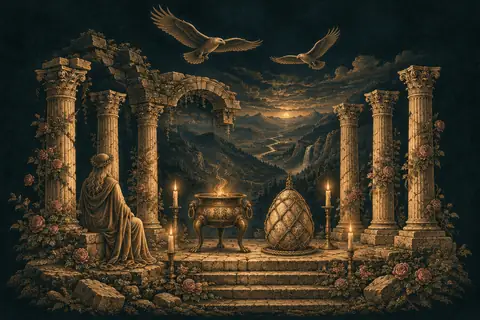
Delphi lies on a steep shoulder of Mount Parnassus in central Greece. For about a thousand years it was the seat of the most consulted oracle of the Greek world, the sanctuary of the god Apollo. Cities and private people came to ask whether to found a colony, go to war or marry. The answer was spoken by the Pythia, a woman of Delphi who served for life and sat on a tripod in the inner room of the temple. Priests received the inquirer, and may have set her words in order. In the temple stood the omphalos, a carved stone the Greeks called the navel of the world: the story was that Zeus loosed two eagles from the ends of the earth and they met here.
The teaching
As the ancient witness of Delphi, from the Homeric Hymn to Plutarch and Pausanias teaches it.
Earth's oracle before Apollo's
Delphi was holy before Apollo came. At the opening of Aeschylus' Eumenides the Pythia, praying at the temple door, names those who held the oracle in turn: first Earth, the first prophet; then her daughter Themis, goddess of right order; then the Titaness Phoebe, who gave it as a birthday gift to Phoebus Apollo, who bears her name. Below the temple a rough boulder is still shown as the rock where Herophile the Sibyl stood to sing her prophecies, a seer of the earliest times.
The serpent and the dolphin
The Homeric Hymn tells how the god took the place. Seeking a seat for his oracle, Apollo came to the foot of Parnassus and laid the foundations of his temple, and the heroes Trophonius and Agamedes set its stone threshold. By a spring nearby lived a great she-dragon, a bane to men and their flocks, and Apollo shot her with his arrows. As she lay dying he told her to rot where she lay, and from that rotting, pythein in Greek, the place was called Pytho and the god Pythian Apollo.
Then he needed priests. Seeing a ship of Cretans from Knossos on the sea, he leapt aboard in the shape of a dolphin and drove it round the Peloponnese to the shore below Delphi, where he showed himself as a god and made the sailors the keepers of his temple. For this he was worshipped as Apollo Delphinios, the dolphin god.
The navel of the earth
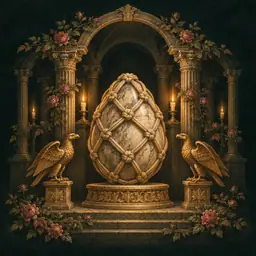
Zeus, wishing to find the middle of the earth, loosed two eagles from its two ends, and where they met, at Delphi, was the centre. The spot was marked by the omphalos, the navel, a stone shaped like a rounded cone and wrapped in a net of woollen bands, with golden eagles beside it.
Another stone at Delphi carried an older story. Hesiod tells that when Rhea saved the infant Zeus from his father Kronos, who swallowed his children, she gave Kronos a stone wrapped in swaddling bands in his place; when Kronos was made to cast it up, Zeus set it at Pytho below Parnassus as a sign and a wonder for mortals. Pausanias saw a small stone near the temple that the Delphians anointed with olive oil every day and covered with raw wool at every festival, and they told him it was that stone.
The spring and the Sacred Way
The inquirer went first to the Castalian spring, in its cleft between the two great cliffs called the Shining Rocks, and washed there, as did the Pythia and the priests. Then he climbed the Sacred Way, which zigzags up the slope past the treasuries, small buildings shaped like temples in which Greek cities kept their offerings and proclaimed their victories; the Athenians, it was said, built theirs from the spoils of Marathon. Before the temple stood the thank-offering of the Greeks who beat the Persians at Plataea, a gold tripod on a bronze column of three twisted serpents, with the names of the cities that fought written on its coils. The gold is long gone, but the bronze column, carried off to Constantinople, still stands in the old Hippodrome of Istanbul.
Know thyself
In the porch of the temple were carved sayings ascribed to the Seven Sages, and two became the god's own counsel to all who came: Know thyself, which is to say know that you are mortal and not a god, and Nothing in excess. There was also a single letter, E, set up first in wood, then in bronze and at last in gold.
Plutarch, who served Apollo as a priest at Delphi, wrote a dialogue on what the letter meant. One speaker takes it as the number five, a number of order and wisdom; another as the Greek word ei, if, with which every question to the god begins; and the last as ei in its other sense, thou art. The god greets each visitor with Know thyself, and the visitor answers him, Thou art: you alone truly are, while we come and go.
The day of consultation
On the day the oracle sat, the priests first sprinkled a goat with cold water. If it trembled through all its limbs the god consented, and if not, there was no oracle that day. The inquirer paid the fee, a sacred cake called the pelanos that in time became a sum of money, and sacrificed at the altar. Cities and men honoured by Delphi held the right to ask first, the promanteia; the rest went in by lot, as the custom was.
The Pythia, a woman of Delphi, bathed at the spring, burned laurel leaves and barley meal on the temple hearth, and went down into the adyton, the inner shrine, where the tripod stood beside the omphalos. Seated on the tripod with a sprig of laurel in her hand, she spoke as the god moved her, and the priests called prophetai gave the answer to the inquirer, often in verse. Pausanias was told of a spring, Kassotis, whose water ran beneath the shrine and made the women there prophetic.
In later times the Pythia was a woman over fifty dressed as a maiden, after a young Pythia had been carried off by a man who came to consult; and at the height of the oracle's fame there were three, two serving in turn and one held in reserve.
What the god answered
The replies the Greeks remembered teach one lesson: the god's word is true, and the hearer's reading of it is the test. Herodotus tells that Croesus, king of Lydia, tried the oracles by sending to ask, on the hundredth day after his envoys left, what he was doing at that hour; Delphi answered that it smelled a tortoise boiling with lamb's flesh in a pot of bronze, and that was Croesus' strange task that day. Then he asked whether to march on Persia and was told that if he did, he would destroy a great empire. He marched, and the empire he destroyed was his own.
When the Persians came against Athens, the Pythia first told the Athenians to flee to the ends of the earth; sent back as suppliants, they were told that only a wooden wall would not be taken, and that divine Salamis would bring death to the children of women. Themistocles read the wooden wall as the fleet, and the Athenians took to their ships and won at Salamis. When Chaerephon asked whether any man was wiser than Socrates, the Pythia answered that none was, and Socrates, as Plato tells it, spent his life testing the answer and found that his wisdom lay in knowing that he did not know.
Dionysus in the winter
Apollo did not keep Delphi all the year. In the three winter months, it was said, he went away to the Hyperboreans, the blessed people beyond the north wind, and Dionysus ruled in his place: the paean, Apollo's hymn, fell silent, and the dithyramb of Dionysus was sung instead. In those months the Thyiades, women of Athens and of Delphi, climbed Parnassus by night to dance for Dionysus on the heights above the Corycian cave, the great cavern sacred to Pan and the nymphs.
The Pythian Games
Every four years the Greeks gathered at Delphi for the Pythian Games, held in memory of Apollo's victory over the serpent. Music came first, as was fitting for the god of the lyre: singers to the lyre, players of the pipe, and the Pythian piece for the pipe, which told the fight with the dragon in five parts, from the god's first look at the field to the hissing of the dying serpent. Then came the races in the stadium high above the temple and the chariot races on the plain below. The prize was a crown of laurel.
The last answer
A late tale tells that the emperor Julian, who wished to bring back the old gods, sent his physician Oribasius to Delphi, and the reply came back that the bright-built hall had fallen, that Phoebus had no shelter now, no prophetic laurel and no speaking spring, and that the water of speech was quenched. It is told as the oracle's farewell, and it is told as legend.
How it is practised
Delphi is an archaeological site and a museum, open by ticket, and no oracle sits there now. A visitor climbs the Sacred Way as an inquirer did, past the treasuries to the temple terrace, then on to the theatre and the stadium above. The climb is steep and the stone is slippery, so wear shoes with grip and go early in summer. In the museum a later copy of the omphalos stands near the bronze Charioteer. The house suggests one thing to carry up the hill in place of a question about the future: the question of what is already known and not yet admitted.
Where it comes from
The sanctuary was drawing visitors from across Greece by the eighth century BCE. At first the Pythia answered on one day a year; later on one day a month, and not in the three winter months, when Apollo was held to be away. The treasuries that Greek cities built along the Sacred Way show how much rode on her word. The historian Herodotus records many replies, some of them famously two-edged, and the writer Plutarch, who served as a priest at Delphi about 100 CE, discussed why the oracle had grown quiet. The Christian emperor Theodosius closed the pagan sanctuaries in the 390s CE. French archaeologists began to uncover the site in 1892, moving a whole village to do it.
What is known, and what is not
That the oracle worked as described is well attested by ancient writers and by inscriptions. How the Pythia came to her state is not settled. Ancient authors spoke of a vapour rising in the temple; the first excavators found no cleft in the rock and dismissed it. In 2001 a geologist and an archaeologist reported two faults crossing beneath the temple and traces of ethylene in a nearby spring; other scientists replied that the amounts were far too small. Nothing shows that any reply foretold what could not have been guessed.
Its words

Ask the Oracle further
How did a consultation at Delphi go, step by step?Did a vapour really rise under the temple at Delphi?
Before you practise
The Oracle tells what is known of a sacred place, who built it and when, and names what is only claimed of it. No instrument has found the “energy” of ley lines or vortices. A holy place of a living faith has rules of its own for visitors. Do not trespass, and do not go to a remote place alone.
Its other branches
Stonehenge and the stone circlesThe pyramids of GizaThe labyrinth of ChartresThe pilgrim roadsLey linesFeng shui and vastuThe whole artSearch the tree

