
Ley lines
Old straight tracks proposed in 1921, and made into lines of energy only in the 1960s.
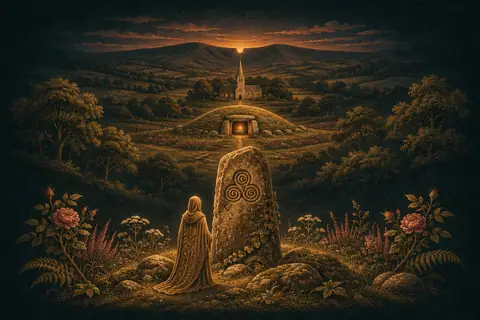
What are ley lines, who proposed them, and has anything ever been measured?
What it is
Ley lines are straight lines drawn on a map through old places: standing stones, burial mounds, hill forts, churches built on older sites, fords and crossroads. The claim has two forms that should be kept apart. In the first, of 1921, they are the lines of prehistoric tracks, sighted from hilltop to hilltop. In the second, of the 1960s, they are channels of an unseen energy in the land, which dowsers say they can feel and which is said to be strongest where lines cross; one such line is drawn through the tower on Glastonbury Tor in Somerset. The second form is the one most people now mean, and it has spread to other countries under other names, among them the vortices of Sedona in Arizona.
The teaching
As Alfred Watkins's The Old Straight Track (1925), with the earth-mystery writers after him teaches it.
The old straight track
Watkins's teaching starts from one plain idea. Before there were roads, a traveller crossing a wild, half-wooded country needed a straight course to reach the few things that had to be fetched from afar, salt, flint and later metals, and the human way to make a line straight is to sight along it, as a marksman lines up the back and fore sights of his rifle with the target. So, he taught, the earliest tracks of Britain were straight lines, laid out by skilled men from one high point to the next, and the line between was marked so that a walker at each mark could see the next.
The sighting points
The marks were of earth, water, stone and trees. Of earth were the mounds he calls tumps, known by many local names, bury, barrow, low, knoll, castle, and the notches cut in ridges so that the line could be sighted through them against the sky. Of water were the moats and ponds, which he held were dug on low ground to catch the light and flash it back to a watcher on the hill. Of stone were the mark stones, natural blocks ranging from a great boulder to one hardly bigger than a football, set by the way; many, he believed, lie now at the foot of churchyard and wayside crosses. Single trees and clumps of Scots pine were planted on the line, and holy wells stood on it or ended it.
In time the sighting points gathered other uses. Groups of tumps on hilltops were joined by banks into camps in years of war; castles were raised on tumps; homesteads and villages grew round the ponds and the stones; and the early Church built on the old sighting points, which had become places of veneration, so that ancient churches, he found, stand on the leys and often where two of them cross.
The names on the land
Place names, Watkins taught, keep the memory of the tracks. The line itself was the ley, and he found the word in farms and places along his lines; the countryman's advice to keep straight on was, he thought, once the rule of the ley. He read names in Cole and Cold as traces of the cole-man, the magician of the ley, whose cole-staff was his sighting staff, and names in Tot and Toot as marks of the sighting mounds. He saw the surveyor himself, the dodman, in the Long Man of Wilmington, the great figure cut in the chalk of a Sussex down, who holds a tall staff in each hand.
The traders' wares, he held, named their roads. The salt from the brine springs of Droitwich came to Hereford along a line of places called White, White House, Whitwick and Whitestone, and the white of those names, he held, is the white of salt; places called Gold marked the meeting points of the dealer in gold, and the Webtrees and Weobleys the way of the weaver.
Hunting a ley
His method is exact. Take the one-inch Ordnance map and ring every ancient church, moat, pond, castle, mound, camp, wayside cross, named crossroads, named stone, traditional tree and holy well. Set a pin in an undoubted sighting point, lay a straight edge against it and turn it until several of the ringed points fall exactly in line. Scrap any line that does not pass through at least four undoubted sighting points, roads apart. Then walk the line in the field, where pieces of the old track show, he said, as straight hollows in untilled ground and as fords where the line meets a river.
The makers of the leys, he guessed, were a class of trained surveyors, men of knowledge and so of power, perhaps the forerunners of the Druids; and when the system decayed their craft might have been remembered as witchcraft, the witch's broomstick a memory of the ley-man's staff.
The ley as a line of power
The second teaching keeps Watkins's lines and changes what they are. In John Michell's The View Over Atlantis the leys are channels of a living energy in the earth, the same, he wrote, as the lung mei, the dragon currents of Chinese geomancy, and an ancient society laid them out across the land to gather and guide that power, setting stones, mounds and holy places on its lines.
Michell found the dragon in English names and legends. The many hilltop churches of Saint Michael and Saint George, the dragon slayers, mark in his reading the places where the old current was tamed, and he drew the longest of the lines, the Saint Michael line, from Saint Michael's Mount in Cornwall across southern England, through Glastonbury Tor and the stones of Avebury, to the Norfolk coast, on the path of the sunrise of early May. Later dowsers walked that line with rods and reported two currents winding about it, one called Michael and one Mary, a male and a female flow that cross at the great sites, Glastonbury Tor and Avebury among them.
The dowsers' lines
The dowsers teach that the energy can be felt. Guy Underwood, a Wiltshire dowser, held that beneath every ancient site lie lines of an earth force that a dowser's rod picks up: water lines, track lines, and spirals he called blind springs, coiled under the centres of stone circles and the altars of old churches. Later dowsers speak of a ley energy strongest where lines cross and at the stones themselves, and trace it with angle rods or a pendulum. This is the dowsers' own account of what they feel, and it is theirs alone.
Vortices and power spots
The idea has travelled far from the English map. At Sedona in Arizona the red rocks are taught as vortices, places where the energy of the earth swirls and gathers, named by the psychic Page Bryant: Bell Rock, Cathedral Rock, Airport Mesa and Boynton Canyon among them. Some are called rising or masculine, lifting the spirit, and others inflowing or feminine, drawing it inward, and visitors come to sit, meditate or walk there; the twisted junipers on the rocks are pointed to as the energy's mark. The trails are steep and the desert hot, so walkers there carry water and keep to the marked paths. In the same way old holy places across the world are now called power spots.
Spirit lines and corpse roads
A third reading, taken up by Paul Devereux after years of editing The Ley Hunter, turns from energy to belief. Many peoples held that spirits travel in straight lines. In the Netherlands medieval death roads, the doodwegen, run straight across the heath to the graveyards; in Britain the dead were carried to church along corpse roads where the living did not linger; and in Ireland a house built across a fairy path was held to have no luck. The straight lines of the old world, in this reading, are the roads of the dead and of the spirit's flight, and the ley is a line of the mind laid on the land.
China holds the same belief from the other side. In the art of wind and water, good breath flows in curves and harmful breath runs straight, and spirits are thought to travel only in straight lines; so a screen wall stands inside the gate of a courtyard house, and bridges in Chinese gardens zigzag across the water, to turn them away. The dragon currents that Michell likened to leys are, in the Chinese books, the winding ridges of mountains, never ruled lines.
How it is practised
The honest way to try the idea is with a map and a ruler. Mark every old site in a district, then count how many lines pass through three or more. Then scatter the same number of dots at random and count again: the reader who does this finds that chance gives lines too. To walk a supposed ley, keep to public paths and rights of way, for a line on a map gives no right to cross a field. A hilltop, a stone and a clear evening are worth the walk for their own sake.
Where it comes from
Alfred Watkins, a Hereford businessman and photographer, noticed the alignments on a map in June 1921 and set out his idea in The Old Straight Track in 1925. He meant trade roads and nothing mystical. Archaeologists of his day rejected them: the sites on his lines were thousands of years apart in age, and a straight line is a poor way to cross hills. In the 1960s writers linked the lines first to the flight of unknown craft and then, in John Michell's The View Over Atlantis of 1969, to earth energies and to the dragon paths of Chinese feng shui. A project begun in 1977 at the Rollright Stones set out to measure such energies and reached no settled result.
What is known, and what is not
That old sites sometimes fall in line is true, and with enough points on a map it is expected: statisticians showed in the 1970s and 1980s that alignments like those of Watkins are no more than chance supplies. Some prehistoric peoples did build straight works, such as the long earthen avenues of Stone Age Britain. No instrument has detected an energy along a ley, and in controlled trials dowsers have done no better than chance.
Its words
 Ley Lines
- Straight lines drawn through old sites on a map: prehistoric tracks to the man who proposed them in 1921, channels of energy to later writers.
- Glastonbury Tor
- A steep terraced hill in Somerset with a lone church tower on top. Legend has called it Avalon since the twelfth century; the spade found a settlement of the fifth to seventh.
- Sedona Vortex
- One of several red rock sites near Sedona in Arizona, named in 1980 as points of earth energy. People report calm there; no instrument has found anything unusual.
Ask the Oracle further
What did Alfred Watkins really mean by ley lines in 1921?Are the vortices of Sedona and other power spots measurable?
Before you practise
The Oracle tells what is known of a sacred place, who built it and when, and names what is only claimed of it. No instrument has found the “energy” of ley lines or vortices. A holy place of a living faith has rules of its own for visitors. Do not trespass, and do not go to a remote place alone.
Its other branches
Stonehenge and the stone circlesThe pyramids of GizaDelphiThe labyrinth of ChartresThe pilgrim roadsFeng shui and vastuThe whole artSearch the tree

