

Mystical systems
Henge
Direct answer
Henge: A henge is a round or oval earthwork of the late Stone Age in Britain and Ireland, with a ditch dug inside its bank and one or more entrances.
$0 today, then $19/month after 7 days. Cancel anytime.
At a glance
- Found in
- Mystical Systems
- Related
- Stonehenge, Megalith, Newgrange
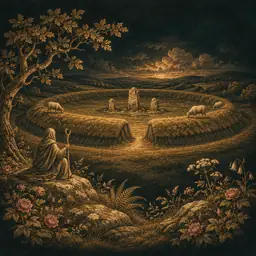

A henge is a round or oval earthwork of the late Stone Age in Britain and Ireland, with a ditch dug inside its bank and one or more entrances.
A lineage map for books and systems; it avoids presenting symbolic traditions as literal fact.
Understand the chapter you are in.
Your life’s turning points, measured from your birth.
Walk through Alex’s whole example first


Prefer to explore first?
 The Road of AgesThe turning points of your whole life, from your own chart
Walk my road
Is Stonehenge a henge?
A henge is an enclosure, not a ring of stones. Its makers dug a circular ditch and piled the spoil in a bank on the outer side, leaving one, two or four gaps to enter by. A ditch inside a bank is useless for defence, so the earthwork seems made to mark ground off, or to keep something in.
Some henges held circles of timber posts or of stones, and some held nothing that survives. They range from a few metres across to the great enclosures of Avebury and Durrington Walls, hundreds of metres wide. They are found only in Britain and Ireland and date from about 3000 to 2000 BCE.
On the tree of the hidden arts: Sacred places.
What sets Henge apart
The telling detail of a henge is the order of its earthwork: ditch within, bank without. A fort is dug the other way round, to keep attackers out. Turned inward, the ditch makes a boundary that is crossed only at the entrances, and people on the bank could look down on whatever went on inside. Several henges were dug around timber or stone circles that already stood, so the earthwork closed a place that was sacred before it.
- Coined: by Thomas Kendrick in 1932, from the name Stonehenge
- Date range: about 3000 to 2000 BCE
- Found in: Britain and Ireland only
- Largest: Durrington Walls in Wiltshire, about 500 metres across
- Entrances: one, two or four gaps through bank and ditch
Often mistaken for something else: A stone circle is a ring of standing stones; a henge is the round bank and ditch, and many henges never held stones at all.
The story behind Henge
The word was coined in 1932 by the archaeologist Thomas Kendrick, who took it from the name Stonehenge, itself from Old English words for stone and for hanging or hinge. By his own definition Stonehenge is not a true henge, since its bank lies inside its ditch. Aerial photographs of the 1920s revealed Woodhenge, a henge of timber posts near Stonehenge, and many more have been found from the air since.
Why Henge matters
The term separates the earthwork from whatever stood inside it, which lets circles of wood, stone and bare ground be compared.
How to read Henge
Archaeologists call a site a henge when the ditch runs inside the bank; a ring of stones without that earthwork is a stone circle.
Henge in practice: an example
At Avebury a visitor can walk the top of the bank and look down into the ditch on its inner side, which is what makes it a henge.
Where readings of Henge go wrong
A henge bank is an ancient earthwork that wears away under feet and bicycles: keep to the paths the keepers have laid.
Sources and editorial method
This entry summarizes the tradition in the Almanac's own words; where no source is listed, it is an editorial summary rather than a primary text, and symbolic readings are named as the tradition's, not as fact.
- Source
- The Great Almanac Dictionary
- Category
- Mystical Systems
- Aliases
- henge monument, henges, henge meaning, what is a henge, neolithic henge
- Last updated
- 2026-09-26
See Henge in your personal almanac
A definition tells you what it is; your own birth chart tells you what it means for you. The Oracle casts your real chart and answers for your love, your work, and your year ahead, in conversation. It opens with the 7-day Oracle trial.
Speak with the OracleRelated terms
More in Mystical Systems
From the reference page to your own chart
Every word here
is in your own chart.
- Your life’s turning points, measured from your birth
- A practical next step to consider
- It opens with 7 days free: the AI Oracle on thirty hidden arts, and your daily horoscope
$0 today, then $19/month after 7 days. Cancel anytime.
Common questions
Is Stonehenge a henge?
Not strictly. The word was taken from its name, but a true henge has its ditch inside its bank, and at Stonehenge the main bank lies inside the ditch.
What were henges for?
Nobody knows for certain. They were not forts or houses. Finds of feasting debris, burials and carefully placed objects suggest gatherings and ceremonies held at set times of year.
Where is the largest henge?
Durrington Walls, about three kilometres from Stonehenge, is roughly five hundred metres across. Avebury, some distance to the north, encloses the widest stone circle in Britain.


