
The third eye
The brow centre in the tradition, and the pineal gland in the modern retelling.
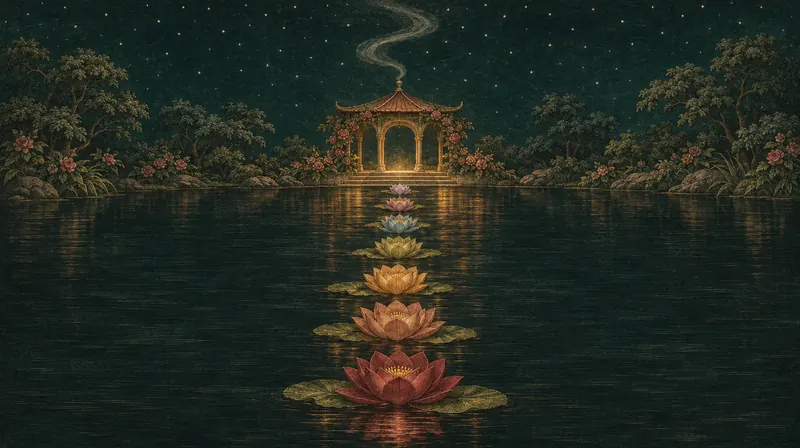
What is the third eye in the chakra tradition, and what is said of the pineal gland?
What it is
The third eye is the brow centre, ajna, which the tantric texts place between the eyebrows and picture as a lotus of two petals. Ajna means command: it is where the teacher's instruction is said to be received. In Hindu myth the god Shiva has a third eye in his forehead that burns desire to ash. Modern writers identify the centre with the pineal gland, a small organ deep in the brain, and speak of opening it.
The teaching
As the tantric teaching of the ajna lotus, with the Bhagavad Gita teaches it.
Ajna, the place of command
In the tantric map the third eye is ajna, the sixth centre, between the eyebrows. Its name means command, and the commentary says it is so called because there the command of the teacher is received from above. It is a lotus of two petals, white as the moon, bearing the letters ha and ksha.
It stands beyond the five elements, which end at the throat. Its seed syllable is OM, and it is the seat of manas, the mind, the faculty that gathers what the senses bring and thinks it over. To rest the attention here is to rest it where, in this map, thinking itself sits.
Where the three channels meet
Here the three chief channels meet: ida from the left, pingala from the right and sushumna in the middle. The texts liken them to the three holy rivers, the Ganga, the Yamuna and the hidden Sarasvati, and the place between the brows to their meeting at Prayag, where pilgrims bathe. In the language of the map, to bring the breath of left and right together into the middle is to arrive at this confluence, where the mind is still.
The eye of Shiva
In Hindu myth the third eye belongs to Shiva. When the gods sent Kama, the god of desire, to stir the great ascetic from his meditation, Kama loosed a flowered arrow at him. Shiva opened the eye in his forehead, and its fire burned Kama to ash. Shiva was won at last not by desire but by the austerity of the goddess Parvati, and Kama lives on without a body, as desire does.
The myth gives the eye its meaning. It is the eye of wisdom, which sees through desire and burns away what is false. In images Shiva's third eye is drawn upright in the middle of his forehead.
The mark on the brow
The brow is marked in worship. Hindus wear a tilaka, a mark of sandal paste, ash or coloured powder, between the eyebrows, its shape telling the wearer's tradition: three level lines of ash for the devotees of Shiva, an upright mark shaped like a U for the devotees of Vishnu. Many women wear the red dot, the bindi.
In Buddhism a curl of white hair between the Buddha's brows, the urna, is one of the marks of a great being, and in the Lotus Sutra a ray of light shines from it, lighting thousands of worlds. In both faiths the place between the brows is where the holy is shown.
The gaze of the Gita
The Bhagavad Gita teaches the meditator to hold the body, head and neck erect and still, and to look towards the tip of the nose without looking about. Of the sage who shuts out the outer world it says that he rests the gaze between the brows and makes even the breaths that move in and out within the nostrils. And of the hour of death it says that one who, with a steady mind and the strength of yoga, brings the breath of life to rest between the brows goes to the highest.
In each case the brow is a place of gathering: the scattered attention and the moving breath are drawn together there. The gaze is a direction for the attention, not a strain of the eyes.
The seal of Shiva
The Hatha Yoga Pradipika teaches a seal named for Shiva, shambhavi: the attention is held within while the eyes look outward without seeing, half open and still, resting on nothing. The text prizes it above much learning, and says it is to be guarded closely. It is the opposite of staring. The eyes are open, but nothing is looked at. The house keeps only its gentle core: that the attention can rest at the brow while the eyes stay soft and blink as they will.
The modern third eye
Modern Western books teach the brow centre as an organ of inner sight, a faculty of intuition and clairvoyance that can be opened, and they identify it with the pineal gland in the middle of the brain; they colour it indigo and offer pictures of light at the brow to awaken it. That is the modern teaching, not the old one.
In the tantric texts the brow is the seat of the mind and the place where the teacher's command is received, and the insight that belongs to it comes from the whole long discipline, the restraints, the steady seat, the quiet breath and years of attention, not from a technique applied to one spot.
Resting at the brow
A reader can rest the attention at the brow as at any other place. Sit upright, breathe slowly and easily through the nose, close the eyes or lower them, and let the attention settle lightly between the eyebrows for a few minutes, without frowning, without turning the eyes up or inward, and without straining to see anything. That is all.
Nothing is stared at, least of all the sun, and nothing is taken to open anything. If pressure, heat or an ache builds in the forehead, as it does when attention is pressed rather than rested, move the attention down to the heart or the belly and end there.
How it is practised
In the tradition the brow is a place to rest the attention, as the chest or the belly is. A reader sits, breathes slowly and easily, and lets the attention settle lightly between the eyebrows for a few minutes, without frowning or straining the eyes. That is all. Nothing is stared at, least of all the sun, and nothing is taken to open anything. Insight in the old texts comes from the long discipline, not from a technique for one spot.
Where it comes from
The brow centre is described in the medieval tantric texts. The link with the pineal gland is Western. Descartes, in the seventeenth century, called that gland the principal seat of the soul, and Helena Blavatsky, in The Secret Doctrine of 1888, wrote that it was the remnant of a lost third eye. In 1958 Aaron Lerner isolated its hormone, melatonin, which helps set the daily rhythm of sleep. Talk of decalcifying the gland spread online in this century.
What is known, and what is not
The pineal gland is real, makes melatonin and responds to light that reaches it by way of the eyes; in some lizards and in the tuatara a related organ is a true light-sensing eye on top of the head. Deposits of calcium in the human gland are common with age. Nothing shows that they block any faculty, that fluoride closes a third eye, or that any practice opens one. Rick Strassman's idea that the gland releases DMT remains a hypothesis.
Its words
- Third Eye
- The brow centre, ajna, placed between the eyebrows in the tantric map. Modern writers identify it with the pineal gland.
Ask the Oracle further
Did Descartes really call the pineal gland the seat of the soul?What did opening the third eye mean in the tantric tradition?
Before you practise
These are maps of attention from the yogic traditions, not anatomy. Keep to slow, gentle breathing while seated; never breathe forcefully or hold your breath in water or at the wheel, or at all if you are pregnant or have a heart condition, epilepsy, or a history of panic, psychosis or mania. If practice brings frightening states or sleepless nights, stop and see a doctor.
Its other branches
Where the chakras come fromThe seven centresGentle breathKundaliniThe whole artSearch the tree

