
Where the chakras come from
The tantric maps of India, and the modern seven colours.
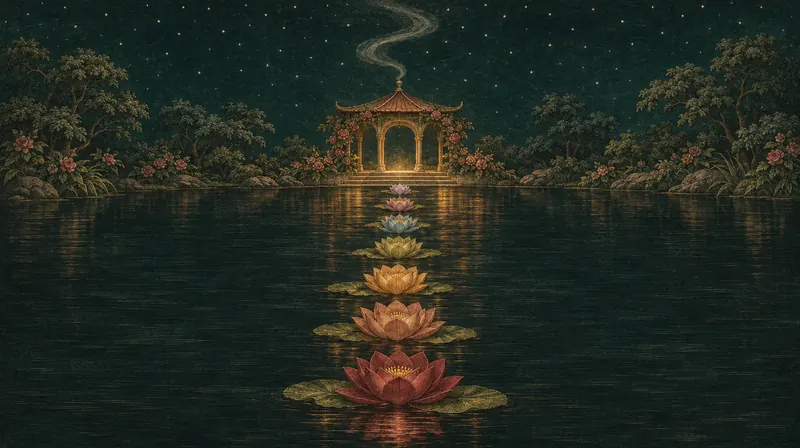
Where do the chakras come from, and how old is the seven-colour system?
What it is
A chakra, Sanskrit for wheel, is a point along the body's axis where a meditator rests the mind. The tantric texts picture each as a lotus with a set number of petals, a seed syllable, an element and a deity, and they describe channels, the nadis, among them the side pair called ida and pingala, through which the life-breath moves. The whole is called the subtle body. Vedanta has a map of its own, the five sheaths or koshas. It was a set of instructions for visualisation, different in each school, and not a description of organs.
The teaching
As the yogic and tantric texts of the subtle body teaches it.
The subtle body
The yogic and tantric texts teach that a person is more than flesh. Vedanta speaks of three bodies: the gross body, made of food; the subtle body, of breath, mind and senses; and the causal body, the seed of the other two. The Taittiriya Upanishad speaks instead of five sheaths, one inside another: of food, of breath, of mind, of understanding and of bliss.
The chakras belong to the subtle body, the body of breath and mind. They are not organs to be found with a knife. They are places where the texts direct the meditator's attention, pictured in detail so that the mind has something to rest on.
The world within the body
The tantras teach that the body is the world in small. The Shiva Samhita finds everything within it: the spine is Mount Meru, the axis of the world, and the body holds islands, seas, rivers, mountains and fields, the stars and the planets, the places of pilgrimage and their gods, and the sun and the moon. The three chief channels are the three holy rivers, Ganga, Yamuna and Sarasvati. So worship can be made within the body as well as at a shrine, and the one who comes to know the body comes to know the world.
Prana and the five winds
Through the subtle body moves prana, the breath of life. The Upanishads tell how the powers of a person once quarrelled over which was greatest; when breath rose to leave, all the others were dragged out with it, as the bees of a hive follow their leader when it flies, and they gave way.
The texts divide prana into five winds by their work. Prana itself dwells in the chest and draws breath in. Apana dwells in the lower body and moves downward and out. Samana dwells at the navel and evens out and digests what is taken in. Udana dwells in the throat and rises, carrying speech, and at death carrying the self upward. Vyana pervades the whole body and moves through all its channels. The practitioner learns them first as names for what the breath and the body already do.
The channels
The winds move in channels, nadis. The hatha texts count seventy-two thousand of them; the Prashna Upanishad counts a hundred and one channels of the heart, each branching a hundred times, and each of those seventy-two thousand times. Three are chief. Ida runs on the left, pale and cool, and is called the moon. Pingala runs on the right, red and hot, and is called the sun. Between them, within the spine, runs sushumna, the central channel, and within it, the Sat-Chakra-Nirupana says, lie finer channels one inside another, the innermost as fine as a spider's thread.
Ida and pingala end at the left and right nostrils. Some pictures show them crossing at each centre as they rise, others running straight beside the spine. In ordinary life, the texts say, the breath flows through ida and pingala, now more through one nostril and now through the other, and the mind wanders with it. The yogi's aim is a breath that flows evenly, and at last enters the central channel, where the mind grows still.
The wheels and their lotuses
Where channels gather along the central channel, the texts place a chakra, a wheel, and they picture it as a lotus whose petals are the channels spreading out from it. Each lotus has its number of petals, a letter of the Sanskrit alphabet on every petal, a shape for its element, a seed syllable, a god and a goddess. While the power at the base of the spine sleeps, the lotuses hang their heads; as she passes through them, they turn upward and open.
The letters show what the lotuses are made of. The six lotuses below the crown have four, six, ten, twelve, sixteen and two petals: fifty in all, the whole alphabet. The tantras call the letters the mothers, matrika, because every word and every mantra is born from them, and they place them on the petals so that the subtle body is a body made of sound.
The schools count differently
The Buddhist tantras, such as the Hevajra, teach four wheels: at the navel a wheel of sixty-four spokes, at the heart one of eight, at the throat one of sixteen and at the crown one of thirty-two, named for emanation, for the teaching, for enjoyment and for great bliss. The Hindu text best known today, the Sat-Chakra-Nirupana, teaches six with the thousand-petalled lotus above them. Other Hindu texts add more, among them a small eight-petalled lotus of the heart just below the heart centre, where the devotee pictures the chosen deity beneath a wishing tree.
Each count serves its own practice, and within its school none is wrong. Modern Western books teach a single system of seven, with the rainbow colours from red at the root to violet at the crown and a part of a person's life for each; the seven are taught one by one in the next branch, with the old description and the modern meaning side by side.
How the map is used
In the tantric rites the map is used in three ways. In dharana, holding, the meditator fixes the attention on one place, the navel, the heart, the throat or the brow, and pictures its lotus there. In nyasa, placing, the letters are laid on the body by touch and mantra, so that the body is made holy before worship. In bhuta shuddhi, the cleansing of the elements, the worshipper pictures each element dissolving into the next finer one, earth into water and so on up to the mind, and then pictures a pure body arising, ready to worship. All three are done in the imagination, and they are learned within a teacher's line.
A reader can take the first and simplest use. Sit upright, breathe slowly and gently through the nose, and rest the attention at one place, the centre of the chest for instance, for a few minutes, noticing what is felt there without trying to change it. Nothing is forced and the breath is never held. If sitting brings fright or sleepless nights, stop, and see a doctor.
How it is practised
Read as a map of attention, the practice is plain and seated. A reader sits upright, breathes slowly and gently through the nose, and rests the attention at one place, the centre of the chest for instance, for a few minutes, noticing what is felt there without trying to change it. Nothing is forced and the breath is never held. If sitting brings fright or sleepless nights, the art's caution is to stop and see a doctor.
Where it comes from
Systems of wheels appear in Buddhist and Hindu tantric texts from about the eighth century, with four, five, six or more centres. The scheme of six with a seventh at the crown was set out by Purnananda in 1577 and reached English in Woodroffe's The Serpent Power in 1919. Theosophists such as Leadbeater added clairvoyant colours and links to nerve plexuses and glands. Kurt Leland's history traces the rainbow colours and the psychological meanings to the 1970s.
What is known, and what is not
The texts and their dates are documented, and so is the modern history of the seven-colour system. No dissection or scan has found a chakra or a nadi, and devices sold to photograph or measure them do not do so. The matches between centres and nerve plexuses or glands were proposed by Western writers and are not in the tantric sources. The acupuncture meridians of Chinese medicine are a separate map, and anatomy has not found them either. Reiki, a Japanese practice of light touch founded in 1922, speaks of a like energy, and reviews of its trials have not shown that it treats any condition.
Its words
- Chakra
- Sanskrit for wheel: a point along the body's axis where a meditator rests the mind, pictured in the tantric texts as a lotus.
- Subtle Body
- The body of channels, breaths and centres that yogic and tantric texts describe within the physical one. A map for practice, not anatomy.
- Nadi
- A channel of the subtle body through which prana is said to flow. The texts count thousands and name three as chief.
- Ida and Pingala
- The two side channels of the yogic map: ida on the left, called lunar, and pingala on the right, called solar, flanking the sushumna.
- Kosha
- A sheath: Vedanta teaches five, of food, breath, mind, understanding and bliss, as layers a student looks through in search of the self.
- Acupuncture Meridians
- The channels along which Chinese medicine says qi travels: twelve regular and eight extraordinary. A traditional model that anatomy has not found.
- Reiki
- A Japanese practice of light touch founded by Mikao Usui in 1922. Reviews of its trials have not shown it to treat any condition.
Ask the Oracle further
Did the old tantric texts count seven chakras, or other numbers?Who gave the chakras their rainbow colours, and when?
Before you practise
These are maps of attention from the yogic traditions, not anatomy. Keep to slow, gentle breathing while seated; never breathe forcefully or hold your breath in water or at the wheel, or at all if you are pregnant or have a heart condition, epilepsy, or a history of panic, psychosis or mania. If practice brings frightening states or sleepless nights, stop and see a doctor.
Its other branches
The seven centresGentle breathKundaliniThe third eyeThe whole artSearch the tree

