
The seven centres
From the root to the crown, one by one.
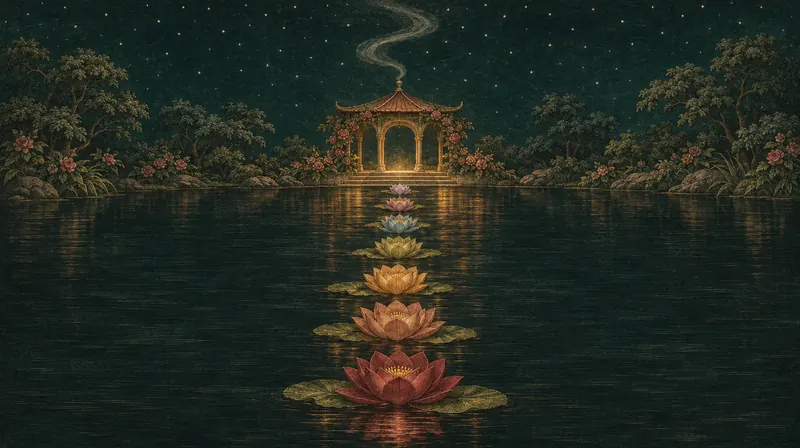
What are the seven chakras, one by one?
What it is
The familiar list has seven. Muladhara, the root, sits at the base of the spine and belongs to earth. Svadhisthana, below the navel, belongs to water. Manipura, at the navel, belongs to fire. Anahata, at the heart, belongs to air. Vishuddha, at the throat, belongs to space. Ajna, between the eyebrows, is the seat of command. Sahasrara, the thousand-petalled lotus, is at the crown. They are strung along the central channel, the sushumna. The hatha texts also tie three knots in that channel, the granthis, which the rising power is said to pierce.
The teaching
As Purnananda's Sat-Chakra-Nirupana, as Arthur Avalon gave it in The Serpent Power teaches it.
The order of the lotuses
Six centres stand one above another along the central channel, from the base of the spine to the brow, and the lotus of a thousand petals stands above them at the crown, beyond the six. The text gives each in the same order: its name and place, its petals and their letters, the shape and seed syllable of its element, the animal that bears the seed, its god and its goddess, and the sense that belongs to it.
The elements rise from the densest to the finest, earth, water, fire, air and space, and above them the mind; the senses rise with them, smell, taste, sight, touch and hearing. The colours given here are the text's own. Western books of the last century give the rainbow instead, with a meaning in a person's life for each centre; that later teaching is noted at the end of each lotus, so that the two are not confused.
Muladhara, the root support
Muladhara lies at the base of the spine, between the anus and the genitals. It is a crimson lotus of four petals, bearing four letters, from va to sa, in gold. In its centre is the yellow square of earth with its seed syllable lam, borne by the elephant Airavata. Its god is Brahma the creator, pictured as a child, and its goddess is Dakini. Within the square, inside a downward-pointing triangle, stands the self-born linga of Shiva, and around it Kundalini sleeps, coiled three and a half times, covering with her mouth the door of the central channel. The sense of earth is smell. The modern books make this the centre of safety and grounding, and colour it red.
Svadhisthana, one's own abode
Svadhisthana lies at the root of the genitals. It is a vermilion lotus of six petals, bearing six letters, from ba to la. In it is the white crescent moon of water, the realm of the water god Varuna, with the seed syllable vam, borne by the makara, a creature of the sea. Its god is Vishnu, dark blue and dressed in yellow, and its goddess is Rakini. The sense of water is taste. The modern books make it the centre of pleasure, desire and creativity, and colour it orange.
Manipura, the city of jewels
Manipura lies at the navel, and is named for the fire within it, which makes it shine like a gem. It is a lotus of ten petals the colour of heavy rain clouds, bearing ten letters, from da to pha. In it is the red triangle of fire, marked with three svastikas, the old sign of good fortune, with the seed syllable ram, borne by a ram. Its god is Rudra, red and smeared with white ash, and its goddess is Lakini. The sense of fire is sight. The modern books make it the centre of will and personal power, and colour it yellow.
Anahata, the unstruck
Anahata lies at the heart, and is named for the sound the sages hear there, a sound made without any two things striking. It is a lotus of twelve petals the colour of the bandhuka flower, a deep red, bearing twelve letters, from ka to tha, in vermilion. In it is the smoke-coloured six-pointed figure of air, two triangles interlaced, with the seed syllable yam, borne by a black antelope. Its god is Isha, the Lord, and its goddess is Kakini. A second linga, called Bana, stands here, and the individual self shines beside it like the steady flame of a lamp. The sense of air is touch.
Just below this lotus the texts place a small lotus of eight petals, the heart's own, where the devotee pictures the chosen deity seated beneath a wishing tree. The modern books make Anahata the centre of love and compassion, and colour it green.
Vishuddha, the purified
Vishuddha lies at the throat. It is a lotus of sixteen petals of a smoky purple, bearing the sixteen vowels in red. In it is the white circle of space, like the full moon, with the seed syllable ham, borne by a white elephant. Its god is Sadashiva in the form that is half male and half female, half snow white and half gold, and its goddess is Shakini. The sense of space is hearing. The modern books make it the centre of speech and expression, and colour it blue.
Ajna, the command
Ajna lies between the eyebrows, and is named, the commentary says, because there the command of the teacher is received from above. It is a lotus of two petals, white as the moon, bearing the letters ha and ksha. It is beyond the five elements, which end at the throat: its seed is OM itself, and it is the seat of the mind. Within it is a triangle with a third linga, called Itara, and its goddess is Hakini. Here the left, right and central channels meet, as the three holy rivers meet at Prayag. The modern books make it the centre of insight and intuition, call it the third eye, and colour it indigo.
Sahasrara, the thousand-petalled
Above all six, at the crown of the head, is the lotus of a thousand petals, whiter than the full moon, its head turned downward, its petals bearing the fifty letters again and again, twenty times over. It is not counted among the six, because it is not one more station on the road but the place where the road ends. In it is the full moon, in the moon a triangle, and in the triangle the bindu, the point, and the great void, where Paramashiva, supreme Shiva, abides.
Here Kundalini, risen from the root, unites with Shiva, and the meditator's mind comes to rest beyond all its movements. The modern books make it the centre of unity and understanding, and colour it violet or white.
Walking the map
In the tradition each lotus is meditated on in full, with its letters, seed, god and goddess, by one initiated into that line, and a seed syllable is given by a teacher. A reader can walk the map with attention alone. Seated, with a slow and easy breath through the nose, rest the mind for a minute at each place in turn, from the base of the spine to the crown, and note one word for what is felt there: warm, tight, blank, nothing.
The list then becomes a way of asking where attention goes easily and where it does not. No centre is opened or closed by this, and nothing is pushed. If pressure, heat or an ache builds in the head, bring the attention down to the belly and the feet, and end there.
How it is practised
A reader can walk the map with attention alone. Seated, with a slow and easy breath, the mind rests for a minute at each place in turn, from the base of the spine to the crown, and a word is noted for what is felt there: warm, tight, blank. The list becomes a way of asking where attention goes easily and where it does not. No centre is opened or closed by this, and nothing is pushed.
Where it comes from
The Sanskrit names, petal counts and seed syllables come from texts such as the Sat-Chakra-Nirupana: four petals at the root, then six, ten, twelve, sixteen and two, and a thousand at the crown. The colours in those texts are not the rainbow. The modern meanings, safety at the root, then pleasure, will, love, speech, insight and unity, took shape in the twentieth century, through Jung's seminar of 1932 and books such as Anodea Judith's Wheels of Life in 1987.
What is known, and what is not
The names and symbols are attested in the texts. The psychological meanings are a modern layer, useful as a set of questions about a life and not as findings. Nobody can test whether a chakra is blocked or open, and anyone who offers to read or clear them for a fee is selling something that has not been shown to exist.
Its words
- Chakra
- Sanskrit for wheel: a point along the body's axis where a meditator rests the mind, pictured in the tantric texts as a lotus.
- Sushumna
- The central channel of the subtle body, said to run from the base of the spine to the crown, with the chakras strung along it.
- Granthi
- A knot: the hatha texts name three, of Brahma, Vishnu and Rudra, as places where the central channel is tied and must be pierced.
Ask the Oracle further
Which chakra is linked with speaking up, and where does that idea come from?What do the petals and seed sounds of each chakra stand for?
Before you practise
These are maps of attention from the yogic traditions, not anatomy. Keep to slow, gentle breathing while seated; never breathe forcefully or hold your breath in water or at the wheel, or at all if you are pregnant or have a heart condition, epilepsy, or a history of panic, psychosis or mania. If practice brings frightening states or sleepless nights, stop and see a doctor.
Its other branches
Where the chakras come fromGentle breathKundaliniThe third eyeThe whole artSearch the tree

