
Vedanta and non-duality
Shankara’s teaching that the self and the ground of all things are not two.
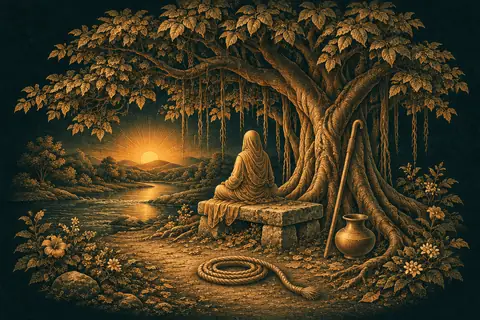
What does Advaita Vedanta teach about non-duality, and where does the teaching come from?
What it is
Vedanta means the end of the Vedas, and names the schools of Hindu thought built on the Upanishads. Advaita Vedanta, the non-dual school, teaches that the self, atman, and the ground of all that is, brahman, are not two. On this teaching the sense of being a separate person is a mistake of knowledge, compared to taking a rope for a snake in poor light, and freedom comes by seeing through it, not by going anywhere. Other schools of Vedanta disagree: Ramanuja taught a qualified non-dualism in which souls remain distinct within God, and Madhva a plain dualism. All three are living traditions with temples, monasteries and teachers.
The teaching
As Advaita Vedanta from the Upanishads to Ramana Maharshi teaches it.
Brahman
The Upanishads name the ground of all things brahman, and Advaita, the teaching of non-duality, takes them at their word. Brahman is being, consciousness and bliss, sat, chit and ananda: not a thing among things but what all things are. The Taittiriya calls it truth, knowledge and the infinite. Because it is beyond every description, the Brihadaranyaka speaks of it best by negation: neti, neti, not this, not this.
The four great sayings
Each of the four Vedas holds a sentence that the tradition calls a great saying, and together they are the heart of the teaching. Consciousness is brahman, from the Aitareya Upanishad of the Rig Veda. I am brahman, from the Brihadaranyaka of the Yajur Veda. That thou art, from the Chandogya of the Sama Veda. This self is brahman, from the Mandukya of the Atharva Veda. A teacher gives them to a prepared student, and the work of Vedanta is to understand them until they are not believed but known.
That thou art
In the Chandogya, Uddalaka teaches his son Shvetaketu with things at hand. He has him leave salt in water overnight and bring it back in the morning: the salt cannot be seen, but the water tastes of it at the top, in the middle and at the bottom. He has him break open the fruit of a banyan, then one of its tiny seeds, and asks what he sees; nothing, says the boy; from that subtle essence, says the father, the great tree stands. Rivers that flow into the sea no longer know which river they were. Each lesson ends the same way: that subtle essence is the self of all this; that is the real; that is the self; that thou art, Shvetaketu.
The rope and the snake
If the self is brahman, why does it seem a small and separate person? Shankara answers with superimposition, adhyasa. In poor light a rope is taken for a snake, and the fear, the jump and the racing heart are real though the snake never was. So the one consciousness, through ignorance, is taken for a body, a mind and a separate life. Other images say the same: silver seen in mother-of-pearl, water seen in a mirage. Knowledge does not destroy the rope; it ends the snake. Nothing has to be reached or made, only seen rightly.
Two levels of truth
For this reason the world is not called a nothing. Advaita distinguishes levels of reality. The absolute level is brahman alone. The practical level is the world of experience, of persons, duties and things, real for every practical purpose and to be lived in rightly. Below both is the merely apparent, like a dream or the snake in the rope. A half verse given to Shankara gathers the teaching: brahman is real, the world is appearance, and the individual self is none other than brahman.
The five sheaths
The Taittiriya Upanishad shows the self as if wrapped in five sheaths, from the outer to the inner. The sheath of food is the body. The sheath of breath is the life force that moves it. The sheath of mind is the stream of thought and feeling. The sheath of understanding is the intellect that judges and knows. The sheath of bliss is the deep joy known in dreamless sleep. The student is taught to see each in turn as something known, and so not the knower: the self is the witness of all five, and touched by none.
The fourfold readiness
The teaching is for a prepared student, and the tradition names four qualifications. Discrimination, viveka, between the lasting and the passing. Dispassion, vairagya, toward the fruits of action here and hereafter. Six virtues: calm of mind, restraint of the senses, withdrawal from needless activity, forbearance, faith in the teacher and the scriptures, and settledness of attention. And mumukshutva, the longing for freedom. The method assumes them, and it is carried on inside a life of duty and devotion.
Hearing, reflection and contemplation
The Brihadaranyaka says that the self is to be seen, to be heard of, to be reflected on and to be meditated upon, and the tradition makes these its method. Shravana is hearing the teaching from a teacher who knows the scriptures and stands in the truth. Manana is reflection, turning it over and testing it by reason until every doubt is answered. Nididhyasana is contemplation, abiding in what has been understood until the old habit of taking oneself for the body and mind wears away.
Free while living
The one who knows is free while still alive, a jivanmukta. The body goes on until the karma that made it is spent, but nothing binds: it is like a rope that has been burned, which keeps its shape and can tie nothing. The space inside a pot, the teachers say, was never different from the space outside it, and when the pot breaks nothing goes anywhere. So the self was never other than brahman, and freedom is not a journey but the end of an error.
The other schools
Not all Vedanta is non-dual. Ramanuja's qualified non-dualism teaches that brahman is the personal God, Vishnu, full of every good quality, and that souls and the world are real, related to God as a body to the soul that lives in it; freedom comes by devotion and surrender, and the freed soul serves God for ever, like Him in nature but never the same as Him. Madhva's dualism teaches five real differences: between God and souls, between God and matter, between one soul and another, between souls and matter, and between one piece of matter and another.
Who am I?
Ramana Maharshi taught a direct form of enquiry. Of all thoughts the first is the thought of I. When any thought arises, do not follow it but ask: to whom has it come? The answer is: to me. Then ask: who am I? Turned back toward its source, the I-thought subsides, and what remains is the self. The enquiry, he said, destroys all other thoughts and at last destroys itself, like the stick used to stir a funeral pyre, which is burned at the end with the rest. It is meant to quiet the mind, not to unsettle it, and anyone it unsettles should stop and speak to a teacher or a doctor.
How it is practised
The classical method has three steps: hearing the teaching from a qualified teacher, reflecting on it until doubts are answered, and steady contemplation of what has been understood. It assumes a prepared student, with calm, restraint and a serious wish for freedom, and it is traditionally carried on inside a life of duty and devotion. The self-enquiry of Ramana Maharshi, turning attention to the one who asks, is a later and simpler form. A reader can begin where the tradition does, with a short Upanishad such as the Mandukya, or with the Gita, read slowly beside a commentary.
Where it comes from
The Upanishads were composed over several centuries, the oldest before about 500 BCE. Adi Shankara, usually placed in the eighth century, wrote commentaries on them, on the Bhagavad Gita and on the Brahma Sutras, and tradition credits him with founding four monasteries in the four quarters of India. Ramanuja answered him in the eleventh and twelfth centuries, and Madhva in the thirteenth. Vivekananda, the pupil of Ramakrishna, presented Vedanta to the West at Chicago in 1893. Ramana Maharshi, who died in 1950, taught the enquiry into who it is that asks, and his is the name modern non-dual teachers most often invoke.
What is known, and what is not
The texts and the schools' debates are well preserved. The dates of Shankara, long given as 788 to 820, are placed earlier by many scholars. Non-duality is a claim of metaphysics and of scripture: it is argued by reasoning and by appeal to experience, and no experiment bears on it. The modern movement called neo-Advaita, which offers the insight without the traditional preparation, is criticised by traditional teachers. People who lose the ordinary sense of self sometimes find it frightening, which is a reason to see a doctor as well as a teacher.
Its words
 Advaita Vedanta
- The non-dual school of Vedanta, set in order by Shankara: the self, atman, and the ground of all, brahman, are held to be not two.
 Bhakti
- Devotion: the Hindu path of love for a personal God, taught in the Bhagavad Gita and sung by poet-saints in the languages of the people.
- Upanishads
- The Sanskrit texts that close the Vedas: dialogues between teachers and pupils on the self and on the ground of all that is.
- Atman
- Sanskrit for the self: in the Upanishads and Vedanta, the innermost reality of a person, distinct from body, senses and passing thoughts.
- Brahman
- The ultimate reality of the Upanishads: the one ground from which all things come and to which they return. Not the god Brahma, nor the Brahmin class.
Ask the Oracle further
What is the difference between Advaita and the other schools of Vedanta?What did Ramana Maharshi teach about non-duality and self-enquiry?
Before you practise
The Oracle tells each mystical path from its own sources and ranks none above another. These are living religions with teachers of their own; a practice that belongs inside one is described here, not prescribed. If an experience overwhelms you, please see a doctor.
Its other branches
The SufisThe Christian contemplativesZenThe TaoistsThe HasidimBhakti, the way of devotionThe whole artSearch the tree

