
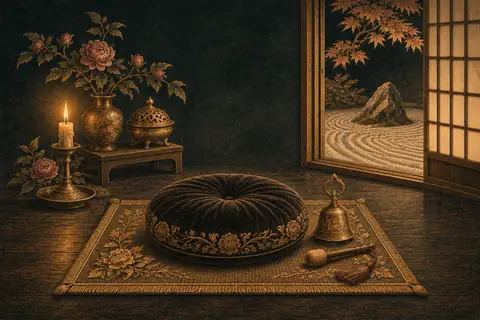
What is Zen, and what are zazen and the koan for in the Zen tradition?
What it is
Zen is a school of Mahayana Buddhism that took shape in China, where it is called Chan, and spread to Korea, Vietnam and Japan. It describes itself as a transmission outside the scriptures that points directly to the mind. In place of long study it sets seated practice, the working relation between teacher and student, and ordinary work done with full attention. The tradition holds that every person already has the nature of a buddha and that practice uncovers it. Its two main Japanese schools differ in emphasis: Soto stresses just sitting, and Rinzai the koan, a case from the old masters that the student must resolve before the teacher.
The teaching
As the Zen tradition of the Chan masters, Dogen and Hakuin teaches it.
Four lines
Zen describes itself in four lines handed down under Bodhidharma's name: a special transmission outside the scriptures; not standing on words and letters; pointing directly to the human mind; seeing into one's nature and becoming a buddha. The scriptures are not thrown away, and Zen monks chant them every day. But awakening is not a doctrine to be learned. It is the nature every person already has, and it is seen directly, in practice and in meeting a teacher.
Practice is awakening
Dogen, who brought the Soto line to Japan, taught that practice and awakening are one. One does not sit in order to become a buddha later: sitting is itself the activity of a buddha, and awakening is expressed in it from the first. He read the old line that all beings have the buddha nature as all beings are the buddha nature, so that nothing stands outside it. To study the way of the Buddha, he wrote, is to study the self; to study the self is to forget the self; and to forget the self is to be confirmed by the ten thousand things.
How to sit
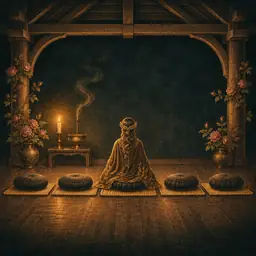
Dogen's instructions for zazen are still followed. Sit on a thick cushion in full or half lotus, or kneel, or sit on a chair: what matters is that the base is steady and the back upright, neither stiff nor slumped, with the ears in line with the shoulders and the nose in line with the navel. Rest the right hand on the left foot and the left hand on the right palm, and let the thumbs touch lightly. Keep the eyes open and lowered, the mouth closed, the tongue against the palate, and breathe quietly through the nose.
Then, in Dogen's words, think of not thinking. How do you think of not thinking? Non-thinking. Thoughts come and go and are neither followed nor fought. Beginners are often taught to count the out-breaths from one to ten and then begin again, starting over at one whenever the count is lost. Periods of sitting, usually of about half an hour, are divided by kinhin, walking slowly and attentively around the hall.
The tradition knows that sitting can be overdone. Hakuin, who revived the koan schools, fell ill from forcing his practice, and wrote of how a hermit taught him to rest and to bring his attention down into the belly and the soles of the feet. Pain in the knees is a reason to change posture, not to endure it, and anyone in distress during long sitting should tell their teacher.
Just sitting
In the Soto school the heart of practice is shikantaza, just sitting: no object, no count, no question, only sitting with the whole body and mind, awake to what is. It is not a means to an end, and nothing is to be gained by it. Dogen called zazen the dharma gate of ease and joy.
The koan
In the Rinzai school a teacher gives a student a koan, a case from the records of the old masters, to resolve. The first case of the Gateless Gate is the best known. A monk asked Zhaozhou whether a dog has the buddha nature, and Zhaozhou answered: Mu, no. The student takes up this Mu day and night, not as a question to answer with an idea but as a doubt held with the whole body. It is, the compiler of the collection says, like having swallowed a red-hot iron ball that can be neither spat out nor swallowed down.
Other cases are as short. Hakuin's own: two hands clap and there is a sound; what is the sound of one hand? Another: what was your original face, before your father and mother were born? The student meets the teacher in private and presents an answer, often without words, and the teacher accepts it or rings the bell to send the student back to the cushion. Three things are needed, the teachers say: great faith, great doubt and great determination.
No dust
The Platform Sutra tells how the Fifth Patriarch asked his monks for a verse to show their understanding. The head monk wrote that the body is the tree of awakening and the mind a bright mirror on its stand, to be wiped clean at all times so that no dust gathers. Huineng, a young layman who pounded rice in the monastery and could not read, had a verse written beside it: awakening has no tree, the bright mirror has no stand; and in the version most often recited, from the beginning not one thing exists, so where could dust fall? An older copy reads instead that the buddha nature is always pure. Huineng received the robe, and Zen holds his verse as its own: awakening is not the slow cleaning of a mind but the seeing that it was never stained.
Ordinary mind
When Zhaozhou asked his teacher Nanquan what the Way is, Nanquan said: ordinary mind is the Way. Zen holds that awakening is lived in plain acts. A monk asked Zhaozhou for teaching, and Zhaozhou asked whether he had eaten his rice gruel; yes, said the monk; then wash your bowl, said Zhaozhou. Baizhang, who set down the first rules for Chan monasteries, worked in the fields into old age and said: a day without work is a day without food. Layman Pang put it in a verse: my supernatural power and marvellous activity, carrying water and chopping wood.
The ten ox-herding pictures
The stages of the way are told in ten pictures of a herdsman and an ox, the ox being one's own true nature. First, searching for the ox. Second, finding its tracks, in the teachings. Third, glimpsing the ox: here many teachers place kensho, the first seeing into one's nature, and the seven pictures still to come are why they call it a beginning. Fourth, catching the ox, with a hard struggle, for it is wild. Fifth, taming it, until it follows of its own accord. Sixth, riding the ox home, playing the flute.
Seventh, the ox forgotten, the herdsman alone at home and at peace. Eighth, both ox and herdsman forgotten: an empty circle. Ninth, returning to the source, where the river flows on of itself and the flowers are red. Tenth, entering the marketplace with open hands, mixing with people and bringing dead trees to bloom. The last picture is the point: awakening comes back into the world as kindness.
The precepts
Practice rests on ethics. In the Soto school a student receives sixteen bodhisattva precepts. First the three refuges, in the Buddha, the teaching and the community. Then the three pure precepts: to refrain from harm, to do good, and to live for the freeing of all beings. Then the ten grave precepts: not to kill, not to steal, not to misuse sexuality, not to lie, not to deal in intoxicants, not to speak of others' faults, not to praise oneself and put others down, not to be mean with the teaching or with goods, not to indulge anger, and not to slander the three treasures.
How it is practised
The daily form is zazen: sitting upright on a cushion or a chair, eyes lowered, attention on the breath or on the bare fact of sitting, for periods of about half an hour, usually in a group and in silence. In Rinzai training a student is given a koan and meets the teacher in private to present an understanding. Satori, a moment of seeing into one's own nature, is spoken of sparingly: teachers warn against chasing it and treat it as a start. Work on a case is done only with an authorised teacher. A newcomer can visit a centre for its introductory evening, or sit quietly at home for ten minutes.
Where it comes from
Chan legend traces the school to the Indian monk Bodhidharma, said to have come to China about 500 CE. Historians date its real shaping to the Tang dynasty, in the seventh to ninth centuries, and treat the story of a split between a northern and a southern school as written by the winners. The great collections of cases, the Blue Cliff Record and the Gateless Gate, were compiled in the twelfth and thirteenth centuries. Eisai brought the Rinzai line to Japan in 1191 and Dogen the Soto line in 1227. Hakuin revived the study of cases in the eighteenth century. The English books of D. T. Suzuki carried Zen to the West from the 1920s.
What is known, and what is not
The school's own account of an unbroken line from the Buddha was assembled in the Tang and Song periods and is not history in the modern sense, as John McRae and others have shown. Studies of long-term practitioners report changes in attention and cannot say what an awakening is. Its institutions have failings on record: Brian Victoria documented the support Japanese Zen leaders gave to militarism before 1945, and several Western centres have faced findings of abuse by teachers. Long sitting can stir distress in some people, and a teacher should be told.
Its words
 Zen
- A school of Mahayana Buddhism, called Chan in China, that sets seated practice and direct pointing by a teacher above the study of texts.
 Zazen
- Seated practice in Zen: an upright posture, attention on the breath or on simply sitting, usually in a group and under a teacher.
 Koan
- A short case from the records of the Chan masters, given by a teacher to a student to resolve. It is not a riddle with a clever answer.
 Satori
- The Japanese Zen word for an awakening, a seeing into one's own nature. Teachers treat it as a beginning to be deepened, not an end.
- Bodhidharma
- The monk from the west whom Chan and Zen name as their first patriarch in China, placed about 500 CE and known mostly through later legend.
Ask the Oracle further
What is a koan, and how do Zen teachers use one?What is satori in Zen Buddhism, and why do teachers say not to chase it?
Before you practise
The Oracle tells each mystical path from its own sources and ranks none above another. These are living religions with teachers of their own; a practice that belongs inside one is described here, not prescribed. If an experience overwhelms you, please see a doctor.
Its other branches
The SufisThe Christian contemplativesVedanta and non-dualityThe TaoistsThe HasidimBhakti, the way of devotionThe whole artSearch the tree

