
Bhakti, the way of devotion
Love of God as the whole path, from the Bhagavad Gita to the poet-saints.
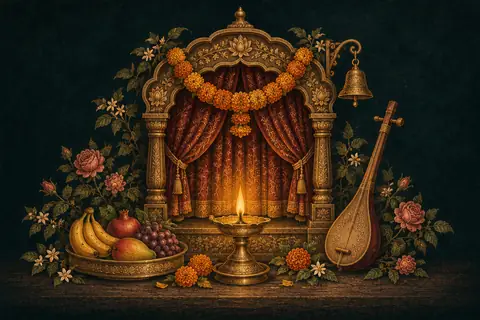
What is bhakti, the way of devotion, and who were its poet-saints?
What it is
Bhakti means devotion: loving attachment to a personal God, taken as a complete path in itself. The Bhagavad Gita sets it beside the paths of knowledge and of action and, on many readings, above them. In bhakti the worshipper relates to God as servant to master, friend to friend, parent to child or lover to beloved, and the tradition holds that grace answers love regardless of caste, learning or sex. Its forms are worship before an image, repeating the divine name, song, pilgrimage and service. Most Hindus today practise some form of it, toward Vishnu and his forms Krishna and Rama, toward Shiva, or toward the Goddess.
The teaching
As the way of devotion in the Gita, the Bhagavata and the poet-saints teaches it.
The path of love in the Gita
In the Bhagavad Gita Krishna sets three paths before Arjuna, knowledge, action and devotion, and in its twelfth chapter he says that those who fix their minds on him with love and faith are the most perfect in yoga, since the way of the formless is hard for embodied beings. Whoever offers him with love a leaf, a flower, a fruit or a little water, he accepts it, because it is offered with love. To those who worship him alone, ever devoted, he brings what they lack and keeps safe what they have.
Whatever their birth, he says, all who take refuge in him reach the highest goal. And at the end: fix your mind on me, be devoted to me, worship me, bow to me, and to me you shall come; I promise you truly, for you are dear to me.
The five loves
The devotional schools, the Bengal tradition of Chaitanya above all, describe the ways a soul can love God, each with its models. In peace, shanta, the devotee rests in God's greatness. As a servant, dasya, one serves a master, as Hanuman serves Rama. As a friend, sakhya, one plays and talks with God as with an equal, as the cowherd boys with Krishna, or Arjuna with his charioteer. As a parent, vatsalya, one cares for God as for a child, as Yashoda for the infant Krishna. As a lover, madhurya, one gives oneself wholly, as the cowherd women of Vraja, and above all Radha, gave themselves to Krishna. Each later love, the teachers say, holds the earlier ones within it.
The nine forms of devotion
In the Bhagavata Purana the boy Prahlada names nine forms of devotion: hearing of God's names and deeds; singing them; remembering God; serving at God's feet; worship before the sacred image; bowing in prayer; servitude; friendship; and the offering of oneself entirely. A devotee may live by one of them or by all. The Bhagavata gives saints for each, and Prahlada himself is its model of a devotion that holds firm under every threat.
Supreme love
The Narada Bhakti Sutra defines bhakti in two short lines: it is supreme love for God, and its nature is nectar. Gaining it, a person becomes perfect, immortal and content; wants nothing, grieves for nothing, hates nothing, delights in nothing else, and strives for no gain of their own. Its model is the love of the cowherd women of Vraja for Krishna, a love that forgot itself entirely in him.
With form and without
The poet-saints sing to God in two ways. Saguna bhakti loves God with qualities and form: Krishna the cowherd, Rama the king, Shiva the lord of the dance, the Goddess. Tulsidas, Surdas and Mirabai sang in this way. Nirguna bhakti loves the God beyond all form, met in the heart and in the name: Kabir, Ravidas and Guru Nanak sang in this way, and the Sikh tradition grew from it. In a song of Kabir, God asks the seeker where they are searching, since God is not in temple or mosque, not in the Kaaba or on Kailash, not in rites or in renunciation, but right beside them.
The monkey and the kitten
How much does the devotee do, and how much does grace? The followers of Ramanuja divided over it, and their two answers became a pair of images. The northern school holds the way of the monkey: the baby monkey clings to its mother as she leaps, so the soul must hold on to God with effort. The southern school holds the way of the kitten: the mother cat picks up her kitten by the scruff and carries it, so the soul need only surrender, and grace does the rest. Both teach prapatti, taking refuge, and both say that God's love comes first.
The name
Many schools hold that God and God's name are not two, so that to sing the name is to meet the one named. Chaitanya gave his followers a verse on how to sing it: humbler than a blade of grass in the street, more patient than a tree, wanting no honour for oneself and giving honour to all, one should sing the name of Hari always. The name is repeated on a string of beads and sung together in kirtan, and Chaitanya taught that in this age it is the surest way of all.
Love in separation
Bhakti knows the pain of absence as one of love's deepest forms, viraha, longing in separation. When Krishna leaves Vraja for Mathura, the grief of the cowherd women becomes the theme of countless songs, and the poets teach that longing for God is itself a way of being with God. Mirabai sings of waiting through the night for her dark lord, the Mountain Lifter, and signs her songs as the servant of Giridhar Nagar. In the Tamil south the poet Andal, who loved Vishnu as a bride, left the thirty verses of the Tiruppavai, still sung each winter at dawn in the month of Margazhi.
The body as temple
Not every devotee builds or visits temples. Basavanna, the Kannada poet of Shiva, set the inner shrine against the outer: the rich build temples for Shiva, but a poor man has only himself, so his legs are the pillars, his body the shrine and his head the golden dome; and what is built will fall, while what moves and lives remains. The saints of every region say the same in their own words: love is the worship, and the heart is where God lives.
The guru and the goal
Devotion is learned from a teacher, a guru, who gives the name and guides its practice, and the Gita says to learn by humble reverence, by questioning and by service, from those who have seen the truth. The goal the devotees name is not always freedom. The Bengal school calls pure love, prema, a fifth aim of life beyond the four that Hindus count, duty, wealth, pleasure and liberation, and the Bhagavata tells of devotees who would refuse even liberation if it meant they could no longer serve.
How it is practised
The practice is worship: an offering of flowers, light and food before an image at home or in a temple, the repetition of a divine name on a string of beads, and singing together. The tradition holds that the name carries the presence of the one named. These are acts of a faith, learned in a family or from a guru, and a visitor is usually welcome to sit at the back of a temple and listen. A reader can come to bhakti through its poetry, in the songs of Mirabai, Kabir or the Tamil saints in translation, which ask for no belief in order to be read with attention.
Where it comes from
Devotion is taught in the Gita, composed some two thousand years ago, and it became a popular movement among the Tamil poet-saints of the sixth to ninth centuries: the Alvars, who sang to Vishnu, and the Nayanars, who sang to Shiva. Ramanuja gave it a philosophy in the eleventh century. It spread north in the languages of the people: Kabir, a weaver of Varanasi, and Mirabai, a Rajput princess, in the fifteenth and sixteenth centuries, Tukaram in Marathi in the seventeenth, and in Bengal Chaitanya, who died in 1533 and whose followers founded the Krishna movement known worldwide since the 1960s.
What is known, and what is not
The poets and their songs are matters of history, though legend has gathered round each life, and many verses credited to Kabir and Mirabai were added by later singers. John Stratton Hawley has shown that the idea of one bhakti movement sweeping from south to north is a story that took its present shape only in the twentieth century, from older tales. The claims of grace and of the power of the name belong to faith. Devotion to a living guru has been abused by some teachers, and the tradition's own books say a teacher is to be tested before being trusted.
Its words
 Bhakti
- Devotion: the Hindu path of love for a personal God, taught in the Bhagavad Gita and sung by poet-saints in the languages of the people.
- Bhagavad Gita
- The Song of the Lord: 700 Sanskrit verses in the Mahabharata in which Krishna teaches Arjuna duty, knowledge and loving devotion before a battle.
Ask the Oracle further
How does bhakti differ from the paths of knowledge and of action?Who was Mirabai, and what do her songs say of bhakti?
Before you practise
The Oracle tells each mystical path from its own sources and ranks none above another. These are living religions with teachers of their own; a practice that belongs inside one is described here, not prescribed. If an experience overwhelms you, please see a doctor.
Its other branches
The SufisThe Christian contemplativesZenVedanta and non-dualityThe TaoistsThe HasidimThe whole artSearch the tree

