
The Sufis
Islam’s path of the heart: the orders, the remembrance of God, and the passing away of self.
What do the Sufis teach, and what does Sufism say the path is for?
What it is
Sufism is the inward path of Islam. The Sufis hold that the law of the religion is the ground, and that within it a believer can travel toward nearness to God by remembrance, service and the training of the self under a guide. The tradition holds that the traveller passes through stations, such as repentance, trust and contentment, and may be given states that come and go. Its best known term is fana, the passing away of self-regard in the awareness of God, which most teachers pair with baqa, abiding: the return to ordinary life, changed. Sufis pray, fast and keep the law as other Muslims do.
The teaching
As the Sufi path of al-Junayd, al-Qushayri, al-Ghazali and Rumi teaches it.
The law, the path and the truth
The Sufis describe their way in three words. The shari'a is the law of Islam, the outward life of prayer, fasting, charity and right dealing that every Muslim keeps. The tariqa is the path, the inner discipline by which a traveller, under a guide, works on the self. The haqiqa is the truth or reality toward which the path leads, the knowing of God that the Sufis call ma'rifa. The order matters: there is no path without the law, and the path exists to make the law alive in the heart. A Sufi prays the five prayers and fasts in Ramadan like any Muslim; the path asks for more, never for less.
The self and its three faces
The work of the path is on the nafs, the self in the sense of the ego that wants. The Sufis read three of its faces in the Qur'an. The commanding self, which urges toward evil, is the self as it starts out. The reproaching self, which turns on itself after it falls, is the self beginning to wake. The self at peace is the self that has come home, whom the Qur'an addresses: O soul at rest, return to your Lord, well pleased and well pleasing. Later orders count seven stages in all, but these three are the frame of every teaching.
Stations and states
The path is mapped as stations and states. A station, maqam, is a stage won by effort and kept: once reached, it becomes part of the traveller. A state, hal, is given by God and passes, like a flash of light; it cannot be summoned or held. Al-Qushayri puts it in a phrase: states are gifts, and stations are earnings.
Abu Nasr al-Sarraj counts seven stations. Repentance, turning back to God. Scrupulousness, avoiding what is doubtful. Renunciation, loosening the world's hold. Poverty, needing nothing but God. Patience, bearing what comes without complaint. Trust, leaning on God in all things. And contentment, being satisfied with whatever God decrees. He names ten states that may be given along the way: watchfulness, nearness, love, fear, hope, longing, intimacy, tranquillity, witnessing and certainty.
Remembrance
The central practice is dhikr, remembrance, drawn from the Qur'an's own words: remember Me and I will remember you, and in the remembrance of God hearts find rest. The traveller repeats a name of God or a short formula, most often the first half of the declaration of faith, la ilaha illa'llah, there is no god but God, in which the first words sweep away every false object of worship and the last affirm the One. Some orders say it aloud together, in circles, with breath and rhythm; the Naqshbandis keep it silent, in the heart. The form, the count and the time are given by the shaykh at initiation, and each order keeps its own.
Al-Ghazali teaches why it works on the heart. The heart is a mirror made to reflect the light of God, dulled by sins and by the dust of the world, and remembrance is its polishing, until it shows what it was made to show. A saying of the Prophet puts it in a line: everything has its polish, and the polish of hearts is the remembrance of God.
The guide
No one travels this path alone. The pupil, the murid, the one who wills, takes the hand of a shaykh in a pledge, bay'a, and enters a chain of masters, silsila, that each order traces back to the Prophet. An old Sufi saying warns that whoever has no shaykh has Satan for a shaykh: the self is cunning, and only someone who has walked the road can see where it deceives. The pupil's part is adab, courtesy, right conduct toward God, the guide, the companions and every creature, and an old saying holds that Sufism is all courtesy.
Watchfulness and the reckoning
Two disciplines run through the day. Muraqaba, watchfulness, is the steady awareness that God sees, held in prayer and in ordinary acts; in the orders it is also a time of sitting in silence with the heart turned toward God. Muhasaba, the reckoning, is the evening review: the traveller goes over the day, thanks God for what was well done, asks forgiveness for what was not, and resolves for tomorrow.
Some orders add khalwa, a retreat of days, or of forty days, in a closed cell, with fasting and long remembrance. It is undertaken only at a shaykh's direction, by a guide who watches over the pupil's body and mind, and never alone; anyone overwhelmed by what such practice stirs should stop and see a doctor.
Love
Many Sufis hold that the path is love from beginning to end. Rabia of Basra is remembered for a prayer that sets the tone for all who came after: O God, if I worship you for fear of hell, burn me in hell; if I worship you in hope of paradise, shut me out of it; but if I worship you for your own sake, do not withhold from me your everlasting beauty. A story has her running through the streets with a torch and a bucket of water, to set fire to paradise and put out the flames of hell, so that people would love God for God alone.
Passing away and abiding
The goal the Sufis name is fana, passing away: the falling away of the self's regard for itself in the awareness of God. They find it described in a saying in which God speaks through the Prophet: My servant draws near to Me by nothing I love more than what I have made his duty, and keeps drawing near by voluntary acts until I love him; and when I love him, I become the hearing with which he hears, the sight with which he sees, the hand with which he grasps and the foot with which he walks.
Al-Junayd of Baghdad taught that fana is followed by baqa, abiding: the traveller returns to the world and to their own self, now living by God and for God. He called the goal a return to the state one was in before one was, when, in the Qur'an's account, all souls stood before God and answered His question, Am I not your Lord?, with yes. Junayd's way is called sober, and the masters who spoke in rapture of union are called intoxicated; the mainstream of the tradition holds sobriety higher, because the one who comes back can serve.
The reed's lament
Rumi opens the Masnavi with the voice of the reed flute. Cut from its reed bed, it cries, and all who hear it weep, because everyone has been parted from a source and longs to return to it. The six books of the poem, with their stories, jokes and teachings, unfold from that cry. The longing itself, for Rumi, is a sign of the way: as he says in the poem, it is not only the thirsty who seek water, for the water too is seeking the thirsty.
The turning
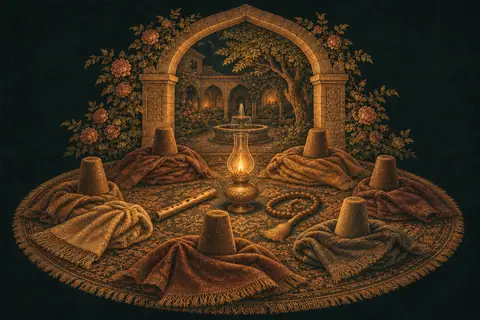
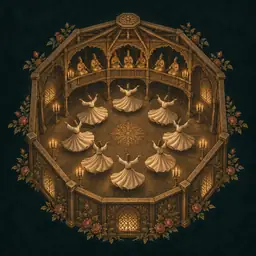
The Mevlevi order, which follows Rumi, keeps the sema, a ceremony of worship with the reed flute, the drum and song. The dervishes wear a tall felt hat, read as the headstone of the ego, and a white robe, read as its shroud, under a black cloak that they cast off at the start, as one rising from the grave. They turn on the left foot, around the heart, the right hand open upward to receive from heaven and the left turned down to pass it on to the earth, through four movements called salams. The turning is prayer, done under the order's teachers, and it is not a technique to be tried alone.
How it is practised
The central practice is dhikr, the remembrance of God: a name or short formula repeated aloud or in the heart, alone after the daily prayers or together in a circle led by a shaykh. Each tariqa has its own form, given at initiation, and the Mevlevi keep the sema, a ceremony of music and turning. These belong inside the religion and the order, with a guide who knows the pupil. A reader outside can read Rumi or Attar in a sound translation, visit a gathering that welcomes guests, and listen. The house describes the rite and does not hand it out.
Where it comes from
The first Sufis were ascetics of Iraq and Khurasan in the eighth and ninth centuries. Rabia of Basra, who died about 801, is remembered for teaching love of God for his own sake. Al-Junayd of Baghdad, who died in 910, set out the sober teaching that later orders claim. In 922 al-Hallaj was put to death in Baghdad after a long trial in which court politics weighed as much as his sayings of union. Al-Ghazali, who died in 1111, joined the path to mainstream scholarship. From the twelfth century the teaching was carried by orders, each called a tariqa: the Qadiri, the Suhrawardi, the Naqshbandi, and the Mevlevi, who follow Rumi.
What is known, and what is not
The history of the orders is well documented, and Sufi manuals from the tenth century on describe the stations and states in detail. What the states are is a matter of faith: the tradition holds that they are gifts of God, and no outside test can say more. Some Muslim reformers reject parts of Sufi practice, such as visiting the tombs of saints, as innovation, and Sufis answer from the Qur'an and the Prophet's example. Popular Western versions of Rumi often cut the Islam out of his verse, which scholars count a distortion.
Its words
 Sufism
- The inward path of Islam: a discipline of remembrance, service and love of God, taught from master to pupil and, since the twelfth century, in orders.
 Dhikr
- Remembrance: the Sufi practice of repeating the names of God or a short formula, aloud or silently, alone or in a circle.
 Fana
- Passing away: the Sufi term for the falling away of self-regard in the awareness of God, followed in most teaching by baqa, abiding.
 Tariqa
- A Sufi order and the path it teaches: a chain of masters, a rule of practice and a community, such as the Qadiri, Naqshbandi or Mevlevi.
 Sema
- The listening ceremony of the Mevlevi order, known for its turning dervishes: a rite of worship with music, not a performance.
- Baqa
- Abiding: the Sufi term for what follows fana, the traveller's return to ordinary life and its duties, lived from the awareness of God.
- Rumi
- Jalal al-Din Rumi (1207 to 1273), the Muslim scholar and Persian poet of Konya whose Masnavi teaches the Sufi path and whose followers founded the Mevlevi order.
Ask the Oracle further
What is fana in Sufism, and what do the Sufis say follows it?What is a Sufi order, and how does a dervish enter one?
Before you practise
The Oracle tells each mystical path from its own sources and ranks none above another. These are living religions with teachers of their own; a practice that belongs inside one is described here, not prescribed. If an experience overwhelms you, please see a doctor.
Its other branches
The Christian contemplativesZenVedanta and non-dualityThe TaoistsThe HasidimBhakti, the way of devotionThe whole artSearch the tree

