
The Taoists
The Way that cannot be named, and the art of acting without forcing.
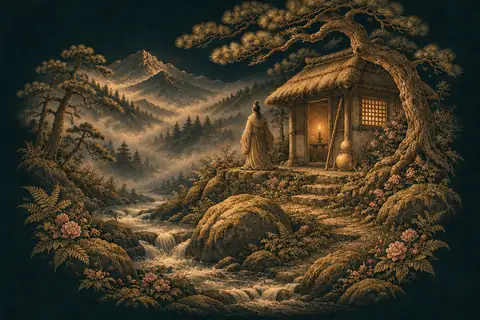
What do the Taoists mean by the Tao and by wu wei?
What it is
Taoism is the Chinese tradition of the Tao, the Way: the source and course of all things, which its first book says cannot be named. From that follows its ethic, wu wei, acting without forcing, as water finds its level and a skilled cook's knife finds the gaps in the joint. The tradition has two faces that Western readers often split apart. One is the philosophy of the Tao Te Ching and the Zhuangzi. The other is a religion with ordained priests, scriptures, temples, gods and rites, and with disciplines of stillness meant to nourish life. Chinese Taoists do not divide the two so sharply.
The teaching
As the Taoist tradition of the Tao Te Ching and the Zhuangzi teaches it.
The nameless
The Tao Te Ching begins: the Way that can be spoken of is not the constant Way; the name that can be named is not the constant name. The nameless is the beginning of heaven and earth; the named is the mother of the ten thousand things. The Way is the source and course of all that is, prior to every word for it, and so the book speaks of it in images and paradoxes, and asks the reader to know it by living in accord with it.
The One, the Two and the Three
The Way gives birth to the One; the One gives birth to the Two; the Two give birth to the Three; the Three give birth to the ten thousand things. The ten thousand things carry yin on their backs and hold yang in their arms, and the blending of their breaths makes their harmony. Yin is the shaded, yielding, receptive side of things, and yang the sunlit, firm, active side; they do not fight but turn into one another, as day turns into night.
Te, the uncarved block and the infant
The book's title joins the Way with te, its power or virtue: the Way as it is present in a particular thing or person, the quality by which each is what it is. Te is greatest where nothing has been added. The book's pictures of it are the uncarved block, pu, wood before the carver has cut it into any one use, and the newborn child, soft and supple, whose grip is firm and whose cry all day does not make it hoarse. To return to the uncarved block and to become like an infant again is the Taoist's aim.
Water, the valley and the empty hub
The book's favourite teacher is water. The highest good is like water: it benefits the ten thousand things without contending, and settles in the low places people scorn, and so it is near the Way. Nothing in the world is softer or weaker than water, yet nothing is better at wearing away the hard. The valley, the empty vessel and the empty hub teach the same. Thirty spokes share one hub, and it is the empty space at the centre that makes the cart useful; clay is shaped into a pot, and it is the emptiness inside that holds. What is there gives the benefit; what is not there gives the use.
Not forcing
From this follows wu wei, not forcing. The Way does nothing, and yet nothing is left undone. In the pursuit of learning something is added every day; in the pursuit of the Way something is dropped every day, less and less, until one arrives at not forcing, and when nothing is forced nothing is left undone. Wu wei is not idleness. It is action that goes with the grain of things, without strain and without the self pushing in.
The Zhuangzi gives it a picture in Cook Ding, who carves an ox for his lord with such ease that his knife moves like a dance. A good cook changes his knife once a year, because he cuts; an ordinary cook once a month, because he hacks; Ding's knife has lasted nineteen years and is as sharp as new, because he follows the natural gaps in the joints and never meets bone. When he comes to a hard place he slows down, looks carefully and moves the blade gently, and the joint falls apart like a clod of earth. The lord says: from hearing this I have learned how to nourish life.
Returning to the root
Attain the utmost emptiness; hold firmly to stillness. The ten thousand things arise together, and I watch them return. Each returns to its root, and returning to the root is called stillness. Reversal is the movement of the Way, and weakness is its means. The Taoist learns to see the turn in everything, that whatever is to shrink must first be stretched and whatever is to fall must first be raised up, and so to stay soft, low and near the source.
The three treasures
I have three treasures, the book says, which I hold and keep. The first is compassion, the second is frugality, the third is not daring to be first in the world. From compassion comes courage; from frugality comes the means to be generous; from not putting oneself first comes the power to lead. And it teaches the measure of enough: there is no greater misfortune than not knowing what is enough, and whoever knows that enough is enough will always have enough.
The butterfly and the useless tree
The Zhuangzi teaches by stories and jokes that loosen fixed views. Zhuang Zhou dreams he is a butterfly, fluttering happily, not knowing he is Zhou; he wakes, and does not know whether he is Zhou who dreamed he was a butterfly or a butterfly dreaming he is Zhou. That, the book says, is the transformation of things. A carpenter passes by a huge old tree because its wood is good for nothing, and in a dream the tree tells him that its uselessness is what has let it grow so great and so old.
Zhuangzi and his friend Huizi, crossing a bridge, see fish darting below. How happy the fish are, says Zhuangzi. You are not a fish, says Huizi; how do you know they are happy? You are not me, says Zhuangzi; how do you know I do not know?
The fasting of the heart
The Zhuangzi also teaches stillness directly, with Confucius as its mouthpiece. Unify your will, he tells his pupil Yan Hui. Do not listen with your ears but with your heart; do not listen with your heart but with your breath. Hearing stops at the ears, the heart stops at what fits it, but the breath is empty and waits on all things. The Way gathers in emptiness alone, and emptiness is the fasting of the heart. It is a fast of the mind, not of the body.
Later Yan Hui reports a further step, sitting and forgetting: he lets go of limbs and body, drives out perception and cleverness, leaves form and knowledge behind, and becomes one with the great thoroughfare.
Nourishing life
Religious Taoism carries these teachings into disciplines of stillness meant to nourish life. Its inner alchemy speaks of three treasures in the body: jing, the essence; qi, the breath and vital energy; and shen, the spirit. Practice is said to refine essence into breath, breath into spirit, and spirit back into emptiness, with the attention resting in the field of the elixir below the navel. The Zhuangzi gives the old ideal: the true person breathes from the heels, while ordinary people breathe from the throat. These disciplines are taught by ordained teachers within a lineage, and gently: forcing or holding the breath is warned against, and they are learned with a teacher, not from a page.
The sage who governs least
The book was also written for rulers, and its counsel reaches every household. Of the best rulers the people barely know that they exist; when the work is done, the people say, we did it ourselves. Govern a great state as you would cook a small fish, without poking at it. The sage puts himself last and finds himself first, and because he does not contend, no one in the world can contend with him.
How it is practised
Wu wei is practised in ordinary acts and needs no rite: doing a task with attention and without haste, noticing where one is pushing against how things stand, and stopping when enough is done. The Zhuangzi teaches by stories and jokes, and reading one a day is a practice in itself. The religious disciplines, such as sitting in forgetfulness and the inner cultivation of the Complete Perfection monks, are taught by ordained teachers within a lineage and are given here only in outline. Taoist temples in many cities welcome respectful visitors.
Where it comes from
The Tao Te Ching is credited to Lao Tzu, of whose life nothing certain is known. Bamboo copies found at Guodian show that parts of the text existed by about 300 BCE. The Zhuangzi, named for a writer of the fourth century BCE, grew over the two centuries that followed. Organised Taoism dates from 142 CE, when Zhang Daoling founded the Way of the Celestial Masters in Sichuan. The Complete Perfection school, a monastic order, was founded by Wang Chongyang in the twelfth century, and both lines survive. The Taoist canon was printed in 1445 and holds about fourteen hundred texts.
What is known, and what is not
That the Tao Te Ching is a layered text and not one man's book is the scholars' settled view, and Lao Tzu may be a legend. The split between a pure philosophy and a superstitious religion was drawn by Western readers of the nineteenth century and is now rejected by specialists such as Russell Kirkland. The Tao is a teaching about the whole and cannot be tested. The old Taoist alchemy sought long life with elixirs of mercury and lead, which poisoned those who took them, emperors among them: that is history, and nothing of it is advised.
Its words
 Taoism
- The Chinese tradition of the Tao, the Way: a philosophy in the Tao Te Ching and the Zhuangzi, and a religion with priests, rites and temples.
 Wu Wei
- Not forcing: the Taoist ideal of acting in line with how things go, without strain or contrivance. It does not mean doing nothing.
- Tao Te Ching
- The short founding book of Taoism, about five thousand characters in 81 chapters, credited to Lao Tzu and concerned with the Way and its virtue.
- Zhuangzi
- The Taoist book of stories and arguments named for Zhuang Zhou of the fourth century BCE, home of the butterfly dream and of Cook Ding's knife.
Ask the Oracle further
What does the Zhuangzi add to Taoism, and how do the Taoists read it?How is religious Taoism, with its priests and rites, tied to the Tao of the old books?
Before you practise
The Oracle tells each mystical path from its own sources and ranks none above another. These are living religions with teachers of their own; a practice that belongs inside one is described here, not prescribed. If an experience overwhelms you, please see a doctor.
Its other branches
The SufisThe Christian contemplativesZenVedanta and non-dualityThe HasidimBhakti, the way of devotionThe whole artSearch the tree

