
The Hasidim
The teaching of joy, the tzaddik, and cleaving to God in ordinary life that began with the Baal Shem Tov.
What do the Hasidim teach about devekut, cleaving to God?
What it is
Hasidism is a Jewish movement of piety that began in the eighteenth century in what is now Ukraine. Its teachers took the ideas of the Kabbalah and turned them toward the inner life of ordinary people. The tradition holds that God's presence fills all things, so that an unlettered person's sincere prayer, a meal, a melody or honest work can be a way to God. The aim is devekut, cleaving to God in thought and feeling, and the mood is joy. At the centre of each community stands the tzaddik, or rebbe, a righteous leader whose followers seek his counsel and blessing. The Hasidim keep Jewish law in full.
The teaching
As the Hasidic teaching of the Baal Shem Tov and his heirs teaches it.
No place empty of Him
The first teaching of Hasidism is that God fills all things. The Kabbalah says that there is no place empty of Him, and the prophet Isaiah heard the seraphim cry that the whole earth is full of his glory. The Baal Shem Tov drew the plain conclusion: if God is in everything, then everything can be a way to God, not only the synagogue and the study house but the field, the workshop, the meal and the road.
The holy sparks
The Hasidim took from the Kabbalah of Isaac Luria the teaching of the sparks. When the world was made, the vessels meant to hold the divine light broke, and sparks of holiness fell and were trapped in husks, kelipot, throughout creation. Every thing a person meets holds sparks that belong to the root of their soul. To use a thing rightly, with a blessing and a pure intention, raises its sparks to their source, and this raising, repeated in countless small acts, is the repair of the world, tikkun. The Hasidim call it serving God through the material, avodah be-gashmiyut.
Cleaving
The aim is devekut, cleaving to God, from the Torah's own words, to cleave unto him. The Baal Shem Tov taught that it is not kept for the hours of prayer: a person can hold the mind and heart to God while talking, trading, eating and walking, for where a person's thoughts are, there the whole person is. Devekut is less a feat than a direction, a turning of the attention back to God whenever it has wandered, until the turning becomes the person's way of being.
Joy
The mood of the path is joy. “Serve the LORD with gladness,” says the psalm, and the Hasidic masters hold that sadness closes the heart and joy opens it to God. Rabbi Nachman of Breslov taught that it is a great commandment to be happy always, and he set heaviness of spirit, which deadens, apart from a broken heart, which is precious to God and soon gives way to joy. He also gave his followers the words they still sing: the whole world is a very narrow bridge, and the main thing is not to be afraid at all.
Prayer with fire
Prayer is the heart of the day, said with kavanah, intention, and at its height with hitlahavut, a burning enthusiasm in which the whole body sways and the words catch fire. The Maggid of Mezeritch taught that the one who prays should become as nothing, ayin, before God: the Hebrew word for I, ani, has the same letters as ayin, and the work of prayer is to turn the one into the other.
A tale told of the Baal Shem Tov makes the same point from below. On the Day of Atonement an unlettered boy who could not read the prayers took out his shepherd's whistle and blew it with all his heart, and it was his whistle, the master said, that carried the prayers of the whole congregation up to heaven.
Two souls and the middle man
Chabad, the school founded by Shneur Zalman of Liadi, teaches in the Tanya that every Jew has two souls: an animal soul, which seeks its own good, and a divine soul, which is truly a part of God above. Their struggle is lifelong. The Tanya's ideal is the beinoni, the middle person, who never sins in deed, word or thought, though the struggle in the heart goes on. Its tool is the mind, which by nature can rule the heart: before prayer the Chabad Hasid spends time in long contemplation of God's greatness, until love and awe awaken of themselves.
Speaking to God alone
Breslov teaches hitbodedut: going out alone, best at night and in the fields or woods, and speaking to God in one's own language, as to a friend, about everything in one's life, for an hour each day if one can. Rabbi Nachman taught that every blade of grass has its own song, and that one who prays in the field gathers their songs into the prayer. On days when the words will not come, he taught, it is still good to sit there and repeat a single word, or only to long to speak.
The wordless melody
Song carries the soul where words cannot. The niggun, a melody without words, or with a few repeated syllables, is sung at the table and in prayer, often slowly at first and then faster, over and over, until the singers are drawn out of themselves. The masters composed niggunim and gave them to their followers as teachings, and the courts treasure melodies handed down from their founders.
The tzaddik and his table
At the centre of each community stands the tzaddik, the rebbe. The tradition holds that his soul is rooted high, so that he can go down to those who cling to him and lift them up, a descent for the sake of ascent. His followers bring him their troubles in private meetings and in written petitions, kvitlach, and ask his counsel and blessing. On the Sabbath they gather at his table, the tish, to hear his teaching, to sing, and to share the remnants of the food he has blessed.
The tales
Hasidism teaches above all in stories. Before his death Reb Zusya said: in the world to come they will not ask me why I was not Moses; they will ask me why I was not Zusya. The Kotzker Rebbe asked his students where God dwells, and answered his own question: wherever He is let in. The tales are told on the anniversaries of the masters, at the table and at home, and to tell one well is itself counted a holy act.
How it is practised
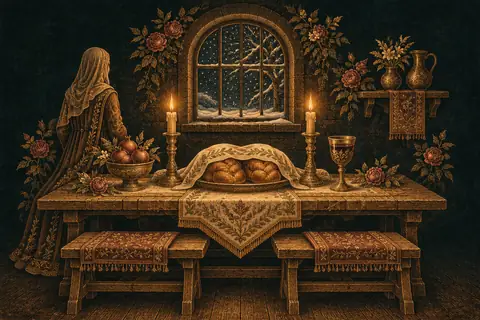
Hasidic life is itself the practice: the three daily prayers said with concentration, study of the Torah and of the masters' teachings, the melody without verses called a niggun, and the gathering at the rebbe's table on the Sabbath. Some schools teach set forms of inward prayer: Chabad teaches long reflection before praying, and Breslov teaches speaking to God alone in one's own tongue. All of it lives inside observant Jewish life and a community. A reader outside can read the tales, in Buber's version or a closer translation, and many communities welcome Jewish guests for a Sabbath.
Where it comes from
Israel ben Eliezer, called the Baal Shem Tov, taught in Podolia and died in 1760. He left almost no writings, and what is known of him comes from a few letters, from his pupils and from tales printed in 1814. His successor Dov Ber, the Maggid of Mezeritch, sent out the disciples who founded the dynasties. Opponents led by the Gaon of Vilna issued bans against the movement from 1772, fearing that it slighted study. Shneur Zalman of Liadi published the Tanya in 1796, the founding book of Chabad. The Holocaust destroyed the Hasidic heartland, and the courts were rebuilt in Israel and America.
What is known, and what is not
The movement's early history is being rewritten from archives: Moshe Rosman showed from Polish records that the Baal Shem Tov was a respected resident of Medzhybizh, housed by the community, and not the hidden outcast of legend. The tales are devotional literature, printed two generations after the events. Gershom Scholem and Martin Buber disagreed sharply over whether Buber's retellings were faithful. The teaching on the tzaddik has drawn criticism within Judaism since the 1770s. What devekut is, and whether prayer reaches God, are questions of faith.
Its words
 Hasidism
- The Jewish movement of piety and joy that grew from the circle of the Baal Shem Tov in eighteenth-century Ukraine and Poland.
 Devekut
- Cleaving: the kabbalistic and Hasidic term for holding the mind and heart to God, in prayer and, the Hasidim taught, in everyday acts.
 Tzaddik
- A righteous one: in Hasidism the rebbe, the leader of a community, through whom his followers are held to be drawn closer to God.
- Baal Shem Tov
- Israel ben Eliezer, died 1760: the healer and teacher of Medzhybizh from whose circle of pupils the Hasidic movement grew.
Ask the Oracle further
What is a tzaddik in Hasidism, and why do the Hasidim seek one out?What did the first Hasidim teach, and why were they opposed?
Before you practise
The Oracle tells each mystical path from its own sources and ranks none above another. These are living religions with teachers of their own; a practice that belongs inside one is described here, not prescribed. If an experience overwhelms you, please see a doctor.
Its other branches
The SufisThe Christian contemplativesZenVedanta and non-dualityThe TaoistsBhakti, the way of devotionThe whole artSearch the tree

