
The Christian contemplatives
From the desert to Carmel: the prayer of the heart, the cloud and the dark night.
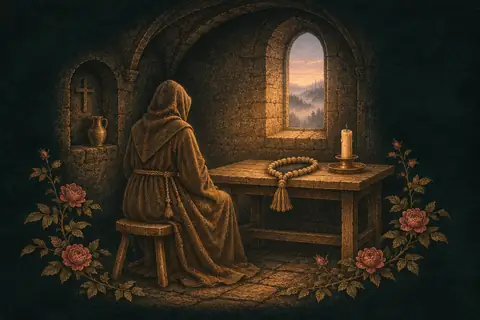
What did the Christian mystics teach about the dark night of the soul and the cloud of unknowing?
What it is
Christian contemplatives are the monks, nuns and lay people who sought God in silent prayer beyond thoughts and images. Two streams run through the tradition. The Eastern Church teaches hesychasm, inner stillness, centred on the Jesus Prayer, said until it is held to descend from the lips to the heart. The Western Church, heir to the same desert monks, produced a line of teachers down to the Carmelites. Both draw on the way of negation, which says that God is beyond every name and concept, so that the one who prays must let even holy thoughts go. The tradition holds that union with God is a gift and cannot be produced by any method.
The teaching
As the Christian contemplative tradition from the desert to Carmel teaches it.
The cell and the thoughts
The tradition begins with the monks and nuns of the Egyptian desert, and their first teaching is to stay. A brother asked Abba Moses for a word, and he answered: go, sit in your cell, and your cell will teach you everything. In the stillness of the cell the monk meets his own thoughts, and the desert teachers made a science of them.
Evagrius of Pontus counted eight thoughts that trouble the soul: gluttony, lust, avarice, sadness, anger, acedia, vainglory and pride. Acedia, the noonday demon, is the restless weariness that makes the hours drag and the cell unbearable, and tempts the monk to leave. Each thought is to be noticed as it comes, named, and answered, often with a line of scripture, before it grows into a passion. Prayer, Evagrius taught, is the laying aside of thoughts.
The three ways
The teachers describe the whole road as three ways. The purgative way is the cleansing of sin and of disordered desire, by repentance, discipline and the patient practice of the virtues. The illuminative way is the growth of the mind in the light of God, in prayer, understanding and love. The unitive way is union with God, in which the soul loves and acts in one will with Him. They are not strictly one after another, since each goes on within the others, but they give the order in which the work usually unfolds.
The way of unknowing
Behind the whole tradition stands the way of negation. God is beyond every name, image and concept, so that whatever the mind grasps is not God. The writer called Dionysius teaches the one who prays to leave behind the senses, the reasonings and all that can be known, and to be drawn up, unknowing, toward the One beyond being. Gregory of Nyssa reads the life of Moses as the soul's journey: God first shows himself in light, at the burning bush; then in the cloud that leads the way; and at last in the thick darkness on Sinai, which Moses enters, and where he sees by not seeing.
The prayer of the heart
In the Eastern Church the way of stillness, hesychia, gathers round the Jesus Prayer: Lord Jesus Christ, Son of God, have mercy on me, a sinner. It answers Paul's counsel, “Pray without ceasing.” It is said slowly and attentively, again and again, often on a prayer rope of knotted wool, first with the lips, then in the mind, until, the teachers say, the mind descends into the heart and the prayer goes on of itself, waking and sleeping.
The old manuals describe a bodily method: sitting on a low stool, head bowed, the breath slowed and the prayer joined to it. Later teachers warn that the method is not the prayer, that forcing the breath or chasing warmth and light does harm, and that it is learned with a spiritual father or mother and inside the life of the Church. The Way of a Pilgrim tells of a Russian wanderer who learned it from an elder, who set him a count of prayers that grew week by week, until the prayer began to say itself in him.
The goal is theosis, deification: the person filled with the life of God by grace. Gregory Palamas taught that God's essence remains beyond all knowing, while His energies, His living presence and action, are truly shared; and that the light the hesychasts see is the uncreated light that shone from Christ on Mount Tabor.
The cloud of unknowing
The English book The Cloud of Unknowing teaches the Western form of the same way. Between you and God, it says, there is a cloud of unknowing, which the mind cannot pierce; so put beneath you a cloud of forgetting, and bury under it every creature, every thought and every memory, even holy ones. Then beat upon the cloud above with a sharp dart of longing love. God may be reached by love, the book says, and never by thought. For a help, take a short word of one syllable, such as God or love, fasten it to the heart, and when thoughts rise, answer each of them with that one word.
Detachment and the ground
Meister Eckhart taught detachment: a heart emptied of every attachment, even to its own spiritual gifts, so that God may be born in it. The birth of the Word in the ground of the soul, where God's ground and the soul's ground are one, is the centre of his preaching. He called the attitude it needs Gelassenheit, letting be, and he pressed the teaching to its edge: he prayed God to rid him of God, meaning of every image of God that stands between the soul and God himself.
The seven dwelling places
Teresa of Avila pictured the soul as a castle made of a single diamond or very clear crystal, with many rooms in seven dwelling places and God in the innermost. The door is prayer. In the first dwellings the soul enters by self-knowledge and humility, still distracted by the cares that crawl in with it. In the second it hears God's call through sermons, books and friends, and must persevere against the pull back. In the third it lives a well-ordered, virtuous life, but cautious and often dry.
In the fourth God begins to act more than the soul: here are the prayer of recollection and the prayer of quiet, delights that God gives, unlike the consolations the soul wins by its own effort. In the fifth comes the prayer of union, brief and certain, and Teresa's image of the silkworm, which spins its cocoon, dies in it, and comes out a small white butterfly. In the sixth the soul is betrothed: raptures, wounds of love and longing come together with great trials. In the seventh comes the spiritual marriage, a lasting union in the centre of the soul, where Martha and Mary, the active and the contemplative, work together.
In her Life she taught the same growth as four ways of watering a garden: drawing water from a well by hand, which is the labour of meditation; turning a water wheel, the prayer of quiet; a stream running through the garden; and rain from heaven, in which God does everything.
The dark nights
John of the Cross teaches that the soul comes to God through nights. In the night of the senses its pleasures in created things, and then even its sweetness in prayer, are taken away; in the night of the spirit its own ways of knowing and loving are emptied, so that God can fill them. Each night has an active part, what the soul gives up, and a passive part, what God does in it. His poem calls the night kinder than the dawn, because it unites the lover with the beloved.
He gives signs by which a guide can tell this night from other dryness: the soul finds no comfort in the things of God and none in created things either; it remembers God with painful care, fearing it has gone backward; and it can no longer meditate as before, but is drawn to rest in a loving attention to God without particular thoughts. He warns that dryness can also come from sin, from lukewarmness, or from melancholy and other ills of the body, which is why all the signs must be present together. What he called melancholy is today a matter for a doctor.
His sketch of Mount Carmel puts the teaching on one page: nothing, nothing, nothing, and even on the mountain nothing. To come to possess all, desire to possess nothing; to come to know all, desire to know nothing.
Reading as prayer
For those who live in the world the tradition offers a simpler ladder. Guigo the Carthusian set out four rungs of lectio divina, sacred reading. Reading takes a short passage of scripture slowly, as if tasting it. Meditation chews on it, turning a phrase over until it speaks. Prayer answers it, in the reader's own words to God. Contemplation rests in God beyond the words. The rungs come round again and again, and a few verses can fill the whole time.
How it is practised
What the teachers ask of those in their care is simple to state and slow to learn: a fixed time, a quiet place, a short phrase or a single word held gently, and a return to it whenever attention wanders. The Cloud of Unknowing advises a word of one syllable. The Jesus Prayer is traditionally taken up with the guidance of a spiritual father or mother, and the manuals warn against forcing the breath or chasing sensations. These are practices of a church, joined to its worship and sacraments. A reader of any background can read The Cloud or Teresa's Interior Castle, and sit quietly for ten minutes.
Where it comes from
The practice begins with the monks of the Egyptian desert in the fourth century. About the year 500 a Syrian writer using the name Dionysius the Areopagite set out apophatic theology, also called the via negativa, in a few short treatises that shaped East and West alike. In the fourteenth century Gregory Palamas defended the hesychasts of Mount Athos, and an unknown English priest wrote The Cloud of Unknowing. Meister Eckhart preached detachment in the Rhineland and was censured in 1329, after his death. In sixteenth-century Spain Teresa of Avila described the stages of prayer as the rooms of a castle, and John of the Cross wrote of the dark night of the soul.
What is known, and what is not
The texts and their history are secure, though authorship is not always: Dionysius was not Paul's convert, and the author of The Cloud is unknown. John of the Cross meant by the dark night a stage of purification in a life of prayer. The phrase is now used loosely for any hard season, and it is not a name for depression, which is a matter for a doctor. Whether the experiences described are of God is a question of faith. Historians note that many mystics, Eckhart and the beguine Marguerite Porete among them, were investigated in their own time.
Its words
 Hesychasm
- The Eastern Orthodox tradition of inner stillness, centred on the Jesus Prayer and taught above all on Mount Athos.
 Jesus Prayer
- A short prayer of the Eastern Church calling on the name of Jesus for mercy, repeated until it is said to move from the lips to the heart.
 Dark Night of the Soul
- John of the Cross's name for the stretch of prayer in which all consolation is withdrawn: in his teaching a purification, not a mood.
 The Cloud of Unknowing
- An English guide to prayer of the late fourteenth century, by an unknown priest, which teaches reaching toward God by love and not by thought.
 Apophatic Theology
- The way of negation, in Latin the via negativa: speaking of God by saying what God is not, since no name is held to fit.
Ask the Oracle further
What is hesychasm, and how is the Jesus Prayer taught?What is the via negativa, the way the Christian mystics spoke of God?
Before you practise
The Oracle tells each mystical path from its own sources and ranks none above another. These are living religions with teachers of their own; a practice that belongs inside one is described here, not prescribed. If an experience overwhelms you, please see a doctor.
Its other branches
The SufisZenVedanta and non-dualityThe TaoistsThe HasidimBhakti, the way of devotionThe whole artSearch the tree

