
Western esoteric history
Qabalah
Direct answer
The spellings are not perfectly standardized, but “Kabbalah” usually denotes Jewish mystical traditions, “Christian Cabala” their Renaissance Christian reception, and “Hermetic Qabalah” a later occult synthesis. Context matters more than the initial letter.
Qabalah, especially with a Q, commonly refers to Hermetic or Christian esoteric systems adapted from Jewish Kabbalah and combined with astrology, alchemy, tarot, and ceremonial magic.
$0 today, then $12/month after 7 days. Cancel anytime.
Quick facts
| Question | Direct answer |
|---|---|
| Is spelling a strict rule? | No. Kabbalah, Cabala, and Qabalah overlap historically, though modern writers use them to signal different lineages. |
| Central diagram in Hermetic use | The ten-sefirot Tree of Life linked by twenty-two paths. |
| Important Jewish sources | Sefer Yetzirah, Sefer ha-Bahir, the Zohar, and later commentarial traditions. |
| What distinguishes Hermetic Qabalah? | It adds extensive correspondences with tarot, planets, alchemy, divine names, and ceremonial grades. |
Qabalah usually signals Western esoteric Kabbalah, distinct from Jewish Kabbalah.
A lineage map for books and systems; it avoids presenting symbolic traditions as literal fact.
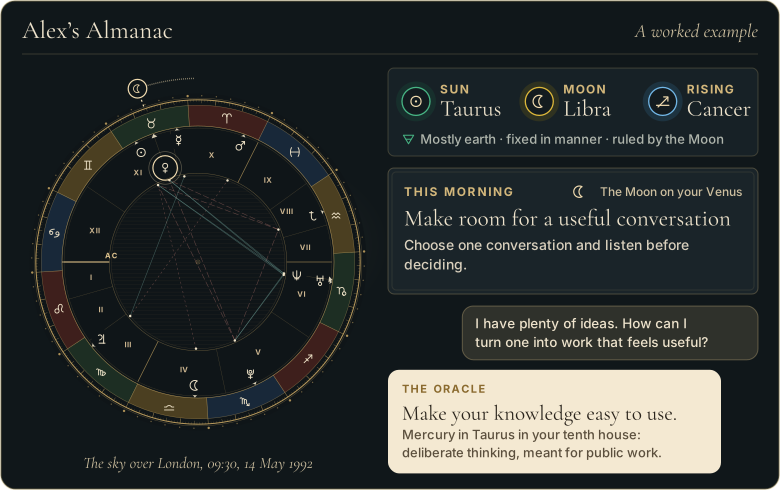
What does your own chart say about you?
Choose love, work or purpose. Your reading is written from your chart. Your reading uses your own birth details.
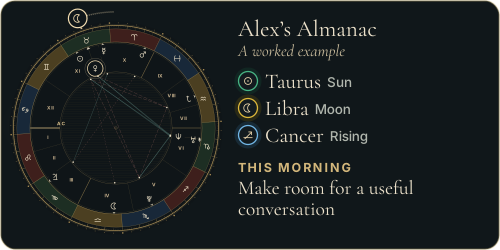
Walk through Alex’s whole example first
 The Road of AgesSee the turning points of your whole life, from your birth date
See your road's shape
The Road of AgesSee the turning points of your whole life, from your birth date
See your road's shape
Prefer to explore first?
 The Road of AgesThe turning points of your whole life, from your own chart
Walk my road
The Road of AgesThe turning points of your whole life, from your own chart
Walk my road
Free, by email
Your daily Almanac letter
One short letter at 7 each morning: the day’s theme read for your own chart, and one thing to do with it.
Kabbalah, Cabala, and Qabalah
All three English spellings transliterate a Hebrew word connected with receiving or tradition, and historical usage is inconsistent. Many contemporary scholars use Kabbalah for Jewish mysticism. Cabala often marks Renaissance Christian thinkers who interpreted Jewish materials through Christian theology. Qabalah is common in nineteenth- and twentieth-century Hermetic occultism. These are useful editorial conventions, not airtight linguistic borders. A book’s author, period, language, and community provide stronger identification than its cover spelling. Treating “Qabalah” as the secret original and “Kabbalah” as a corruption reverses the actual history of adaptation.
Jewish mystical foundations
Jewish Kabbalah encompasses diverse texts and practices rather than one diagram. Sefer Yetzirah reflects on creation through letters and numbers; the Bahir and Zohar develop symbolic readings of divine manifestation, Torah, commandments, and cosmic repair; Safedian thinkers such as Moses Cordovero and Isaac Luria shaped influential later systems. The sefirot are relational dimensions within theological discourse, not simply ten personality boxes. Jewish practice, Hebrew language, law, prayer, and communal interpretation remain central contexts. A Western occult chart that removes those contexts represents a reception of Kabbalah, not the whole tradition.
How Hermetic Qabalah built a correspondence system
Renaissance Christian Cabala and early modern occult philosophy helped move kabbalistic concepts into Christian and magical settings. Later groups, especially the Hermetic Order of the Golden Dawn, mapped the ten sefirot and twenty-two connecting paths onto planets, zodiac signs, elements, tarot trumps, colors, divine names, and initiation grades. This produced a flexible filing system for Western esotericism. The correspondences are historically layered choices, not translations directly found in the Zohar. Aleister Crowley, Dion Fortune, Israel Regardie, and others then published influential but differing versions.
How to read a Qabalistic diagram accurately
First identify the diagram’s source and path attributions. Golden Dawn, Thelemic, Christian, and Jewish layouts may use similar circles while giving paths or names different functions. Check transliteration because Hebrew letters can be rendered in multiple English forms. Do not assume a tarot correspondence is ancient merely because it appears beside a Hebrew letter. When comparing systems, create separate columns for the Jewish textual concept, Renaissance interpretation, and modern occult attribution. That preserves meaningful connections without collapsing distinct religions into a universal code or treating living Jewish tradition as raw material without history.
How to evaluate claims about Qabalah
Claims about Qabalah should be tied to a dated text, object, author, or community rather than presented as timeless fact. Names and images often accumulate new meanings as they move between languages, religions, literature, art, and popular culture. Etymology does not by itself determine later symbolism, and a resemblance between traditions is not proof that one secretly derived from the other. A useful interpretation identifies the historical layer being discussed, distinguishes evidence from speculation, and acknowledges competing readings. Personal reflection may begin with a cultural symbol, but it should not erase the people, texts, or circumstances that gave that symbol its documented forms.
A lecture on this, free to read

Sources and editorial method
Research and editorial references used for this page include:
- Encyclopaedia Britannica: Kabbala - Scholarly overview of Jewish mystical history and texts.
- The British Library: The Kabbalah - Historical introduction grounded in manuscripts and Jewish textual traditions.
These references support the factual, historical, textual, or interpretive claims on this page. Interpretive traditions are identified as such, and factual claims are kept separate from symbolic claims.
Related reading
Distinguish the spellings
A definition tells you what it is; your own birth chart tells you what it means for you. The Oracle casts your real chart and answers for your love, your work, and your year ahead, in conversation. It opens with the 7-day Seeker trial.
Speak with the OracleYour year, written once from your chart alone: the Cosmic Codex reads the whole of it, month by month. Open the Cosmic Codex
More in Mystical Systems
- Taoism
- The Great Work
- Tiphereth
- Alchemy
- Chesed
- Hermetic Qabalah
- Kabbalistic Tree of Life
- Mystery Schools
From the reference page to your own chart
Every word here
is in your own chart.
- A personal reading about love, work or purpose, written from your chart
- A practical next step to consider
- It opens with 7 days free, with the AI Oracle and daily guidance
$0 today, then $12/month after 7 days. Cancel anytime.
Common questions
Is Qabalah a different word from Kabbalah?
It is a different transliteration often used to signal Hermetic occult reception, but usage is not perfectly consistent.
Did ancient Kabbalists use tarot?
No evidence places tarot in early Jewish Kabbalah; systematic tarot correspondences are a later Western esoteric development.
Is the Tree of Life all of Kabbalah?
No. It is an important diagrammatic framework, but the traditions include extensive texts, practices, theology, and interpretation.
Free, by email
The Almanac, in your inbox at 7
One short letter at 7 each morning: the day’s theme read for your own chart, and one thing to do with it.
