Comparative religious symbolism
Tree of Life Symbol
Direct answer
There is no single universal Tree of Life diagram. The Edenic tree, the kabbalistic sefirot, Yggdrasil, the Buddhist bodhi tree, the Christian cross-tree, genealogical trees, and evolutionary trees have different sources and functions.
The Tree of Life is a family of tree images used to represent life, divine order, connection, ancestry, wisdom, fertility, salvation, or the structure of reality in different traditions.
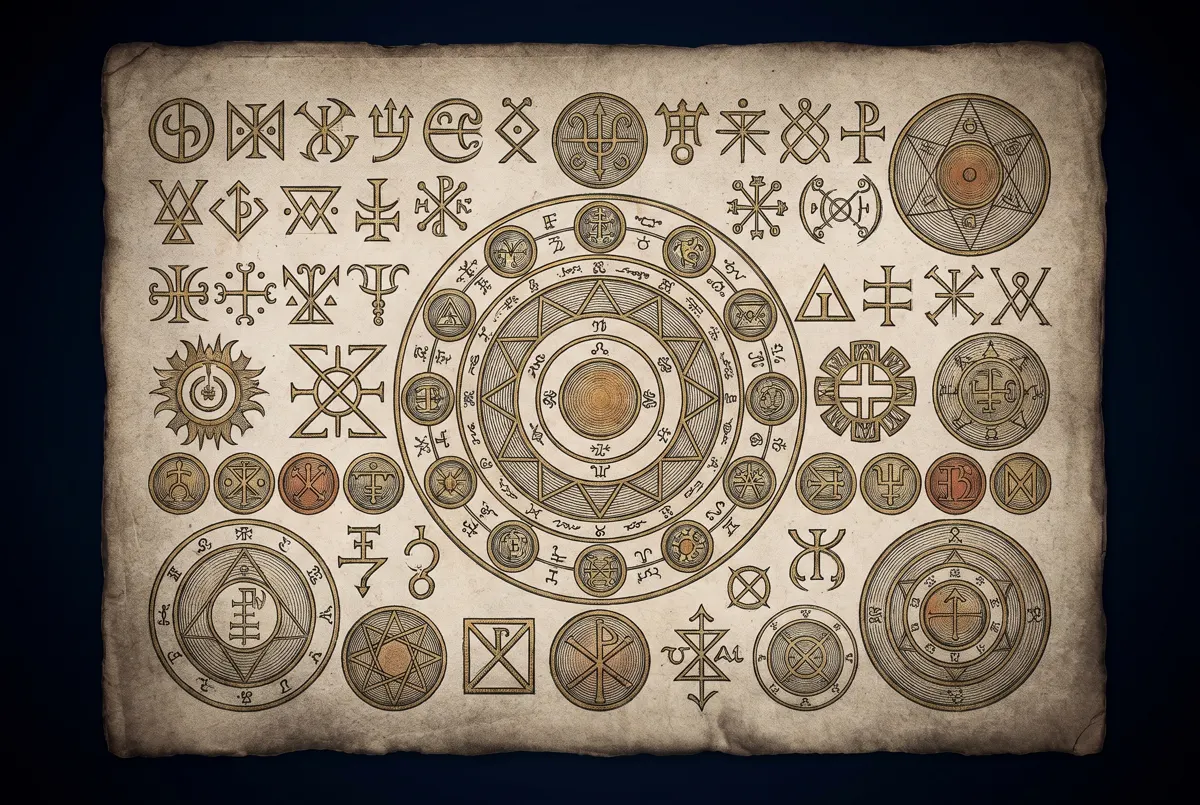
Tree of Life Symbol means a tree image of life, connection, roots, and heavenly-earthly order.
A conceptual orientation, not an exact historical reproduction of every mark or seal.Quick facts
| Question | Direct answer |
|---|---|
| Biblical appearance | The Tree of Life stands in Eden and reappears in Revelation’s restored city imagery. |
| Kabbalistic form | Ten sefirot arranged in a relational diagram, developed through Jewish mystical interpretation. |
| Norse comparison | Yggdrasil, the world tree connecting mythic realms. |
| Scientific use | A branching model of common descent, analogous in shape but evidence-based in function. |
The Instruments
Ten readings, worked out from your own birth chart
An instrument is a reading this house works out for you. Give your birth date, time and place once, and each one reads today’s real sky against the chart you were born under. Eight are personal; two are calendars anyone can open. A free account opens one instrument a day. The plans open every instrument, every day.
- Natal Chart Every planet, house and aspect in your chart
- Active Transits Where the planets are now, read against your chart
- Daily Counsel What to pursue today, and what to leave alone
- Personal Timing Your best days to decide, weeks ahead
- Fellowship Your chart and another, read side by side
- Theme of the Day The one thing today is asking of you
- Sacred Numbers Your life path, your cycles, your name in numbers
- Aeolian Harmonics Classical music chosen to match your chart
- Mercury Retrograde Every Mercury retrograde this year, with its dates Open to all
- Void-of-Course Moon When the Moon is between signs, hour by hour Open to all
The Tree of Life in Genesis and Revelation
Genesis places the Tree of Life in Eden alongside the Tree of the Knowledge of Good and Evil. After the humans eat from the prohibited tree, access to the Tree of Life is guarded, linking it with unending life and lost access. Proverbs uses “tree of life” metaphorically for wisdom, fulfilled desire, healing speech, and righteous fruit. Revelation returns to the image in a renewed city, where the tree bears fruit and its leaves serve the healing of nations. These passages are related within biblical tradition but do not supply the later ten-circle kabbalistic diagram.
The kabbalistic Tree of the sefirot
Jewish mystical texts and later diagrammatic traditions describe ten sefirot through which divine manifestation and relational processes are contemplated. Printed and manuscript trees arrange them in columns and paths, but layouts and emphases vary. Hermetic Qabalah later mapped planets, tarot cards, colors, and initiation systems onto a version of this tree. Those occult correspondences are historically later adaptations, not transparent translations of all Jewish Kabbalah. A responsible caption identifies whether the image is Jewish, Christian Cabalist, Golden Dawn, Thelemic, or a modern hybrid and preserves the source language where possible.
World trees, sacred trees, and independent traditions
Norse sources describe Yggdrasil as an immense tree connecting realms and involved in divine and cosmic events. Buddhist traditions revere the bodhi tree associated with the Buddha’s awakening. Ancient Near Eastern art includes stylized sacred trees whose precise names and functions vary. Mesoamerican, South Asian, African, and Indigenous traditions have their own axis, ancestry, fertility, and landscape trees. Calling every example “the same Tree of Life” can erase those differences. Similar branching forms arise naturally from trees and kinship, so resemblance alone cannot prove diffusion from one lost civilization.
Family trees and Darwin’s tree of descent
Branching diagrams became powerful tools for representing genealogy: one trunk or ancestor divides into lines of descent. Biology uses tree structures to model evolutionary relationships supported by comparative anatomy, fossils, genetics, and statistical inference. Darwin famously sketched a branching tree, and modern phylogenetics tests alternative patterns of common descent. This scientific tree is not a mystical energy map, even though artists may combine the images. Likewise, a commercial family-tree emblem cannot prove a specific lineage. The shared geometry helps humans organize relationships; evidence and purpose distinguish the diagrams.
Why context controls the meaning of Tree of Life Symbol
No symbol carries one fixed meaning across every culture and century. Interpreting Tree of Life Symbol begins with the object that bears it: where it was made, when it was made, who used it, what surrounds it, and whether any inscription or contemporary text explains it. Similar forms can arise independently because they are visually simple, structurally useful, or common in nature. A modern spiritual association may be meaningful to a community without being an ancient universal code. Good interpretation labels the specific tradition, separates documented use from personal association, and avoids claiming that an isolated motif proves hidden ancestry, supernatural protection, or a message intended for one viewer.
Sources and editorial method
Research and editorial references used for this page include:
- Bible Gateway: Genesis 2–3 - Primary biblical context for Eden’s Tree of Life.
- Encyclopaedia Britannica: Tree of Life - Comparative reference for religious tree imagery and traditions.
These references support the factual, historical, textual, or interpretive claims on this page. Interpretive traditions are identified as such, and factual claims are kept separate from symbolic claims.
Related reading
Read the symbol with context
Tree of Life Symbol in a book is one thing; Tree of Life Symbol in your own birth chart is your life. The Oracle casts your real chart and tells you what it means for your love, your work, and your year ahead, in conversation, free.
Speak with the OracleYour year, written once from your chart alone: the Cosmic Codex reads the whole of it, month by month. Open the Cosmic Codex
More in Sigils, Seals & Symbols
Common questions
Is the Tree of Life the same as the Tree of Knowledge?
No. Genesis names them separately, though later art and interpretation may relate them.
Is every Tree of Life image kabbalistic?
No. A kabbalistic tree usually shows ten sefirot; many other religious and decorative trees have different origins.
Does the symbol prove all religions share one source?
No. Similar tree imagery can arise independently, and historical connection requires evidence.