Comparative symbol history
Spiral Symbol
Direct answer
Spiral motifs are widespread because the form is simple to draw and appears in shells, storms, plants, and movement. Similar shape does not prove identical meaning: archaeological context, date, material, placement, and associated imagery are essential.
A spiral is a curve turning around a point while moving inward or outward, used in art across many cultures and often interpreted through motion, growth, cycles, return, or passage.
Quick facts
| Question | Direct answer |
|---|---|
| Basic form | A curve revolving around a center while its distance from that center changes. |
| Famous prehistoric context | Passage-tomb art at Newgrange and Knowth in Ireland. |
| Common modern associations | Growth, cycles, journey, inwardness, expansion, energy, or transformation. |
| Universal ancient meaning? | No. Many uses survive without explanatory texts, and traditions differ. |
Spiral Symbol means a curved symbol of unfolding, return, growth, or cyclic motion.
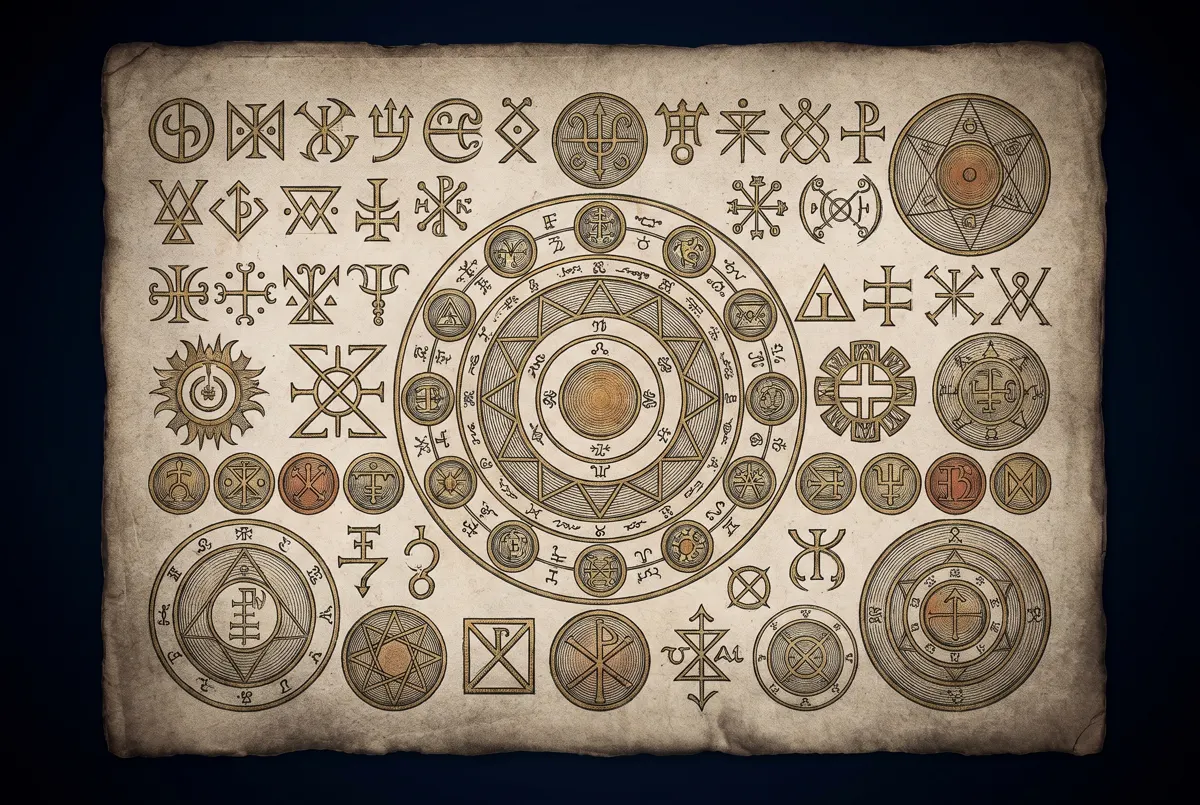
A conceptual orientation, not an exact historical reproduction of every mark or seal.
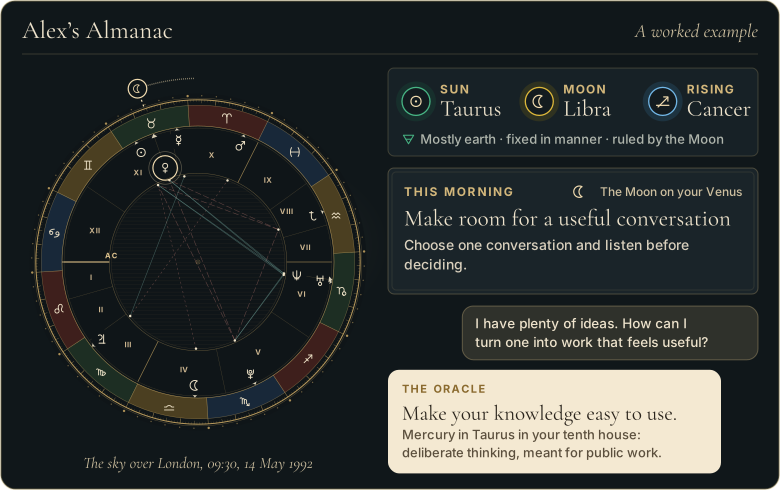
What does your own chart say about you?
Choose love, work or purpose for a personal insight and a useful next step. Your reading uses your own birth details.
Walk through Alex’s whole example first
 The Road of AgesSee the turning points of your whole life, from your birth date
Free first look
The Road of AgesSee the turning points of your whole life, from your birth date
Free first look
Prefer to explore first?
 The Road of AgesThe turning points of your whole life, from your own chart
Walk my road
The Road of AgesThe turning points of your whole life, from your own chart
Walk my road
Why a spiral invites symbolic interpretation
A spiral holds repetition and change in one line: it circles a center but never returns to precisely the same position. That visual structure supports modern associations with development, recurrence, descent, ascent, time, and unfolding. In nature, spiral-like forms appear in shells, seed heads, galaxies, weather systems, and fluid motion, though they arise from different physical processes. Not every artistic spiral copies nature, and not every natural spiral encodes spirituality. Geometry provides possibilities for metaphor; culture and context determine which possibilities a maker or community actually used.
Spirals in prehistoric monuments
Neolithic art at Brú na Bóinne in Ireland includes single, double, and triple spirals carved on stones associated with passage tombs. Newgrange’s famous triple-spiral motif and decorated entrance stone attract solar, lunar, calendrical, funerary, and initiatory interpretations. The monument’s midwinter sunrise alignment is documented, but that fact does not decode every carved sign. With no surviving explanatory text from the builders, archaeologists compare placement, carving technique, repeated motifs, landscape, and contemporary sites. Responsible writing distinguishes observed alignment and artifact context from speculative claims that the spiral definitely meant reincarnation or a named later deity.
Different spirals in different traditions
Greek meanders, Celtic and Insular ornament, Māori koru forms, Buddhist and Hindu diagrams, African designs, Pacific tattoo traditions, and modern logos can all contain spiral movement while carrying distinct histories. A Māori koru, for example, should not be relabeled a generic “Celtic spiral” because a viewer notices visual resemblance. Direction may matter in one design and be incidental in another; a double spiral may mark balance, sequence, or decoration according to context. Identify the object and community first, and use tradition-specific scholarship rather than compiling an unsupported worldwide dictionary of clockwise and counterclockwise meanings.
Dreams, tattoos, and modern spiritual use
Today people choose spirals to represent healing, growth, recovery, ancestry, a life path, or acceptance of cyclical change. Those personal meanings can be sincere without being prehistoric facts. For a tattoo, research whether a copied motif belongs to a living Indigenous tradition and whether permission or attribution matters. In dreams, note whether the spiral is a staircase, whirlpool, shell, storm, drawing, or motion; emotion and waking context are more informative than a universal list. A spiral does not by itself indicate spiritual awakening, mental illness, or a supernatural portal.
Why context controls the meaning of Spiral Symbol
No symbol carries one fixed meaning across every culture and century. Interpreting Spiral Symbol begins with the object that bears it: where it was made, when it was made, who used it, what surrounds it, and whether any inscription or contemporary text explains it. Similar forms can arise independently because they are visually simple, structurally useful, or common in nature. A modern spiritual association may be meaningful to a community without being an ancient universal code. Good interpretation labels the specific tradition, separates documented use from personal association, and avoids claiming that an isolated motif proves hidden ancestry, supernatural protection, or a message intended for one viewer.
Sources and editorial method
Research and editorial references used for this page include:
- UNESCO: Brú na Bóinne - Authoritative archaeological context for Newgrange, Knowth, and Dowth.
- National Monuments Service Ireland: Brú na Bóinne - Official heritage context for the monuments and their carved art.
These references support the factual, historical, textual, or interpretive claims on this page. Interpretive traditions are identified as such, and factual claims are kept separate from symbolic claims.
Related reading
Read the symbol with context
A definition tells you what it is; your own birth chart tells you what it means for you. The Oracle casts your real chart and answers for your love, your work, and your year ahead, in conversation, free.
Speak with the OracleYour year, written once from your chart alone: the Cosmic Codex reads the whole of it, month by month. Open the Cosmic Codex
More in Sigils, Seals & Symbols
From the reference page to your own chart
Every word here
is in your own chart.
- Your chart and numbers, read for you in about a minute
- Ask the Oracle anything about them
- Every personal tool and daily guidance
Free reading, no card needed. Optional membership: payment details required, 7 days free, then $12/month. Cancel before it renews and you pay nothing.
Common questions
What does a spiral symbolize?
Common themes include movement, cycles, growth, inward journey, and expansion, but the documented context controls meaning.
Does clockwise versus counterclockwise have a universal meaning?
No. Direction-specific meanings vary, and some objects were not designed around that distinction.
Is the triple spiral Celtic?
The famous Newgrange motif is Neolithic, thousands of years earlier than historically documented Celtic cultures in Ireland.