

Kabbalah and the sefirot
Geburah
Direct answer
Geburah is not simply an “evil” or punitive sphere. It represents necessary differentiation and measure, balancing the outpouring identified with Chesed. In many diagrams their tension is mediated through Tiferet, where severity and mercy can be held in a more proportionate relation.
Geburah is the fifth sefirah in the familiar tenfold arrangement. Its Hebrew name means strength or might, and kabbalistic interpretation associates it with judgment, boundary, restraint, awe, and the disciplined limitation of expansive force.
$0 today, then $12/month after 7 days. Cancel anytime.
Quick facts
| Feature | Reference point |
|---|---|
| Hebrew | גבורה, commonly transliterated Gevurah or Geburah. |
| Basic sense | Strength, might, power, discipline, and judgment. |
| Tree position | Usually fifth in the standard enumeration, opposite Chesed and above Hod. |
| Important distinction | Jewish kabbalistic meanings should be distinguished from later Hermetic planetary and tarot correspondences. |
Geburah means Strength or Severity, the force of boundary, judgment, and disciplined power.
A lineage map for books and systems; it avoids presenting symbolic traditions as literal fact.
What does your own chart say about you?
Choose love, work or purpose. Your reading is written from your chart. Your reading uses your own birth details.
Walk through Alex’s whole example first
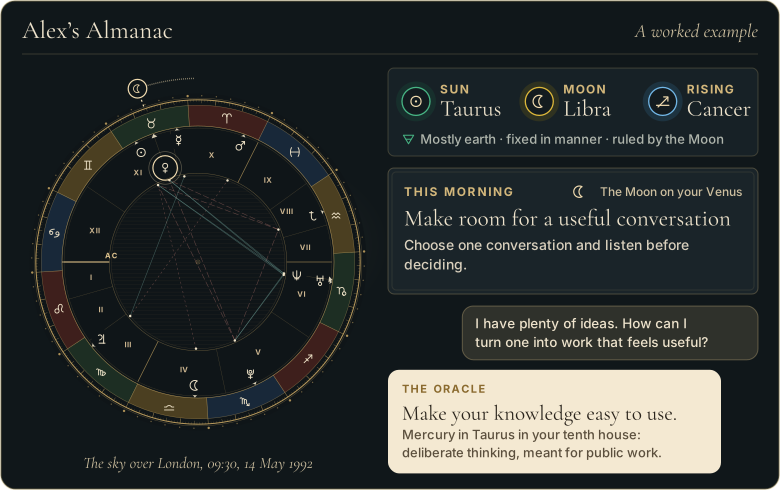
 The Road of AgesSee the turning points of your whole life, from your birth date
See your road's shape
The Road of AgesSee the turning points of your whole life, from your birth date
See your road's shape
Prefer to explore first?
 The Road of AgesThe turning points of your whole life, from your own chart
Walk my road
The Road of AgesThe turning points of your whole life, from your own chart
Walk my road
Free, by email
Your daily Almanac letter
One short letter at 7 each morning: the day’s theme read for your own chart, and one thing to do with it.
Strength as boundary and judgment
Gevurah names strength, but kabbalistic strength is not raw aggression. It includes the capacity to limit, distinguish, withhold, judge, and give form. Unlimited generosity can overwhelm its recipient or dissolve every boundary; measured restraint makes relation and responsibility possible. This is why Gevurah is often connected with din, judgment, and pachad, fear or awe. The terms describe an aspect of divine manifestation within particular Jewish mystical systems, not an independent god or a personality type that can be detached from theology. Translation should therefore preserve the relationship among power, discipline, and judgment rather than reducing the Hebrew name to severity alone.
The dynamic with Chesed and Tiferet
Chesed is commonly described through lovingkindness, expansion, and generosity, while Gevurah contracts and sets limits. The two are complementary, not a simple contest between good and bad. Tiferet, often associated with beauty, compassion, or harmony, mediates their polarity in many presentations of the sefirotic tree. Ethical reflection follows from the relation: mercy without accountability can enable harm, while judgment without mercy becomes cruelty. Balanced action requires both the courage to draw a boundary and the humility to apply it proportionately.
Why definitions differ across kabbalistic texts
The sefirot developed through centuries of Jewish mystical writing, including the Sefer Yetzirah’s earlier terminology, medieval theosophical Kabbalah, the Zohar, and later Cordoverian, Lurianic, Hasidic, and other interpretations. Diagrams and summaries can conceal genuine differences among these traditions. A source may emphasize cosmic emanation, divine names, ethical attributes, bodily symbolism, biblical verses, or devotional practice. Read Gevurah within the author’s complete system and avoid treating one modern keyword list as a timeless consensus.
Jewish Kabbalah and later Hermetic correspondences
Renaissance Christian cabala and nineteenth-century Hermetic Qabalah adapted the sefirot into new frameworks, often assigning Gevurah the planet Mars, red, weapon imagery, tarot correspondences, and ritual grades. Those systems are historically influential, but they are not interchangeable with Jewish Kabbalah and should not be retroactively attributed to the Zohar or to Judaism as a whole. Respectful study names the tradition being described, uses reliable translations, and resists reducing a living religious inheritance to occult décor. Gevurah can support reflection on disciplined power without authorizing harshness toward oneself or others.
Sources and editorial method
Research and editorial references used for this page include:
- Sefaria: Sefirot source collection - Primary Jewish texts and linked passages concerning the sefirot.
- Encyclopaedia Britannica: Kabbala - Historical overview of major ideas and developments in Jewish mysticism.
These references support the factual, historical, textual, or interpretive claims on this page. Interpretive traditions are identified as such, and factual claims are kept separate from symbolic claims.
Related reading
Let strength become holy restraint
A definition tells you what it is; your own birth chart tells you what it means for you. The Oracle casts your real chart and answers for your love, your work, and your year ahead, in conversation. It opens with the 7-day Seeker trial.
Speak with the OracleYour year, written once from your chart alone: the Cosmic Codex reads the whole of it, month by month. Open the Cosmic Codex
More in Mystical Systems
From the reference page to your own chart
Every word here
is in your own chart.
- A personal reading about love, work or purpose, written from your chart
- A practical next step to consider
- It opens with 7 days free, with the AI Oracle and daily guidance
$0 today, then $12/month after 7 days. Cancel anytime.
Common questions
Are Geburah and Gevurah different sefirot?
No. They are common transliterations of the same Hebrew word. Spelling differences reflect conventions for representing Hebrew sounds in Latin letters.
Is Geburah evil because it represents severity?
No. In kabbalistic thought, limitation and judgment are necessary powers. The ethical danger lies in imbalance, just as unbounded expansion can also become harmful.
Is Mars an original Jewish correspondence of Geburah?
The strong Mars assignment belongs especially to later Hermetic Qabalah. Jewish sources have their own diverse symbolic networks and should be described on their own terms.
Free, by email
The Almanac, in your inbox at 7
One short letter at 7 each morning: the day’s theme read for your own chart, and one thing to do with it.
