
How a working is built
Intention, image, word and act, repeated: the four parts most traditions share.
How do the traditions say a spell or ritual is built, part by part?
What it is
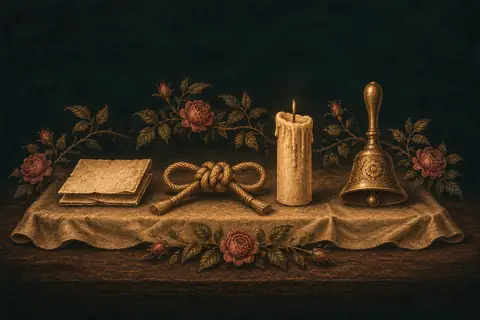
Most traditions build a working from the same four parts. There is an intention, stated as plainly as a sentence. There is an image that stands for it: a figure, a knot, a candle, a drawn sign. There are words, spoken or written, often in a set form. And there is an act that carries the rest, done at a chosen time and usually repeated. A spell, in this sense, is a wish given a shape, a voice and a deed.
The teaching
As the Western magical tradition from the papyri to the Golden Dawn teaches it.
What a working is
A working, in this tradition, is an act of will given a form. Aleister Crowley put the modern definition in one sentence: magick is “the Science and Art of causing Change to occur in conformity with Will.” Others in the same school call it the art of changing consciousness at will. The older books say the same thing in the language of faith: the operator, made pure and steady, joins what is below to what is above, and works by powers that belong to God.
Every working has four parts. There is the intention, the one thing wished for. There is the image, a thing that stands for it. There is the word, said or written with authority. And there is the act, done at a fitting time and place, that carries the other three. The papyri of Roman Egypt, the books of Solomon and the rituals of the lodges differ in almost everything else and agree in this.
Likeness and contact
Why should an act reach beyond itself? The tradition's oldest answer is sympathy: the world is one body whose parts feel one another, and things that are alike, or that have once touched, stay joined. James Frazer named the two laws that believers follow. By the law of similarity, like produces like, so that an image acts on what it pictures. By the law of contact, things once joined go on acting on each other at a distance, so that a lock of hair or a worn garment keeps its tie to its owner.
The learned magic of the Renaissance put the same idea in the language of the heavens. In Agrippa's teaching the virtues of the stars flow down through the soul of the world into stones, plants, metals and animals, so that each thing on earth bears the mark of a planet. A working gathers the things that share one virtue, at the hour when that virtue is strongest, so that like calls to like up the whole chain.
The intention
Every school begins with the intention and asks for it to be single and clear. The Golden Dawn had the purpose of a ceremony declared at its opening and held to throughout. Austin Osman Spare had the wish written out as one sentence before anything else was done. A wish that is vague, or that hides another wish behind it, is held to scatter the work; a wish that is single gathers it.
The tradition also limits what may be wished. The old spell books are full of workings aimed at other people, for love, for victory at law or for harm, and the churches, the philosophers of magic and the modern schools alike count every working that tries to force another person's will as the black art. The ground the tradition marks out as clean is one's own conduct, one's own mind and one's own home.
The image and its correspondences
The image gives the wish a body. It may be a likeness, such as a figure of wax or clay; a thing bound or loosed, such as a knot; a light that burns down, such as a candle of a chosen colour; or a sign that stands for the wish, such as a seal, a sigil or a written name. Knots are among the oldest images. In the folklore of the northern seas, wind was sold to sailors tied in a cord with three knots: the first to be untied for a breeze, the second for a strong wind and the third for a gale.
Correspondences dress the image. Each planet has its day and its metal: the Sun Sunday and gold, the Moon Monday and silver, Mars Tuesday and iron, Mercury Wednesday and quicksilver, Jupiter Thursday and tin, Venus Friday and copper, and Saturn Saturday and lead. A working for a quality is dressed in the things of its planet, so that every part of it says the same thing. Lead and quicksilver are poisons, and in this house they are names in a table and nothing to handle.
The word
The word is spoken with authority. In the spell books of Roman Egypt the speaker often names himself as a god, I am this one or that one, so that the command comes from a higher mouth. Strings of strange names, the barbarous words, are said for their sound and not their sense, among them palindromes such as ablanathanalba, and many spells close with a cry to the powers: now, now, quickly, quickly.
In the Jewish and Christian books the authority is the names of God. The magician adjures by the name of the Most High and by the names written in the circle and on the pentacles, and the power is held to lie in the names and not in the one who speaks them. The words are to be said exactly and with care, for a word spoken carelessly is held to leave the working undone.
The time and the act
The act carries the whole: the knot tied, the candle lit and watched as it burns down, the paper written and folded, the sign drawn and put away. It is done at a time chosen for its fitness, on the day and in the hour of the planet whose virtue is sought, with the Moon waxing for what is to grow and waning for what is to lessen. The planetary hours run in the old order, Saturn, Jupiter, Mars, the Sun, Venus, Mercury and the Moon, and each day begins at sunrise with the hour of its own planet.
Most workings are repeated. The papyri tell the user to say a charm several times or on several days, folk charms are said three times, and the lodges set their students daily rites. Repetition is held to build the working as water wears a stone.
The one who works
The one who works is part of the working. The grimoires ask for days of prayer, washing and plain living before an operation, with clean clothes and a clean place; the lodges ask for steady daily practice of concentration, of breath and of holding an image in the mind. The modern schools call the same thing focus or gnosis, a mind gathered on one point. The sensible limit, which careful teachers in every school repeat, is that no fast, vigil or exercise is pushed until it harms the body or unsettles the mind.
A working is closed as carefully as it is opened. The powers are thanked and given leave to go, the space is cleared with a banishing, and the operator returns to ordinary life, eats and rests. Then, many teachers say, the wish is let go: Crowley warned against the lust of result, and Spare taught that a wish must pass out of the mind once it has been made into its sign.
Last comes the record. The Golden Dawn and its heirs keep a diary of every working: the date and hour, the intention, what was done and what followed. The tradition asks the operator to judge honestly by that record, and keeping such a book of intentions is the one part of the art that a reader can practise with no rite at all.
How it is practised
Seen from outside, any working can be taken apart with four questions: what exactly was wished, what image stood for it, what was said, and what was done. A reader can try the first part alone, with no rite at all. Writing a wish as one clear sentence, about oneself and one's own conduct, is harder than it sounds and often shows what is actually wanted. The traditions add a warning of their own: a working aimed at another person's will is where harm begins.
Where it comes from
The Greek Magical Papyri of Roman Egypt already show the pattern: an offering, a spoken formula, a thing made and an instruction to repeat it. James Frazer began The Golden Bough in 1890, and in its later editions he sorted such rites under what he called sympathetic magic, working by likeness or by contact. Later anthropologists, Bronislaw Malinowski among them, added that magic gathers where outcomes are uncertain, as in fishing on the open sea, and is absent where skill alone is enough.
What is known, and what is not
The four-part pattern is well documented in texts and in fieldwork. That a working changes outside events is a claim of the traditions and has not been shown under test. What experiments on ritual do find is an effect on the person: a set sequence of actions lowers anxiety before an uncertain event. Frazer's scheme describes how believers reason. It is not evidence that the reasoning holds.
Its words
 Sympathetic Magic
- Frazer's name for magic that works by likeness or by contact: like is held to affect like, and things once joined to stay linked.
 Greek Magical Papyri
- The spell books of Greek and Roman Egypt, written between the second century BCE and the fifth CE in Greek, Demotic and Coptic.
Ask the Oracle further
Why do so many traditions build a magic ritual from the same four parts?What did Frazer mean by sympathetic magic, and is that how spells are held to work?
Before you practise
The Oracle explains these traditions as belief and practice, not as proven fact. It will never tell you that you are cursed, or name anyone as the cause. If someone is threatening you, that is for the police. If fear, voices or a sense of being controlled stays with you, please see a doctor.
Its other branches
Protection and cleansingCurses and fearWhite and black magicTalismans and sigilsThe grimoiresThe witch trialsWicca and the modern craftCunning folk and folk magicThe evil eyeCeremonial and chaos magicThe whole artSearch the tree

