
Wicca and the modern craft
A religion of the twentieth century, made public in England in 1954, and what it draws on.
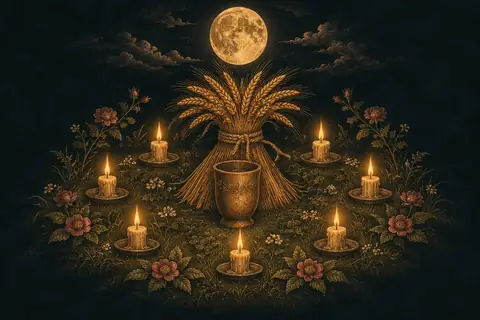
What is Wicca, where does it truly come from, and what do its members believe?
What it is
Wicca is a modern pagan religion. Its members, who often call themselves witches, honour a goddess and a god seen in the turning of the seasons, meet in small groups called covens or practise alone, and keep eight festivals known as the wheel of the year. Ritual is done inside a marked circle and usually includes a working for some purpose, which Wiccans call magic. Its best known ethical line, the Wiccan Rede, says that anything may be done that harms none. It is a living faith with followers in many countries, and it is told here from its own sources and from its historians.
The teaching
As Wiccan teaching from Gardner and Valiente to Cunningham teaches it.
The Goddess and the God
Wicca worships the divine as a Goddess and a God. The Goddess is the Lady of the Moon, the earth and the sea, mother of all living things, and many Wiccans honour her as maiden, mother and crone, the waxing, full and waning Moon. The God is the Horned One of the woods and the beasts and the lord of the Sun and the grain, who is born, grows, loves, dies and is born again with the turning year. Behind both, many Wiccans hold, is one source beyond naming, and the Goddess and God are the faces in which it can be known.
Nature is holy in this faith, not fallen, and the body and its pleasures belong to that holiness. The Charge of the Goddess, the best loved of its texts in Doreen Valiente's words, has the Goddess say that every act of love and pleasure is a rite of hers, that whoever does not find her within will never find her outside, and that she asks no sacrifice, for she is the mother of all living.
The Rede and the law of return
The Wiccan Rede gives the faith its one rule of conduct: whatever harms none may be done freely. It is read as both freedom and burden, since every act must be weighed for the harm it might do, to oneself included. Many Wiccans add a law of return, that what a person sends out comes back to them, and some say threefold. Both teachings rule out any working against another person's will or good.
The circle and its tools
Wiccan rites take place within a circle cast for each meeting, a space set between the worlds. The priestess or priest walks it with the athame, the black-handled knife, which is a tool for directing power and is never used to cut, while a white-handled knife does the cutting work of the craft. Salt and water are blessed and sprinkled round, the circle is censed and carried round with fire, and the guardians of the four quarters are called at east, south, west and north. Members enter the circle in perfect love and perfect trust.
The tools of the altar stand for the elements: the athame and the wand for air and fire, which traditions assign differently, the chalice for water, and the pentacle, a disc marked with a five-pointed star, for earth, with the censer, the candles and the cords. Gardner's covens work skyclad, unclothed, as a sign of freedom, and many other Wiccans robe. Fire is part of nearly every rite, and a candle in the circle is watched as any flame is watched.
Drawing down the Moon
At the full moons, the esbats, the coven meets to worship and to work. In the rite called drawing down the Moon the high priest invokes the Goddess into the high priestess, who then speaks as her, often in the words of the Charge. Cakes and wine are blessed, the cup held by the priestess and the athame lowered into it by the priest, in token of the union of Goddess and God, and shared round. Work for a purpose is done by raising power with chant and dance, the cone of power, and sending it to its end, and the circle is closed with thanks to the quarters.
The wheel of the year
The year turns on eight festivals, the sabbats. Samhain, on the last night of October, is the Wiccan new year, when the veil between the living and the dead is thin and the dead are remembered; the God has gone down into the underworld. Yule, at the winter solstice, keeps his rebirth as the returning Sun.
Imbolc, at the start of February, keeps the first stirring of spring and the Goddess as a maiden, with candles and the fires of Brigid. Ostara, at the spring equinox, is the balance of light and dark tipping toward the light, with eggs and new growth.
Beltane, on the eve of May, is the festival of fertility and of the union of Goddess and God, with the maypole and the bonfire. Litha, at the summer solstice, is the God at the height of his strength on the longest day.
Lughnasadh, also called Lammas, at the start of August, is the first harvest, when the God as the grain gives his life so that the people may eat. Mabon, at the autumn equinox, is the second harvest and a thanksgiving, as the dark begins to win. South of the equator many Wiccans turn the wheel to fit their own seasons.
The degrees and the solitary
Covens in the lines of Gardner and of Alex Sanders give three degrees. The first makes a person a witch and a priestess or priest of the craft; the second brings more of the teaching and a share in leading the rites; the third makes a high priestess or high priest, who may found a coven. The teaching passes in a Book of Shadows, copied by each initiate from the book of the one who brought them in. Others practise alone, as Scott Cunningham taught, holding that a sincere person may dedicate themselves to the Goddess and the God without a coven.
How it is practised
A reader who is drawn to Wicca can learn it as any religion is learned: from its own books, beginning with those of Doreen Valiente and Scott Cunningham, from open public rituals, and from people who practise it, taking time before joining anything. The seasonal festivals can be kept by anyone as a way of noticing the year: a candle at midwinter, flowers at the start of May, a shared meal at harvest. Any group that asks for money, for secrecy from family or for obedience to one leader fails the tests this shelf gives elsewhere.
Where it comes from
The religion became public in England in 1954, when the retired civil servant Gerald Gardner published Witchcraft Today, three years after the last English law against witchcraft was repealed. Gardner said he had been initiated in 1939 into a coven in the New Forest that carried on an ancient religion. Historians, above all Ronald Hutton, have found no evidence of that survival, and trace the rites to Freemasonry, the Golden Dawn, folklore and the writings of Margaret Murray and Aleister Crowley. Doreen Valiente rewrote much of the liturgy in the 1950s, and the names of several festivals were settled only in the 1970s.
What is known, and what is not
That Wicca dates from the middle of the twentieth century is established by the documents, and many Wiccans now accept this while valuing the older materials it draws on. The claim of an unbroken witch religion from before Christianity is not supported. The festivals mix old and new: the solstices and the Irish quarter days have long histories, while the set of eight is modern. As with any working on this shelf, no test has shown that a spell changes outside events, and the worth of the religion to its members does not rest on that.
Its words
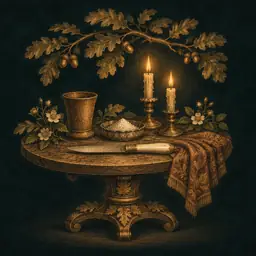 Wicca
- A modern pagan religion, made public in England by Gerald Gardner in 1954, whose members often call themselves witches.
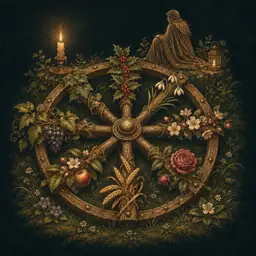 Wheel of the Year
- The cycle of eight seasonal festivals kept by Wiccans and other modern pagans: the solstices, the equinoxes and four days between.
- Coven
- A small group of witches who meet to keep the festivals and work ritual together; in Wicca, by custom, no more than thirteen.
Ask the Oracle further
Is Wicca an ancient religion or a modern one, and what did Gerald Gardner add?What are the eight festivals that Wicca calls the wheel of the year?
Before you practise
The Oracle explains these traditions as belief and practice, not as proven fact. It will never tell you that you are cursed, or name anyone as the cause. If someone is threatening you, that is for the police. If fear, voices or a sense of being controlled stays with you, please see a doctor.
Its other branches
How a working is builtProtection and cleansingCurses and fearWhite and black magicTalismans and sigilsThe grimoiresThe witch trialsCunning folk and folk magicThe evil eyeCeremonial and chaos magicThe whole artSearch the tree

