
The grimoires
The books of magic, from the Key of Solomon to the Golden Dawn: who wrote them, and when.
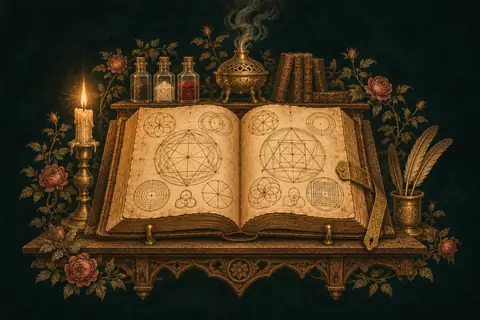
What are the grimoires, the old books of ritual magic, and what is truly known of them?
What it is
A grimoire is a handbook of ritual magic. It gives prayers and preparations, the circle to stand in, lists of spirits with their signs, and designs for talismans. Most were copied by hand and passed privately, and nearly all claim an ancient author, above all King Solomon. The best known are the Key of Solomon, the Lesser Key with its catalogue of seventy-two spirits, the Picatrix and the Sworn Book of Honorius. They read less like scripture than like technical manuals, full of conditions and warnings.
The teaching
As the grimoire tradition from the Key of Solomon to Mathers teaches it.
What a grimoire is for
A grimoire is a working book: it teaches an operation from beginning to end, and it rests on one idea. The magician does nothing by his own power. He is made pure, armed with the names of God and the seals of Solomon, and set within a consecrated circle, and by that authority the spirits are held to come, answer and obey. Without the purity and the names, the books warn, the operator is in danger and the spirits deceive.
The Key of Solomon
The Key of Solomon opens with its legend: Solomon wrote it for his son Roboam and commanded that it be buried with him, until the wise found it. Its first book teaches the planetary hours, the conjurations, the experiments for particular ends and the pentacles; its second the preparation of the operator and the instruments, and how each is made and consecrated. The operator prepares with days of prayer, confession, fasting and continence, bathes in blessed water and puts on a robe of white linen. Its fasting is taught here as the book's own demand and not as a practice: those whom a fast could harm, the young, the old and frail, the unwell, the pregnant and the nursing, keep none.
The instruments are many and each has its rule: the knife with the white hilt, which serves for making the other instruments, the knife with the black hilt for drawing the circle, the sword, the wand, the staff, the pen and ink, and the parchment. Each is made on a set day and hour, inscribed with names and characters, censed and sprinkled with blessed water, and wrapped in silk when not in use.
The circle is the heart of the operation. It is drawn on the ground with the consecrated knife or sword, with names of God written between its rings and pentacles laid or worn, and the operator stands within it and does not leave it until the spirit has been given its licence to depart. The spirits are called by conjurations that rise in force, each in God's names, and are dismissed with thanks and a charge to go in peace and do no harm.
The Lesser Key
The Lesser Key of Solomon has five parts. The Goetia catalogues the seventy-two spirits Solomon is said to have bound, with their ranks, shapes, offices and seals; its operator stands in a circle inscribed with divine names, calls the spirit into a triangle drawn outside it, and wears the pentagram of Solomon on the breast and his hexagram at the skirt of the robe, to be shown to the spirit when it appears. The Theurgia Goetia deals with the spirits of the points of the compass, good and evil mixed; the Ars Paulina with the angels of the hours of the day and night and of the signs of the zodiac; the Ars Almadel with angels addressed through a tablet of wax; and the Ars Notoria, the notory art, with prayers and figures for gaining memory, eloquence and the liberal arts.
The other books
The Heptameron gives the angels of the days of the week, Michael for Sunday, Gabriel for Monday, Samael for Tuesday, Raphael for Wednesday, Sachiel for Thursday, Anael for Friday and Cassiel for Saturday, with the circle to be drawn for each. The Sworn Book of Honorius sets its aim above all others, the vision of God in this life, sought through long prayer and confession and a great figure called the Seal of God. The Book of Abramelin puts the whole of magic after one work, the knowledge and conversation of one's holy guardian angel, and uses squares of letters for its operations.
The French chapbooks are of another spirit. The Grand Grimoire and its kin teach a pact with Lucifuge Rofocale, the prime minister of hell, for the finding of hidden treasure, and set out hell as a government under Lucifer, Beelzebuth and Astaroth. The Church counted every pact with a spirit a denial of God.
The angelic language
From the visions of John Dee and Edward Kelley came another system, which the Golden Dawn took up: an angelic language with its own alphabet, nineteen calls or keys in that tongue by which the angels are addressed, the last of them repeated for each of thirty aethyrs, and a great table of letters divided into four watchtowers, from which the names of hosts of angels are drawn. Dee held that the angels themselves dictated it, letter by letter, as Kelley gazed into a stone.
How the books are read
Every grimoire demands much of its user, a pure life, exact hours, rare materials and long prayer, and every one promises much in return: knowledge, treasure, love, safety and command over spirits. Read as their users read them, they are books of hope and of fear. The house reads them as books and performs nothing from them.
How it is practised
A grimoire is best read as a historical document. Of any one a reader can ask: whose name is on it, and when was the oldest copy really made; what does it promise; what does it demand in preparation and prayer; and what does that say about the hopes of the people who used it? Owen Davies's history and the scholarly editions answer most of these. The house reads the books this way and performs nothing from them.
Where it comes from
The roots lie in the Greek Magical Papyri and in Jewish and Arabic texts, but the grimoires proper are medieval and later. The oldest manuscripts of the Key of Solomon are from the fifteenth century, more than two thousand years after Solomon. The Lesser Key was put together in the seventeenth century from older parts. Print made such books cheap: French chapbooks such as the Grand Grimoire sold widely in the eighteenth and nineteenth centuries. In 1889 S. L. MacGregor Mathers published an English Key of Solomon, and the Golden Dawn built its rituals on sources of this kind.
What is known, and what is not
The manuscripts exist and can be dated by their paper, handwriting and language, and none goes back to the authors they name. Solomon, Moses, Honorius and Albertus Magnus did not write the books signed with their names. The seventy-two spirits of the Lesser Key derive largely from a list that Johann Weyer printed in 1577. Whether any rite in them ever did what it promised is nowhere recorded by a neutral witness. Their value is as evidence of what people feared and wanted.
Its words
 Grimoire
- A handbook of ritual magic, usually signed with an ancient name such as Solomon to lend it authority.
 Talisman
- An object made at a chosen time to draw a particular influence, as distinct from an amulet, which only wards off.
 Greek Magical Papyri
- The spell books of Greek and Roman Egypt, written between the second century BCE and the fifth CE in Greek, Demotic and Coptic.
Ask the Oracle further
Did King Solomon really write the Key of Solomon and the other books of ritual magic?Which grimoires did the Golden Dawn draw on for its ceremonial magic?
Before you practise
The Oracle explains these traditions as belief and practice, not as proven fact. It will never tell you that you are cursed, or name anyone as the cause. If someone is threatening you, that is for the police. If fear, voices or a sense of being controlled stays with you, please see a doctor.
Its other branches
How a working is builtProtection and cleansingCurses and fearWhite and black magicTalismans and sigilsThe witch trialsWicca and the modern craftCunning folk and folk magicThe evil eyeCeremonial and chaos magicThe whole artSearch the tree

