
The Golden Dawn
The London order of 1888 that shaped modern occultism.
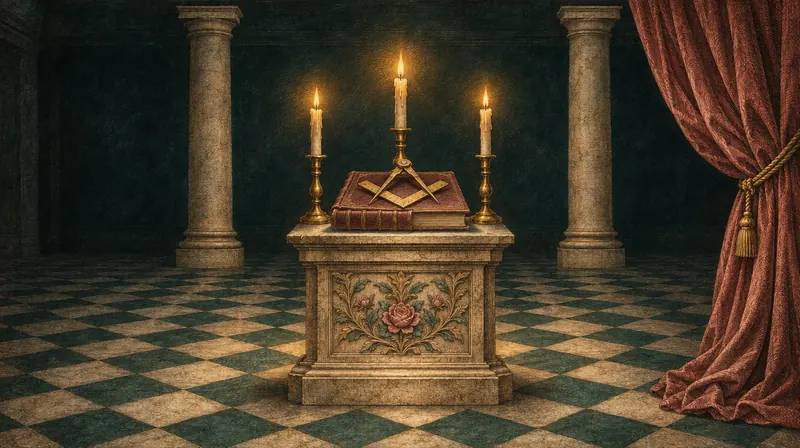
What was the Golden Dawn, the London order of 1888?
What it is
The Hermetic Order of the Golden Dawn was a private society for the study and practice of ceremonial magic. Members advanced through grades, each with an examination and a ceremony, and followed a set course: the Hermetic Qabalah, astrology, the tarot, alchemy, geomancy and the angelic system recorded by John Dee. It admitted women on the same terms as men, which was unusual for its time. A few hundred people passed through its temples in London, Bradford, Weston-super-Mare, Edinburgh and Paris during the 1890s.
The teaching
As the order's own course in Israel Regardie's printing of 1937 to 1940 teaches it.
The Tree and the grades
The order taught by grades, and its grades are steps up the Tree of Life of the Qabalah, from Malkuth, the Kingdom, at the foot, to Kether, the Crown, at the top. Each grade bears two numbers: the first counts the step, the second names the sephirah it belongs to, counted down from the Crown, so that a Zelator, 1=10, has taken the first step and stands in the tenth. The grades fall into three orders: the Outer, which is the Golden Dawn proper; the Second, the Order of the Red Rose and the Cross of Gold; and the Third, which belongs to the Secret Chiefs, the masters the order held to stand beyond its living members.
The grades of the Outer Order
The Neophyte, 0=0, stands at the threshold, not yet on the Tree. The grade is a beginning: the candidate is brought from darkness into light and given the first lessons and the first daily rite.
The Zelator, 1=10, belongs to Malkuth and to the element of Earth. The Kingdom is the world as the senses give it, and the climb begins there, on the ground of what is real.
The Theoricus, 2=9, belongs to Yesod, the Foundation, and to Air. To reach it the candidate passes the thirty-second path, of the letter Tav and the tarot card of the Universe, rising from the earth to the Moon's sephirah of images and dreams.
The Practicus, 3=8, belongs to Hod, Splendour, and to Water, reached by the thirty-first path, of Shin and the card of Judgement, and the thirtieth, of Resh and the Sun. Hod is the sephirah of Mercury, of the intellect and the forms of things.
The Philosophus, 4=7, belongs to Netzach, Victory, and to Fire, reached by the twenty-ninth path, of Qoph and the Moon card, the twenty-eighth, of Tzaddi and the Star, and the twenty-seventh, of Peh and the Tower. Netzach is the sephirah of Venus, of feeling and desire, and with it the four elements of the Outer Order are complete.
The Portal and the Second Order
Between the orders stands the Portal of the Vault of the Adepti, a grade with no sephirah of its own, in which the four elements worked through below are crowned by a fifth, Spirit, as the four lower points of the pentagram are crowned by the fifth.
The Adeptus Minor, 5=6, belongs to Tiphareth, Beauty, the sun at the heart of the Tree. Here the order's practical magic begins, under the adept's vow, in the vault described below.
The Adeptus Major, 6=5, belongs to Geburah, Severity, the sephirah of Mars, of strength and of judgement.
The Adeptus Exemptus, 7=4, belongs to Chesed, Mercy, the sephirah of Jupiter, of order and grace, and is the highest grade of the Second Order.
The Third Order
The Magister Templi, 8=3, belongs to Binah, Understanding, the first of the three highest sephiroth, the great Mother of form, under Saturn.
The Magus, 9=2, belongs to Chokmah, Wisdom, the great Father, the first outpouring of force, whose heaven is the zodiac.
The Ipsissimus, 10=1, belongs to Kether, the Crown, the first point of being. The order taught that these three grades were held by the Secret Chiefs, from whom its authority came, and by no member of its temples.
The Hall of the Neophytes
The Neophyte ceremony is the pattern of all the rest. The candidate, called a child of earth, comes hoodwinked to the door: in darkness, seeking light. Within, the officers are clothed as the gods of Egypt. The Hierophant on the throne of the east is Osiris, the one who shows the mysteries; the Hiereus in the west, the place of darkness, is Horus, the guardian against evil; the Hegemon between the pillars is the goddess of truth, who guides the candidate and reconciles the opposites; and the Kerux, the herald, is Anubis. The Stolistes in the north purifies with water, and the Dadouchos in the south consecrates with fire.
The two pillars are the two sides of the Tree, the black of severity and the white of mercy, and the path runs between them. Brought between them, purified and consecrated, the candidate at last has the hoodwink taken away and sees the light. The meaning of the grade is that a light has been kindled which the rest of the work is to grow.
The knowledge lectures
Every grade had its knowledge lecture, and an examination before the next. The first gives the elements and their symbols; the twelve signs of the zodiac grouped by their elements; the seven planets and their signs; the twenty-two letters of the Hebrew alphabet with their names, numbers and meanings; and the ten sephiroth with their names in Hebrew and English. Later lectures add geomancy and its sixteen figures, the tarot, the alchemical symbols, the paths of the Tree and the divine names that rule each part of it.
Each member took a motto, the name of the self that seeks. Westcott's was Sapere Aude, dare to be wise; Yeats's Demon est Deus Inversus, the devil is God reversed; Florence Farr's Sapientia Sapienti Dono Data, wisdom is given as a gift to the wise; and Crowley's Perdurabo, I will endure to the end.
The Lesser Ritual of the Pentagram
The first practice the Neophyte receives is the Lesser Ritual of the Pentagram, done daily. It opens with the Qabalistic Cross. Standing and facing east, the student touches the forehead and says Ateh, thou art; the breast, Malkuth, the kingdom; the right shoulder, ve-Geburah, and the power; the left shoulder, ve-Gedulah, and the glory; and, hands clasped on the breast, le-Olahm, Amen, for ever, amen.
Then in each quarter the student traces a pentagram in the air, the banishing pentagram of Earth, drawn from its lower left point up to its top, and vibrates a divine name into its centre: in the east YHVH, in the south Adonai, in the west Eheieh and in the north AGLA. Standing with arms outstretched as a cross, the student calls on the archangels: before me Raphael, behind me Gabriel, on my right hand Michael, on my left hand Auriel, for about me flames the pentagram and in the column stands the six-rayed star. The Qabalistic Cross is made again to close.
The rite clears the student's place and mind before work and steadies them after it. The lecture warns that whoever takes it for a mere device for calling up or driving away spirits has missed it, and calls it, rightly understood, the medicine of metals and the stone of the wise: its true work is on the one who performs it.
The tarot of the order
The order's tarot, set out in its Book T, ties every card to the Tree. The twenty-two trumps are the twenty-two paths and the twenty-two Hebrew letters, beginning with the Fool on Aleph, the Magician on Beth and the High Priestess on Gimel. Strength and Justice exchange their old places, so that Strength, on Teth, falls under Leo, and Justice, on Lamed, under Libra. The four suits are the four elements and the four letters of the divine name: Wands are Fire, Cups Water, Swords Air and Pentacles Earth.
The court cards are King, Queen, Prince and Princess, the elements within each element. The small cards from two to ten are the thirty-six decans of the zodiac, ten degrees each, beginning with the two of Wands for Mars in the first decan of Aries. The aces are the roots of the four elements, from which the rest grow.
The vault and the Rose Cross
The Adeptus Minor ceremony brings the candidate into the vault of the Rosicrucian story, seven-sided as the Fama tells it and painted in symbolic colours, with the founder's tomb at its centre. Bound on a cross, the candidate takes the adept's obligation: from that day to apply themselves to the Great Work, which is to purify and exalt their spiritual nature, so that with divine help they may at length become more than human, and by degrees raise and unite themselves to their higher and divine genius. Then the tomb is opened and the Chief Adept rises from it as Christian Rosenkreutz, a figure of the death and rising the adept is to undergo within.
The adept's emblem is the Rose Cross. On a cross whose arms carry the colours of the elements is a rose of twenty-two petals in three rows, three, seven and twelve, for the three mother letters, the seven double and the twelve simple letters of the Hebrew alphabet, so that the whole alphabet, and with it the whole Tree, blooms at the heart of the cross.
Vision through the tattwas
One method the order taught for seeing in the spirit used the tattwas, five coloured symbols of the elements taken from Indian teaching: a yellow square for earth, a silver crescent for water, a blue circle for air, a red triangle for fire and a black egg for spirit. The student gazes at a symbol, closes the eyes to see its after-image in the opposite colour, imagines it grown into a doorway and passes through it in imagination, noting what is seen and testing every figure met by the divine names of that element. The return is made by the same door, and the Pentagram Ritual ends the work.
The papers treat this as disciplined imagination: sessions are short, the return is complete, and the mind is cleared afterwards. Anyone whom such work leaves unsettled, sleepless or unsure of what is real should stop, and speak with a doctor if it does not pass.
How it is practised
The order's method was study before practice: a member learned the Hebrew alphabet, the planets and signs and the order of the cards before any ceremony was taught. Its papers were printed by Israel Regardie between 1937 and 1940, so the whole course can be read by anyone. A reader today can treat it as a syllabus of Western symbolism and take it slowly, one table of correspondences at a time, without joining anything. Groups that use the name now are modern foundations.
Where it comes from
It was founded in London in 1888 by three Freemasons, William Wynn Westcott, Samuel Liddell MacGregor Mathers and William Robert Woodman. Westcott said its rituals came from a manuscript in cipher and that a German adept, Anna Sprengel, had authorised the temple by letter. Mathers wrote most of the working ceremonies. The poet W. B. Yeats joined in 1890, the actress Florence Farr came to lead the London temple, and Aleister Crowley was admitted in 1898. In 1900 the London members rejected Mathers's rule, and within three years the order had broken into rival bodies.
What is known, and what is not
The founding, the membership rolls and the quarrels are well documented, largely from the order's own surviving papers. The cipher manuscript exists, though its author is not known. The Sprengel letters are another matter: Mathers himself charged Westcott with forging them in 1900, and the historian Ellic Howe concluded in 1972 that they were fabricated. The order's claim to an old lineage in Rosicrucianism is therefore its own legend. What its ceremonies achieve is a matter of belief.
Its words
- Hermetic Order of the Golden Dawn
- A society founded in London in 1888 that taught ritual magic in graded steps and admitted women as equals. Most later Western occultism borrows from it.
- Rosicrucianism
- The current that grew from three German books of 1614 to 1616 announcing a secret brotherhood of the Rose Cross, which no one ever found.
- Freemasonry
- A fraternity organised in lodges, which teaches by ceremony and the symbols of the stonemason's craft. Its documented history begins in Scotland and England about 1600.
Ask the Oracle further
Which poets and artists belonged to the Golden Dawn, and what did they take from it?Were the founding letters of the Golden Dawn forged?
Before you practise
The Oracle keeps documented history apart from an order’s own legend, and both apart from conspiracy theory. It claims no order’s secrets.
Its other branches
The FreemasonsThe RosicruciansThe ancient mysteriesTemplars and IlluminatiThe GnosticsThe whole artSearch the tree

