
The Freemasons
From stonemasons’ lodges to the Grand Lodge of 1717.
What is the documented history of the Freemasons?
What it is
Freemasonry is a fraternity whose members meet in lodges and are admitted by ceremony through three degrees: Entered Apprentice, Fellow Craft and Master Mason. It teaches by allegory, taking the stonemason's tools, the square, the compasses and the level, as figures for conduct. The third degree is built round the legend of Hiram Abiff, master builder of Solomon's Temple, which the lodges teach as allegory. Further degrees, such as those of the Scottish Rite, may be taken afterwards and give no authority over the lodge. Regular lodges ask a candidate to profess belief in a Supreme Being and bar talk of religion and politics from their meetings. It is not a religion, and its halls, officers and rule books are public.
The teaching
As the craft's printed monitor of William Preston and Thomas Smith Webb teaches it.
A system of morality veiled in allegory
Freemasonry calls itself “a peculiar system of morality, veiled in allegory and illustrated by symbols”, peculiar in the old sense of its own. It is not a creed, since a lodge holds men of many faiths, but a way of building a life, taught by the figure of a building. Working masons shaped rough stone and raised temples; the Freemason, a speculative mason, takes their tools as lessons and turns them on himself. The building he raises is his own character, and the pattern held before him is King Solomon's Temple.
Each of the three degrees is given by a ceremony, kept within the lodge with the signs by which Masons know one another, and explained by a lecture whose public part the craft prints in its monitors. That public part is what follows.
The lodge and its lights
A lodge is a figure of the world, reaching in the lecture's words from east to west and from the centre of the earth to the heavens, to show that the craft is universal and that a Mason's charity should know no bounds but those of prudence. Its covering is the starry sky, reached by the ladder Jacob saw, whose chief rounds are Faith, Hope and Charity; the greatest is Charity, which outlasts the grave. Three pillars hold it up: Wisdom to contrive, Strength to support and Beauty to adorn.
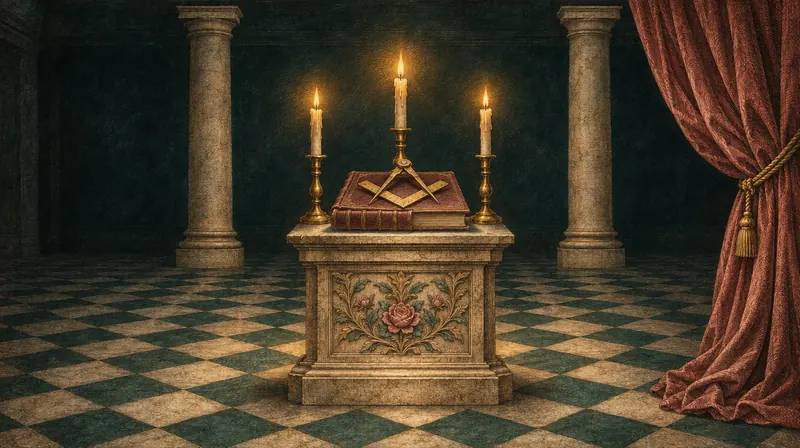
On the altar lie the three great lights: the Bible, or the sacred book of the candidate's own faith, to guide his faith; the square, to square his actions; and the compasses, to keep his desires within due bounds. The lesser lights are the sun, the moon and the Master, who should rule his lodge as they rule the day and the night. The floor is a mosaic pavement of black and white, human life chequered with good and evil. On it lie the rough ashlar, a stone fresh from the quarry, which is a person in the rude state of nature, and the perfect ashlar, squared by the workman, the state he hopes to reach by education, effort and the blessing of God.
The Entered Apprentice
The first degree receives a man who has asked of his own free will, for the craft does not recruit. He comes as one in darkness seeking light, the craft's word for instruction, and takes his first lesson in the north-east corner, where a building's foundation stone is laid. His tools are the twenty-four inch gauge and the common gavel, with the chisel in the English working. The gauge is the day's twenty-four hours: eight for the service of God and of a worthy brother in distress, eight for his calling, eight for refreshment and sleep. The gavel, which knocked the corners off rough stones, teaches him to rid his heart of vice and excess, fitting him as a living stone for the house not made with hands. The chisel shows the worth of education.
His white lambskin apron is the badge of a Mason and an emblem of innocence. He is charged with three duties: to God, to speak His name only with reverence and to seek His help in all he does; to his neighbour, to act on the square and do as he would be done by; and to himself, to keep body and mind sound, so that he may use his gifts for God's glory and the good of others.
Brotherly love, relief and truth
Three tenets bind every Mason. By brotherly love he regards the whole human race as one family, children of one Almighty Parent, who are to aid and protect one another. Relief is the duty owed to the distressed. Truth is the foundation of every virtue, and to be good and true is the first lesson of the craft. With them come the four cardinal virtues: temperance, the due restraint of the passions; fortitude, the steady purpose that bears pain and danger when duty asks it; prudence, which orders life by reason; and justice, by which he renders to everyone their due.
The Fellow Craft and the winding stair
The second degree turns to the trained mind. Its tools are the square, the level and the plumb: the square teaches morality; the level equality, since all travel on the same level of time to the undiscovered country from whose bourn no traveller returns; and the plumb uprightness of life.
He is shown the two pillars of the Temple's porch: “he set up the right pillar, and called the name thereof Jachin: and he set up the left pillar, and called the name thereof Boaz.” The lecture reads Boaz as strength and Jachin as to establish, and the two together as stability. Then, in the craft's story, he climbs the stair, for “they went up with winding stairs into the middle chamber”, by three, five and seven steps. Three rule a lodge, five hold it and seven make it perfect. The five are also the orders of architecture, Tuscan, Doric, Ionic, Corinthian and Composite, and the five senses, hearing, seeing, feeling, smelling and tasting. The seven are the liberal arts: grammar, rhetoric, logic, arithmetic, geometry, music and astronomy.
Geometry is the chief of them, for the craft is founded on it: by it, the lecture says, one traces nature to her hidden places and sees the power, wisdom and goodness of the Grand Artificer of the Universe. So the letter G in the east of the lodge stands for Geometry and for God. At the top of the stair the craftsmen took their wages of corn, wine and oil, the elements still poured when a lodge is consecrated: emblems of nourishment, refreshment and joy.
The Master Mason and the legend of Hiram
The third degree is the summit of the craft. Its American tool is the trowel, which spreads the cement of brotherly love, uniting the brethren in a society whose only contention is who best can work and best agree. The English working gives the skirret, the pencil and the compasses: the straight line of conduct laid down in the sacred law, the record the Most High keeps of every word and deed, and the limits of good and evil set by divine justice.
The degree is taught by the legend of Hiram Abiff. The Bible knows him as a widow's son of the tribe of Naphtali, a worker in brass whom Solomon fetched from Tyre; the craft makes him the Temple's chief architect and, with the two kings, the keeper of a Master Mason's secrets. In the legend three Fellow Crafts, impatient for a master's wages, waylay him at the Temple's gates and demand the secrets. He refuses each in turn, saying they must be earned by time and merit, and is killed. They bury him in haste on a hill, marking the grave with a sprig of acacia, and there he is found and raised.
Hiram is the pattern of fidelity, a man who would die before he broke his trust. His grave is the lesson of mortality, his raising the hope of a life beyond it, and the evergreen acacia the immortal part of a person. With his death the master's word was lost and substitutes were adopted until it should be found, so the Master Mason is left seeking what was lost.
The emblems of the third degree
The monitor gives each emblem of this degree its lesson. The three steps are youth, manhood and age. The pot of incense is a pure heart, an acceptable offering. The beehive is industry: whoever can work and will not is a drone in the hive of nature. The Book of Constitutions guarded by the Tyler's sword asks for watchfulness in thought, word and deed. The sword pointing to a naked heart shows that justice will sooner or later overtake us, and the All-Seeing Eye, whom the sun, moon and stars obey, that the inmost heart lies open to God.
The anchor and the ark are a well grounded hope and a well spent life, which carry a person over a sea of troubles to a peaceful harbour. The forty-seventh problem of Euclid, which the monitor gives to Pythagoras, teaches the love of the arts and sciences. The hourglass is human life running out, and the scythe is time, which cuts its brittle thread. Last come the setting maul, the spade, the coffin and the sprig of acacia, which bring the Mason to the grave and, beyond it, to the hope of immortality.
God, the sacred law and the peace of the lodge
The oldest printed charge, of 1723, binds a Mason to obey the moral law, and says that if he rightly understands the art “he will never be a stupid atheist, nor an irreligious libertine.” It asks of him only the religion in which all good people agree, to be good men and true, whatever their church, so that the craft becomes a centre of union among people who would otherwise never have met. So he professes belief in a Supreme Being, the Great Architect of the Universe, keeps the rest of his faith his own, leaves quarrels of religion and politics at the lodge door, and is a peaceable subject wherever he lives.
Beyond the third degree
In England pure ancient Masonry is three degrees and no more, with the Holy Royal Arch as their completion. In the Royal Arch's story, men clearing ground for the second Temple break into a vault beneath the first and find what had been lost. Elsewhere the York Rite goes on to Christian orders of knighthood, and the Scottish Rite confers the fourth to the thirty-second degrees, with a thirty-third given for service; but all rest on the Master Mason, and none outranks him in his lodge.
How it is practised
A reader who wants to know an order starts with what it prints about itself and what outsiders recorded at the time, and notes which is which. For Freemasonry that means the published constitutions of a grand lodge, lodge histories and the work of historians such as David Stevenson. A useful habit is a page ruled in three columns, documents, the craft's own legend and outside accusation, with each claim entered where it belongs. The house describes no private ceremony, and nothing here is a way in.
Where it comes from
The oldest documents are the Old Charges of the English stonemasons, beginning with the Regius poem of about 1390. In Scotland William Schaw, the king's master of works, issued statutes for the lodges in 1598 and 1599, and lodge minutes survive from then. Men who were not stonemasons were admitted during the seventeenth century: Elias Ashmole recorded his own making at Warrington in 1646. Four London lodges are said to have formed a Grand Lodge on 24 June 1717, and James Anderson's Constitutions followed in 1723. Pope Clement XII condemned the fraternity in 1738.
What is known, and what is not
The medieval charges, the Scottish statutes and minutes and the eighteenth-century grand lodges are documented. The date of 1717 rests on Anderson's account written twenty years later, and some historians now put the founding in 1721. Descent from Solomon's Temple or from the Templars is the craft's own legend, with no document behind it. That Masons direct governments or worship the devil is conspiracy theory and false: the best known source of the devil-worship tale, Léo Taxil, admitted in 1897 that he had invented it.
Its words
- Freemasonry
- A fraternity organised in lodges, which teaches by ceremony and the symbols of the stonemason's craft. Its documented history begins in Scotland and England about 1600.
- Knights Templar
- A Catholic military order founded in Jerusalem about 1119, arrested in France in 1307 and dissolved by the pope in 1312.
- Hiram Abiff
- The master builder of Solomon's Temple in Masonic legend, killed for keeping a trust. The Bible names a craftsman Hiram; the murder is allegory, first printed in 1730.
- Scottish Rite
- A body of further Masonic degrees, numbered four to thirty-three, open to Master Masons. It took shape in France and at Charleston in 1801, and does not govern the lodges.
Ask the Oracle further
Why did the popes condemn the Freemasons, and does that ban still stand?Is there any record that links the Freemasons to Solomon's Temple?
Before you practise
The Oracle keeps documented history apart from an order’s own legend, and both apart from conspiracy theory. It claims no order’s secrets.
Its other branches
The RosicruciansThe ancient mysteriesThe Golden DawnTemplars and IlluminatiThe GnosticsThe whole artSearch the tree

