
Templars and Illuminati
Two real orders, and the legends piled on them.
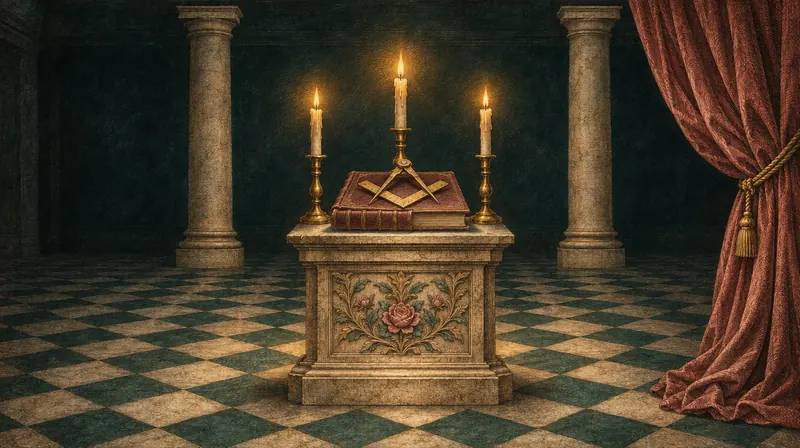
What is truly known of the Knights Templar and the Bavarian Illuminati?
What it is
Two real bodies carry most of the legend. The Knights Templar were a Catholic order of fighting monks, founded to guard pilgrims in the Holy Land, who grew into a wealthy network of estates across Europe and held deposits for kings. The Bavarian Illuminati were a secret society of the Enlightenment, with perhaps two thousand members at its height, that aimed to spread reason and loosen the hold of the clergy on public life. One lasted nearly two centuries and the other about a decade. Both were suppressed by the rulers of their day.
The teaching
As the Rule of the Temple with the Illuminati's own seized papers teaches it.
The new knighthood
The Templars took their teaching from Bernard of Clairvaux, who wrote In Praise of the New Knighthood for them. They are a new kind of knighthood, he says, fighting a double war, against flesh and blood and against the spiritual powers of evil. The worldly knight decks himself in silk, paints his shield, grows his hair long and fights for anger and vain glory. The knight of Christ is armoured with faith within and iron without, keeps his hair short, scorns ornament, and so need fear neither demons nor men. If he dies, he goes to Christ; if he kills an evildoer in a just war, Bernard says, he has killed not a man but evil itself, which he calls malicide. The brothers live in common, owning nothing, under obedience.
The Rule: prayer, table and dress
The Rule, given at the Council of Troyes and enlarged afterwards in French, shapes a brother's day like a monk's. He hears the hours of the office, and a brother away on duty says the Lord's Prayer instead, thirteen times for matins, seven for each of the day hours and nine for vespers. At table the brothers eat in silence while scripture is read, two to a bowl, so that each may see that the other neither starves himself in secret nor is stinted, and meat is served three times a week, since the habit of eating flesh is held to corrupt the body.
Their habits are of one colour, white, black or brown, and only the knights wear the white mantle, the sign of chastity and of a life reconciled to its maker. Gold and silver are forbidden on bridle and harness, and so are pointed shoes and laces. A brother may not hunt with hawk or hound, for the only beast he is to hunt is the lion, the adversary who “as a roaring lion, walketh about, seeking whom he may devour.” The last clause of the Latin Rule forbids a brother to kiss any woman, not even his mother or his sister.
Obedience, the banner and the chapter
Obedience comes first. When the Master, or one he has set over them, commands, a brother obeys at once, as though God commanded. In war the brothers ride under the Baucent, their banner of black and white, and a brother may not leave the field while it flies.
In chapter a brother confesses his own faults before the others and receives a penance, from eating on the ground to losing the habit for a year and a day. The gravest faults cost him the house itself, among them simony, killing a Christian, theft, conspiracy, going over to the enemy, heresy, and flight from the field while the banner stands.
The reception
The reception is set down in the Rule itself. In chapter, before the brothers, the candidate is asked whether he has a wife or a betrothed, whether he has vowed himself to another order, whether he owes debts he cannot pay, whether he has a hidden sickness, and whether he is anyone's serf, and is warned that a lie will cost him the house.
Then he hears the hard sayings of the life. You see us, the brothers tell him, with fine horses and harness, good food and drink and fine robes, and think it easy. You do not see the strong commands within: when you wish to be on this side of the sea you will be sent beyond it, when you wish to sleep you will be made to wake, and when you wish to eat you will go hungry.
If he still asks, he promises God and Our Lady obedience to the Master, chastity, and a life without property of his own, to keep the good customs of the house, to help to win the Holy Land, and never to leave the order. The chaplain says the psalm that begins “Behold, how good and how pleasant it is for brethren to dwell together in unity!”, the mantle is laid on his shoulders, and the brother who received him raises him and gives him the kiss of peace.
The ranks of the house
The house had three kinds of brother: the knights, born to knighthood and clad in white; the sergeants, in black or brown, who fought and served; and the chaplains, priests who heard the brothers' confessions. Over them stood the Master, with the Seneschal at his side, the Marshal who commanded in war, the Commanders of the lands and houses, the Draper who kept the clothing, and the Turcopolier who led the light horse.
The Illuminati: their aim
Adam Weishaupt first called his society the Perfectibilists, and the name says what he wanted: human beings made better, step by step, by reason and education. The order was to be a school of humanity. Its members were to study, to improve their characters under the watch of their superiors, and to win good and able people to the cause of light against superstition, prejudice and the abuse of power by church and prince.
Its furthest teaching was kept for the grade of Priest. Its address told of a humanity that once lived free and equal, lost that freedom when it gathered into states and submitted to rulers, and could win it back by spreading reason and good morals so widely that people would govern themselves, and princes and nations would pass from the earth without violence. Members were to bring this about by teaching and example, and by placing enlightened people in positions of trust.
The Illuminati: names and reports
Every member took a name from antiquity: Weishaupt was Spartacus, Baron Knigge was Philo, Franz Xaver von Zwackh was Cato. Places had names too, Munich being Athens and Ingolstadt Eleusis, and the emblem of the Minerval grade was the owl of Minerva. Each member wrote regular reports, called quibus licet, on his reading, his progress and the people around him, and passed them up to superiors he might not know, for the order was secret even within itself.
The grades of the Illuminati
After Knigge's reform the grades ran in classes. The nursery held the Novice, the Minerval and the Illuminatus Minor, who studied and were watched over. The Masonic class gave the three degrees of craft Freemasonry, Apprentice, Fellow and Master, and then two Scottish grades, the Illuminatus Major or Scottish Novice and the Illuminatus Dirigens or Scottish Knight, who directed the lower circles.
The Mysteries were the last class: the Lesser Mysteries of the Priest and the Regent, who governed the order's provinces, and the Greater Mysteries of the Magus and the King, which were planned but never written out before the order was banned.
How it is practised
The useful test for any claim about either order is its date. A statement about Templars after 1312, or Illuminati after 1787, needs a document from the time, and a book written centuries later is not one. A reader can trace a claim backwards: who printed it first, and what did that writer cite? For the surviving Illuminati the trail ends at two books of 1797, by Augustin Barruel and John Robison, written to explain the French Revolution. For Templar treasure it ends in novels and in forged papers of the 1960s, the files planted for the Priory of Sion, an association registered in France in 1956.
Where it comes from
The Templars were founded in Jerusalem about 1119 and approved by the Church at the Council of Troyes in 1129. On 13 October 1307 Philip IV of France, who owed them money, had the French members arrested on charges of heresy, and confessions were taken under torture. Pope Clement V dissolved the order in 1312, and its last Grand Master, Jacques de Molay, was burned in 1314. Adam Weishaupt, a law professor at Ingolstadt, founded the Illuminati on 1 May 1776. The Elector of Bavaria banned secret societies from 1784, the order's papers were seized and printed, and by 1787 it was finished.
What is known, and what is not
The trial records of the Templars survive, and a parchment found in the Vatican archives in 2001 shows that Clement V absolved the order's leaders of heresy in 1308, before closing it under royal pressure. No document shows the order living on in secret, and the Masonic claim of descent dates from the eighteenth century. Nothing shows the Illuminati outliving their ban. The theory that they rule the world is false, and its later versions were joined to an old slander against Jews that rests on a proven forgery.
Its words
- Knights Templar
- A Catholic military order founded in Jerusalem about 1119, arrested in France in 1307 and dissolved by the pope in 1312.
- Bavarian Illuminati
- A secret society of the Enlightenment, founded by Adam Weishaupt at Ingolstadt in 1776 and suppressed by the Bavarian state by 1787.
- Freemasonry
- A fraternity organised in lodges, which teaches by ceremony and the symbols of the stonemason's craft. Its documented history begins in Scotland and England about 1600.
- Jacques de Molay
- The last Grand Master of the Templars, arrested in 1307 and burned at Paris in 1314 after declaring his confession false. The dying curse is later legend.
- Adam Weishaupt
- The Ingolstadt professor of canon law, 1748 to 1830, who founded the Illuminati in 1776, lost his post in 1785 and lived out his life in exile at Gotha.
- Priory of Sion
- A small French association registered in 1956. Its medieval past was invented with planted documents in the 1960s, as its founder stated under oath in 1993.
Ask the Oracle further
What were the Templars accused of at their trial, and was any of it shown?Why do people believe the Illuminati survived after Bavaria banned them?
Before you practise
The Oracle keeps documented history apart from an order’s own legend, and both apart from conspiracy theory. It claims no order’s secrets.
Its other branches
The FreemasonsThe RosicruciansThe ancient mysteriesThe Golden DawnThe GnosticsThe whole artSearch the tree

