
Daimons and intelligences
The Neoplatonists’ guiding spirits, and the intelligences they gave the planets.
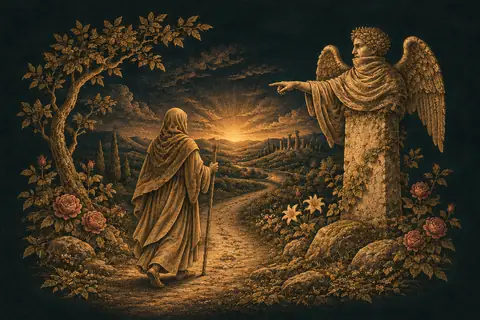
What did the Neoplatonists mean by a daimon, a guiding spirit?
What it is
A daimon, in Greek, is a being between gods and mortals. Plato has Socrates speak of a divine sign that warned him off mistakes, and in the Symposium the priestess Diotima calls love itself a great daimon, carrying messages between heaven and earth. Later Platonists held that each soul is given a daimon as its guide through life. The word did not of itself mean an evil being. The Christian demon is the same word turned to a new use, after the church classed the pagan intermediaries as fallen.
The teaching
As the Platonic tradition from Plato to Agrippa teaches it.
Between gods and mortals
A daimon is a being between the gods and mortals, and its work is to carry between them. In Plato's Symposium the priestess Diotima teaches that everything daimonic is in the middle. It interprets and conveys to the gods what comes from human beings, their prayers and sacrifices, and to human beings what comes from the gods, their commands and their gifts in return. It fills the space between, so that the whole is bound together, and through it pass all prophecy and priestcraft, rites, initiations and charms. God does not mingle with mortals, she says; all converse between them goes through the daimonic.
Love himself is a great daimon in her teaching, the child of Resource and of Poverty, conceived at the feast for Aphrodite's birth: always in need and always contriving, neither mortal nor immortal, a lover of wisdom standing between wisdom and ignorance. Hesiod gives an older account, in which the men of the golden age became after their death holy daimons dwelling on earth, kindly guardians of mortals, clothed in mist and watching over justice and wrongdoing.
The sign of Socrates
Socrates told his judges that from his childhood a kind of voice had come to him, a divine sign, which always turned him back from something he was about to do and never urged him on. It had opposed his going into public life, and he judged that it was right. In the Phaedrus it stops him as he is about to cross a stream, until he has made amends to Love for a careless speech.
On the day of his condemnation, he said, the sign had not opposed him once, neither when he left home in the morning, nor on his way to the court, nor anywhere in his speech. From that silence he reasoned that what was happening to him was good, and that death is no evil. The daimon of Socrates teaches by restraint: it does not command, it warns, and even its silence has a meaning.
The daimon chosen before birth
In the myth of Er, at the end of the Republic, the souls about to be born are gathered before Lachesis, daughter of Necessity. Her herald tells them that no daimon will be allotted to them; they will choose their own. They draw lots for the order of choosing and choose their lives, and the herald proclaims that the blame belongs to the one who chooses, and God is blameless. Then Lachesis sends with each soul the daimon it has chosen, to guard its life and fulfil the choice.
The daimon leads the soul to the other Fates, Clotho and Atropos, then under the throne of Necessity to the plain of Forgetfulness, where each drinks from the river of Unmindfulness and forgets. In the Phaedo the guardian allotted in life leads the soul after death to its judgement. The daimon is thus the keeper of a destiny that the soul once chose and no longer remembers.
The daimon within
In the Timaeus Plato gives the daimon an inward place. The highest part of the soul, reason, is given by God to each person as a daimon, dwelling at the top of the body and lifting it toward its kin in heaven, for we are, he says, a heavenly plant and not an earthly one. Whoever tends this divine part and keeps it in good order is eudaimon, happy, which in Greek means having a good daimon. Its care is study: thinking thoughts that are immortal and divine, and bringing the motions of one's own mind into tune with the ordered motions of the heavens.
The Stoics kept the teaching. Epictetus says that God has set beside each person a daimon as guardian, one who never sleeps and cannot be deceived, so that one who has shut the doors and darkened the room should never say he is alone: God is within, and his daimon. Marcus Aurelius calls the daimon that Zeus gives each person as guardian and guide a fragment of Zeus himself, which is each one's mind and reason, and he teaches that to live with the gods is to keep that daimon content.
Plotinus teaches it as a ladder. A person's daimon is the power just above the one by which they live: for one who lives by the senses it is reason, and for one who lives by reason it is what stands above reason. Each soul becomes after death what it most lived by in life, and so each person, by the way they live, chooses which power will be their guide.
The orders of daimons
Later Platonists sorted the beings between. Apuleius, in his book on the god of Socrates, gives three kinds. The human soul while still in the body is itself a daimon, which the Romans called the genius. The soul after death is a lemur: the good become household Lares, the wicked wander as larvae, and those whose deserts are uncertain are called Manes. Above both is a higher kind that has never been in a body, and to it belonged the guardian of Socrates.
Iamblichus, in On the Mysteries, ranks gods, archangels, angels, daimons, heroes and souls, and teaches how to tell them apart by what each leaves in the one who sees it. The gods give a perfection beyond the passions and a divine love; archangels a pure, settled calm and steady contemplation; angels wisdom, truth, pure virtue and firm knowledge; daimons a pull toward nature and the world of birth, with the power to finish its works; heroes much the same, with zeal for the care of souls; and souls a longing for birth and for the care of bodies. The higher the being, the freer it leaves the soul.
On the daimon of each person Iamblichus answered Porphyry, who had asked how it might be found from the horoscope. One's own daimon, he replied, is given from the whole order of the world and not from a single star, and it is known through the sacred rites and not by calculation; and each person has one guardian daimon, not a good one and a bad one.
The genius and the good daimon
The Romans honoured a man's genius, born with him and guarding him through life, on his birthday with wine, flowers and incense; a woman had her juno, and every place had its genius too, the spirit of the place. Greek households poured a drop of unmixed wine at the end of the meal to the Agathos Daimon, the good daimon of the house, who was often pictured as a serpent.
Not every daimon was good in Greek thought. Xenocrates, Plato's pupil, taught that there are wicked daimons too, to whom the days of mourning and ill omen belong, and Plutarch followed him. Christian writers went further and judged all the daimons of the pagans to be fallen spirits, and so the Greek word became the English demon.
The intelligences of the heavens
The medieval philosophers, following Aristotle and the Arabic thinkers, gave every heaven a mind that moves it. In Avicenna's scheme ten intelligences proceed one from another out of the First. Each, knowing its cause and itself, gives rise to the next intelligence, to a soul and to a heaven, until the tenth, the Active Intellect, governs the world below the Moon and gives light to the human mind when it understands. Christian thinkers called the movers angels, and Dante sets the nine choirs to turn the nine heavens, the angels moving the heaven of the Moon and the seraphim the outermost.
Agrippa, in his Three Books of Occult Philosophy, gives each planet a square of numbers, with an intelligence set over it for good and a spirit for evil: for Saturn, Agiel and Zazel; for Jupiter, Johphiel and Hismael; for Mars, Graphiel and Barzabel; for the Sun, Nachiel and Sorath; for Venus, Hagiel and Kedemel; for Mercury, Tiriel and Taphthartharath; and for the Moon the spirit Hasmodai, with an intelligence of intelligences and a spirit of spirits whose names are long phrases. Each name, counted letter by letter in Hebrew numbers, gives one of its square's key numbers: Agiel and Zazel both come to forty-five, the total of the numbers one to nine in the square of Saturn.
Trithemius, abbot of Sponheim, taught that seven planetary angels govern the world in turn under God, each for three hundred and fifty-four years and four months: Orifiel of Saturn first from the creation, then Anael of Venus, Zachariel of Jupiter, Raphael of Mercury, Samael of Mars, Gabriel of the Moon and Michael of the Sun, after which the round begins again.
How it is practised
The old question behind the daimon is what a person is for, and a reader can use it without believing in any being. Socrates' sign only ever said no, so one exercise is to list the times a quiet reluctance turned out to be right, and to notice how it felt. Another is the myth of Er read as a prompt: if this life had been chosen on purpose, for what? James Hillman built a whole psychology on that question in The Soul's Code. The answers are one's own, and the house assigns no guide to anyone.
Where it comes from
Plato's myth of Er, at the end of the Republic, has each soul choose a life and receive a daimon to see it fulfilled. Plutarch around 100 CE and Apuleius in the second century wrote essays on the daimon of Socrates. Plotinus, his pupil Porphyry reports, was found to have a god for his guide. Medieval philosophers, following Aristotle and the Arabic thinkers, spoke of intelligences that move the planets, and Agrippa's Occult Philosophy of 1533 gave each planet a named intelligence and spirit. The Romans called the personal guide a genius, and gave each place a guardian of its own, the genius loci.
What is known, and what is not
The texts are secure: Plato, Plutarch, Apuleius and the Neoplatonists say what is reported here. What Socrates actually experienced is unknown, and ancient and modern readers have taken his sign as a god, as conscience and as a heard voice. The personal daimon is a philosophical and religious idea with no test that could confirm it. As a figure for vocation and inner warning it has lasted because it names something people recognise.
Its words
 Daimon
- In Greek thought, a being between gods and humans; in Plato and after, the guiding spirit allotted to each soul.
- Genius Loci
- Latin for the spirit of a place: the guardian the Romans honoured at a spring, a fort or a field, often without knowing its name.
Ask the Oracle further
What was the daimon of Socrates, and what did it tell him?How did the Greek daimon become the Christian demon?
Before you practise
The Oracle tells what the traditions say of spirits and names whose account it is. It does not speak for the dead, and it cannot tell you that a spirit is with you. If you hear voices or feel commanded, please see a doctor.
Its other branches
Angels and their ordersThe jinnThe ancestorsThe elementalsTesting the spiritsGhosts and hauntingsMediums and SpiritualismShamans and spirit journeysThe fair folkDemons in the old booksThe whole artSearch the tree

