
Mediums and Spiritualism
The movement that began at Hydesville in 1848, its séances, and what the investigations showed.
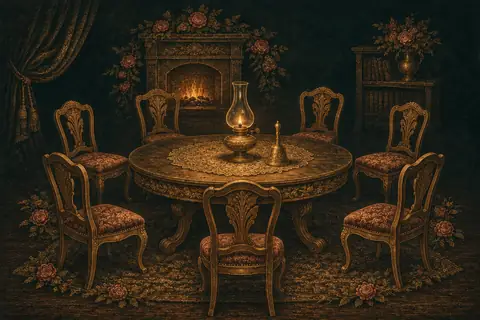
How did mediums and séances begin with Spiritualism, and what did the investigations of them show?
What it is
A medium is a person who is said to carry messages between the living and the dead, and the practice is called mediumship. Spiritualism is the movement built around that claim: that the dead survive, wish to speak, and can do so through sensitive people. Its meeting is the séance, a sitting round a table in low light at which raps, movements of the table, voices or writing are taken as answers. The spirit said to manage a medium's sitting was called a control, and from it comes the modern idea of a spirit guide. Spiritualism became a religion with churches, which still meet in Britain and the United States, and it was also, from the start, a stage for fraud.
The teaching
As Spiritualist doctrine in its British, American and French forms teaches it.
What Spiritualism teaches
Spiritualism teaches that the human personality survives death unchanged in its essentials, that the dead live on in a spirit world close to ours, and that they can and do communicate with the living through people sensitive to them, the mediums. Death, in its words, is a passing, the change called death: the spirit leaves the physical body and goes on in a spirit body, keeping its memory, character and affections. The purpose of communication, as the movement understands it, is to prove that survival and to comfort the bereaved, and through that proof to change how people live.
The spirit world is not heaven or hell in the old sense. It is a ladder of brighter and brighter conditions, which Andrew Jackson Davis called the Summerland, and each spirit begins where its life on earth has fitted it to be and rises by its own effort. There is no eternal punishment: each soul meets the fruit of what it did, and the way upward is never closed.
The seven principles
The Spiritualists' National Union in Britain states its faith in seven principles, which Emma Hardinge Britten said were given to her from the spirit world. The first is the fatherhood of God, the one creative power behind all things. The second is the brotherhood of man, since all people are children of that one source. The third is the communion of spirits and the ministry of angels: the dead and the higher beings remain in touch with the living and help them.
The fourth is the continuous existence of the human soul, which death does not interrupt. The fifth is personal responsibility: each person answers for their own life, and no one else can bear the consequences of their wrongs for them. The sixth is compensation and retribution hereafter for all the good and evil deeds done on earth. The seventh is eternal progress open to every human soul, so that none is lost for ever.
The largest association of Spiritualist churches in America states its faith in nine principles to much the same effect, beginning with a belief in Infinite Intelligence and ending with the teaching that prophecy and healing are divine gifts shown through mediumship.
Spiritism: the teaching of Kardec
Allan Kardec's Spiritism, strong in France and above all in Brazil, adds reincarnation, which most British and American Spiritualists did not at first hold. The spirit, he teaches, is the intelligent being of creation, joined to the body by a fine envelope he calls the perispirit; it is born again and again, in this world and in others, to learn and to rise, and between lives it dwells in the spirit world. Its motto is that without charity there is no salvation.
Kardec ranks the spirits in three orders and ten classes. Lowest are the imperfect spirits, in five classes: the impure, the frivolous, the falsely learned, the neutral, and the boisterous ones who make noises and move things. Above them are the good spirits, in four classes: the benevolent, the learned, the wise and the superior. Highest are the pure spirits, a single class, who have finished every trial.
The gifts of the medium
Spiritualism distinguishes two kinds of mediumship. Mental mediumship works through the medium's own mind: clairvoyance, seeing the spirit; clairaudience, hearing it; clairsentience, sensing its presence; and, in deeper states, trance, in which a spirit is said to speak through the medium, and automatic writing, in which it writes through the medium's hand. Physical mediumship is said to work through matter: raps, the tilting or turning of a table, the direct voice heard through a trumpet, lights, and figures formed from a substance the movement calls ectoplasm.
Each medium, in this teaching, has a spirit guide or control, a helper who keeps the door between the worlds and lets through only those who should come. Mediums are trained slowly in a development circle under an experienced leader, meeting at the same time each week, opening with prayer and closing with care, and the churches warn against sitting alone or using a talking board.
The service
The public rite of Spiritualism is the church service. It opens with a hymn and an invocation, a prayer asking for protection and for the presence of good spirits. An address follows, often given by the visiting medium, and then healing, by healers who lay their hands on or near the body; the churches offer it as a help beside medicine and never in its place. Then comes the demonstration, in which the medium stands before the congregation, describes a spirit said to be present, offers details by which a listener may recognise it, and passes on its message. A closing prayer ends the service.
The cautions within the movement
Spiritualism has its own cautions, sharpest in Kardec. The spirits, he teaches, are not all-knowing, and many are frivolous or lying spirits who borrow great names. A communication is to be judged by reason and by its moral content. Superior spirits speak with dignity and simplicity, say only what they know, never flatter and never command anything against good sense or charity; a message that is trivial, boastful, harsh or against reason comes from a low spirit, whatever name it signs. Kardec also taught that mediumship must be given freely, as it was freely received, and never sold.
Emanuel Swedenborg, whose visions of the spirit world the Spiritualists read as a forerunner, gave the sternest warning of all: in this age, he wrote, to speak with spirits is rarely granted, because it is dangerous, for evil spirits who know they are with a person seek to harm them. The Spiritualist churches teach likewise that contact is sought only in a guarded circle, with prayer, and never alone or in fear.
How it is practised
Nothing on this shelf is a way to hold a séance, and the house passes on no message from anyone who has died. What a reader can practise is recognition. A sitting works on grief, darkness and expectation; statements that would fit almost anyone feel personal; a sitter remembers the hits and forgets the misses. Before paying anyone who offers contact with a dead relative, it is worth asking what they could know by ordinary means, and why the message needs a fee. Grief is better carried to people who knew the one who died, to a counsellor, or into plain acts of remembrance.
Where it comes from
Modern Spiritualism began in March 1848 at Hydesville, New York, when the sisters Kate and Margaretta Fox said that raps in their house answered questions. Within a few years there were sittings across America and Europe, and Allan Kardec in France gave the teaching a system in The Spirits' Book of 1857. Scientists were drawn in: William Crookes tested the medium Daniel Dunglas Home in the early 1870s. In 1888 Margaretta Fox said in public that the raps had been made by cracking the joints of her toes, and a year later she took the statement back. The losses of the First World War filled the rooms again.
What is known, and what is not
The history is documented in detail. Many of the best known mediums were caught in trickery, some of them repeatedly, and Harry Houdini spent the 1920s showing the methods on stage. Controlled tests since have not shown that any medium can give facts about the dead beyond what guessing and cold reading explain. A few small studies report otherwise and have not been reliably repeated. That bereaved people are comforted by a sense of contact is real, and is studied as a part of grief, which is not evidence that a message was sent.
Its words
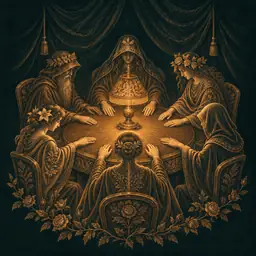 Séance
- A sitting, usually round a table in low light, at which a medium is said to bring messages from the dead.
 Spiritualism
- The movement, begun at Hydesville in 1848, which holds that the dead survive and speak through mediums. It has churches of its own.
- Spirit Guide
- A being said to accompany and advise a living person. The phrase is modern, grown from the controls of Spiritualism's mediums.
Ask the Oracle further
What happened at Hydesville in 1848, and what did the Fox sisters later say of the spirits?How did séances work, and how were the tricks of false mediums found out?
Before you practise
The Oracle tells what the traditions say of spirits and names whose account it is. It does not speak for the dead, and it cannot tell you that a spirit is with you. If you hear voices or feel commanded, please see a doctor.
Its other branches
Angels and their ordersThe jinnThe ancestorsDaimons and intelligencesThe elementalsTesting the spiritsGhosts and hauntingsShamans and spirit journeysThe fair folkDemons in the old booksThe whole artSearch the tree

