
The ancestors
How many houses honour their dead, and what that keeps alive.
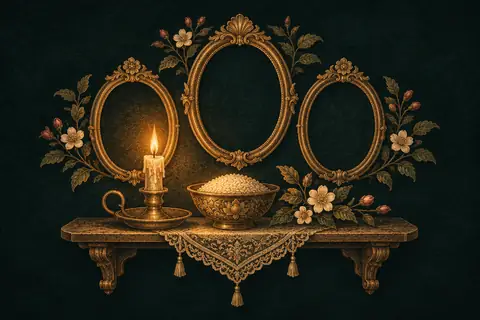
How do the traditions honour the spirits of the ancestors, and how can I do so simply?
What it is
To honour the ancestors is to keep the family dead as members of the household. Names are remembered, graves are tended, food or light is set out on certain days, and the dead are told the family's news. Scholars call this ancestor veneration, and in much of Africa and East Asia it is the centre of religious life. In Japan a family's dead are honoured beside the kami, the spirits of Shinto. The purpose most often given is gratitude and continuity, though in many places the neglected dead are also feared: the living owe their lives to the dead, and a family that remembers is held to stand firmer.
The teaching
As the honouring of the dead from Confucius to the Day of the Dead teaches it.
The dead remain in the family
The first teaching is that death does not end a person's place in the family. The dead keep their names and their seats; they are told the household's news, asked to bless its great days, and given food, drink and light. The bond runs both ways: the living owe the dead remembrance and care, and in most of these traditions the well-kept dead are held to watch over the line that remembers them.
Not every death makes an ancestor. In many African traditions, those of the Akan of Ghana and the Yoruba of Nigeria among them, a person becomes an ancestor after a good life, old age, children and a fitting death, with the right funeral rites, and then stands as an elder of the family in the other world, guarding its customs. The dead whom no one feeds or names become, in the Chinese teaching, hungry ghosts, wandering and unhappy, which is why the rites matter so much to the living.
Filial piety: the teaching of Confucius
Confucian teaching calls the root of virtue xiao, filial piety, and it does not end at the grave. Asked about it, Confucius said: while parents live, serve them according to the rites; when they die, bury them according to the rites, and sacrifice to them according to the rites. His disciple Zengzi said that when the funerals of parents are kept with care and the distant ancestors are remembered, the virtue of the people grows full again.
The heart of the rite is sincerity. Confucius sacrificed to the dead as if they were present, the Analects says, and he held that if he did not take part in a sacrifice himself it was as if there had been none. In mourning, he taught, deep grief is better than perfect form, and in all rites it is better to be sparing than lavish. He also warned that to sacrifice to spirits who are not one's own is flattery: each family keeps its own dead.
When a disciple asked how to serve the spirits of the dead, Confucius turned him back to the living: not yet able to serve people, how could he serve the spirits? Not yet understanding life, how could he understand death? The rites are kept, and the duties of the living come first.
The tablet, the altar and the graves
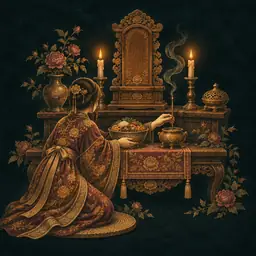
In a Chinese house the dead are present in their tablets, slips of wood inscribed with each name and kept on the family altar or in the hall of the lineage. Incense is lit before them, and on the first and fifteenth days of the lunar month, at the New Year and on the anniversaries of birth and death, food and tea or wine are set out and the family bows. A birth, a marriage, a new house or a long journey is announced to them, as it would be to the living elders.
At Qingming, the festival of clear brightness in early April, families go out to the graves. They clear the weeds, mend the mound, set out food and wine, burn incense and paper offerings and bow, and then they eat together. The custom gives the festival its other name, the sweeping of the tombs.
Japan: the household altar and Obon
In a Japanese house the Buddhist altar, the butsudan, holds the ihai, lacquered tablets bearing the names given to the dead at their funerals. Each morning the family offers rice, water or tea, flowers and incense, rings a small bell and joins hands. Memorial services follow on set anniversaries through the years, in many families until the thirty-third, after which the person is held to have joined the ancestors as a whole.
At Obon, in July or August according to the region, the dead come home. A small welcoming fire is lit at the gate to show them the way, and some families make a horse from a cucumber, so that the dead may come quickly, and an ox from an aubergine, so that they may go back slowly. The Bon dances are danced, and at the end a farewell fire is lit, or lanterns are floated down the rivers, to see the dead back. At the equinoxes, in the weeks of Higan, families visit and wash the graves.
Rome: the days of the parents
The Romans called their dead the di manes, the divine spirits of the dead, and their tombstones begin with the letters D M, for the Manes. From the thirteenth to the twenty-first of February came the Parentalia, the days of the parents, when the temples were shut and families went out to the tombs beyond the walls. The poet Ovid says the dead ask little: a tile wreathed with garlands, a scattering of grain, a few grains of salt, bread softened in wine and loose violets, left on a potsherd in the road.
The last day, the Feralia, belonged to the dead, and the day after, the Caristia, to the living kin: a family meal of reconciliation at which quarrels were set aside and incense was offered to the household gods, the Lares. Ovid adds that the quarrelsome and the unkind should stay away from it.
West Africa: the libation and the returning elders
Across much of West Africa the commonest rite is the libation. An elder pours water, palm wine or strong drink on the ground, calling by name on God, on the earth and on the ancestors, and asks their blessing on the matter in hand: a naming, a marriage, a funeral, a harvest, a journey, the opening of a meeting. Among the Akan the blackened stools of chiefs who have died are kept as their seats and honoured at the Adae and Odwira festivals.
Among the Yoruba the ancestors come back in person at the yearly egungun festival. Masqueraders covered from head to foot in layered cloth dance through the town, and the people hold that the dead walk among them in these figures, blessing and admonishing the living. No one may touch an egungun or see who is inside, and when the dances end the dead are sent home.
Mexico: the Day of the Dead
On the first and second of November the dead of Mexico come home: the children on the first day and the grown on the second. Families build an ofrenda, an altar of offerings, with photographs of their dead, candles, copal incense, a glass of water for the thirst of the journey, salt, the sweet bread of the dead, sugar skulls bearing names, and the foods and drinks each one loved. Orange marigolds, the cempasúchil, are scattered in paths of petals, because their colour and scent are said to lead the dead to the house.
At the cemetery the graves are cleaned and covered with flowers, and in many towns families keep watch through the night with candles, food and music, telling stories of the dead. The tone is welcome, not mourning: the painted skulls smile, and the dead are greeted as guests.
The faiths of Abraham: prayer for the dead
Judaism, Christianity and Islam pray for their dead and not to them. A Jewish mourner says the Kaddish for eleven months after a parent's death and again on each anniversary, the yahrzeit, when a candle is lit that burns for a whole day; the memorial prayer Yizkor is said four times a year, and a visitor leaves a small stone on the grave. Catholics keep All Souls' Day on the second of November with Masses and prayers, asking “Eternal rest grant unto them, O Lord, and let perpetual light shine upon them,” and the Orthodox hold memorial services on the third, ninth and fortieth days and at the year, with a dish of boiled wheat.
Muslims visit the graves and greet the dead with the words of peace the Prophet taught; many recite the opening chapter of the Qur'an for them, and all ask God's mercy on them and may give in charity on their behalf.
The measure of the rite
Each of these traditions puts sincerity before cost. Confucius preferred grief to display, Ovid's dead ask for violets and salt, and the ofrenda is built from what the family has. The rite is kept at the family's own altar, for its own dead, in its own words or its own faith, and a candle set before a name is watched while it burns and put out before the room is left.
How it is practised
The simple form takes a shelf and a few minutes. A person sets out a photograph or a written name, lights a candle on a birthday or on the day of a death, says aloud what they are thankful for and what has happened since, and puts the candle out before leaving. Some cook a dish the person loved. Learning the names of great-grandparents, and one true story about each, is part of the same work. It is remembrance, done in one's own words or one's own faith, and it asks the dead for nothing.
Where it comes from
The custom is among the oldest on record. Chinese oracle bones of the Shang dynasty, more than three thousand years old, put questions to royal ancestors, and Confucian teaching made the rites of sons and daughters a duty that survives in the Qingming festival of grave sweeping. Roman families kept wax masks of their forebears and fed the dead at the Parentalia each February. Mexico's Day of the Dead, the Japanese Obon and the Christian All Souls' Day on 2 November each set aside days when the dead are welcomed or prayed for.
What is known, and what is not
The rites are documented in every period, from the Shang oracle bones to modern fieldwork. Whether the dead receive anything is a matter of belief. Research on grief supports a narrower point: since the 1990s psychologists have described continuing bonds, in which an ongoing inner relationship with the dead is a normal part of mourning and often a comfort. The house does not speak for the dead, and no message from them is offered here.
Its words
 Ancestor Veneration
- The honouring of the family dead with offerings, remembrance and set days, found in most cultures of the world.
- Kami
- The spirits or deities honoured at the shrines of Japanese Shinto: gods of myth, presences of mountain and tree, and honoured ancestors.
Ask the Oracle further
What is ancestor veneration, and is it the same as worshipping the dead?How do Qingming, Obon and the Day of the Dead each honour the spirits of the dead?
Before you practise
The Oracle tells what the traditions say of spirits and names whose account it is. It does not speak for the dead, and it cannot tell you that a spirit is with you. If you hear voices or feel commanded, please see a doctor.
Its other branches
Angels and their ordersThe jinnDaimons and intelligencesThe elementalsTesting the spiritsGhosts and hauntingsMediums and SpiritualismShamans and spirit journeysThe fair folkDemons in the old booksThe whole artSearch the tree

