
Demons in the old books
How the lists of demons were made, from the Testament of Solomon to the Goetia: a history of books.
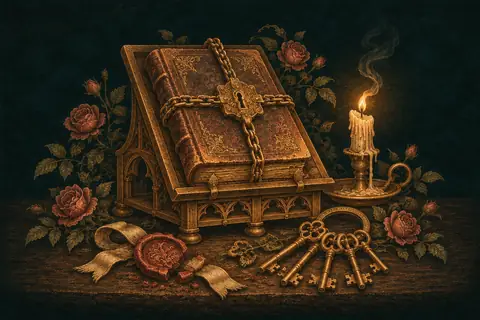
How were the old lists of evil spirits and demons made, from the Testament of Solomon to the Goetia?
What it is
The demon of European tradition is built from several older figures. The Greek daimon was a go-between and no enemy. The Hebrew Bible speaks of an accuser, the satan, who in the Book of Job stands in God's court, and Jewish writings of the last centuries BCE tell of angels who fell. The New Testament has unclean spirits sent out by a word. From these the church drew one picture: angels who fell and now tempt. The books of magic called grimoires then did something odd with it, and wrote the demons down like a civil service, with names, ranks and seals.
The teaching
As the demonology of the Bible, the Church and the books of magic teaches it.
Where the demons come from
The teaching on demons is built from several older accounts. The Book of Enoch tells of the Watchers, two hundred angels who came down on Mount Hermon under their leader Semyaza, took human wives and taught forbidden arts: Azazel the making of weapons and ornaments, others charms and the cutting of roots and the signs of the stars. Their children were giants, and when the giants died their spirits went out over the earth as evil spirits. The Book of Jubilees adds that their chief, Mastema, asked God to leave him a tenth part of them to test humankind, and the other nine parts were bound.
The Hebrew Bible's satan is the accuser, who in the Book of Job stands among the sons of God in the heavenly court. Christian reading joined him to the fallen star of Isaiah, “How art thou fallen from heaven, O Lucifer, son of the morning!”, and to the dragon of Revelation, whose tail drew a third part of the stars of heaven and cast them to the earth. From these the Church drew one picture: angels created good, who fell by their own pride and now tempt human beings.
The doctrine of the Church
Thomas Aquinas sets out what the demons are. They fell by pride, wishing to reach their happiness by their own power and not by God's gift, and their choice, made with an angel's whole mind, cannot be undone. They keep the natural knowledge of angels, so that they know much, but they cannot read thoughts, only guess them from signs. They can work wonders by natural means, but not true miracles. They can tempt, deceive and trouble, but they cannot force the human will, and God allows their temptation only so far as it can serve the good of those who resist.
In the Gospels unclean spirits are cast out by a word. A man among the tombs in the country of the Gadarenes, asked his name, answers “My name is Legion: for we are many,” and the spirits go into a herd of swine. The Pharisees call Beelzebub the prince of the devils, and Jesus answers that a kingdom divided against itself cannot stand. Of one stubborn spirit he says that this kind goes out only by prayer and fasting.
The Church keeps a rite of exorcism, given only to a priest with his bishop's leave. Its old form named the signs of possession: speaking or understanding an unknown tongue, telling things distant or hidden, and showing strength beyond one's nature. The same rite told the exorcist not to believe easily that anyone is possessed, since such signs are more often those of illness, and the present rite asks for the judgement of physicians first.
The Testament of Solomon
The first book to set the demons in order is the Testament of Solomon. A demon named Ornias torments a boy working on the Temple, taking half his pay and food and sucking the thumb of his right hand, until Solomon prays and the archangel Michael brings him a ring engraved with the seal of God. The boy throws the ring at the demon's chest and brings him to the king, and Solomon, with the archangel Uriel's help, sets him to cut stones for the Temple. Through Ornias he summons Beelzeboul, the prince of the demons, and through him the rest, one by one.
Each demon is made to give its name, its work, the star it is under, and the angel or name that thwarts it. Beelzeboul is thwarted by the holy name of God that the Greeks call Emmanuel. Asmodeus, born of an angel's seed and a daughter of men, is thwarted by Raphael and put to flight by the liver and gall of a fish smoked over the ashes of tamarisk. Onoskelis, a beautiful woman with the legs of a mule, is set to spin hemp for the ropes of the Temple. Thirty-six spirits, the decans of the zodiac, each name the pain they bring and the words that drive them off: Ruax, the first, dulls the heads of men, and retreats when he hears, Michael, imprison Ruax.
The pattern of the book runs through all later demonology: every demon has a name, an office and a limit, and every one is under some higher name. The demons do the king's building not by their own will but because the seal compels them.
Kings, dukes and presidents
The books of magic wrote the demons down like the officers of a court. In the Goetia, the first part of the Lesser Key of Solomon, seventy-two spirits are listed by rank: kings, dukes, princes, marquises, presidents, earls and one knight. Each entry gives the spirit's number and name, its rank, the shape in which it appears, its office, the number of legions it commands, and its seal. The first is Bael, a king ruling in the east, who appears as a cat, a toad or a man, or all three at once, speaks hoarsely, rules sixty-six legions and is said to make men invisible. Paimon, the ninth, a great king obedient to Lucifer, comes riding a dromedary under a glorious crown, a host of spirits before him with trumpets and cymbals. Over all seventy-two stand four kings of the quarters: Amaymon of the east, Corson of the west, Ziminiar of the north and Goap of the south.
The book tells why such spirits are abroad at all. Solomon, it says, shut them with their legions in a vessel of brass, sealed it and cast it into a deep lake at Babylon; the Babylonians, hoping for treasure, broke it open, and the spirits flew back to their old places, all but Belial, who entered an image and gave answers to those who sacrificed to it. The magician in this teaching stands where Solomon stood, compelling them by God's names. The house reads the book as a book, and gives no way to call, bind or bargain with anything.
The demons of the sins and the court of hell
Later demonologists set a demon over each of the seven deadly sins. In the list of Peter Binsfeld, Lucifer is the demon of pride, Mammon of greed, Asmodeus of lust, Leviathan of envy, Beelzebub of gluttony, Satan of wrath and Belphegor of sloth. The French chapbook grimoires made hell a government, with Lucifer as emperor, Beelzebuth as prince and Astaroth as grand duke, and below them a prime minister, Lucifuge Rofocale, with generals and marshals. Such books offered pacts for treasure, which the Church condemned as a denial of God.
What the teaching asks of the faithful
The faiths that hold this teaching give it a sober end. The demon of Christian doctrine is a tempter, not a master, and the defence is ordinary: prayer, the sacraments, honest confession, the sign of the cross, and the refusal of every dealing with spirits. Jewish and Islamic teaching likewise set God's name, his scripture and a clean life against every evil spirit. A voice that commands, or a fear that does not lift, the churches themselves send first to a doctor.
How it is practised
These books are read here as history, and nothing in them is offered as something to do. A reader can take any famous name and trace it backwards: which list first has it, what the entry before that looked like, and what older god or word it was made from. Beelzebub, for instance, goes back to a Philistine god named in the Second Book of Kings. The house gives no way to call, bind or bargain with anything, tells no reader that a demon is near them, and reads no trouble in a life as the work of one. Fear that does not pass, or a voice that commands, is for a doctor.
Where it comes from
The Testament of Solomon, a Greek work of the first centuries CE, has the king question demons one by one and set them to build the Temple. In 1577 the physician Johann Weyer added a list of sixty-nine demons and their offices to his book arguing that those accused as witches were deluded and should not be burned. The Lesser Key of Solomon, put together in England in the seventeenth century, reworked his list as the seventy-two spirits of its first part, the Goetia. Collin de Plancy's Dictionnaire Infernal gave them the faces now familiar, in the engravings of its edition of 1863.
What is known, and what is not
The dates of the lists and their dependence on one another are well established from the manuscripts: the Goetia copies Weyer, and Weyer says that he copied an older book. The entries read as literature, with ranks borrowed from the courts of the time. Whether evil spirits exist is a matter of faith on which the religions themselves differ. The churches that keep a rite against them ask for a medical judgement first, and the experiences once put down to demons, among them seizures, voices and sleep paralysis, are understood by medicine.
Its words
Ask the Oracle further
Where do the seventy-two evil spirits of the Goetia come from, and who first listed them?Why did Johann Weyer, who defended the accused, print a list of unclean spirits and their ranks?
Before you practise
The Oracle tells what the traditions say of spirits and names whose account it is. It does not speak for the dead, and it cannot tell you that a spirit is with you. If you hear voices or feel commanded, please see a doctor.
Its other branches
Angels and their ordersThe jinnThe ancestorsDaimons and intelligencesThe elementalsTesting the spiritsGhosts and hauntingsMediums and SpiritualismShamans and spirit journeysThe fair folkThe whole artSearch the tree

