
The fair folk
The fairies of Ireland and Britain: neighbours to be respected, long before they were given wings.
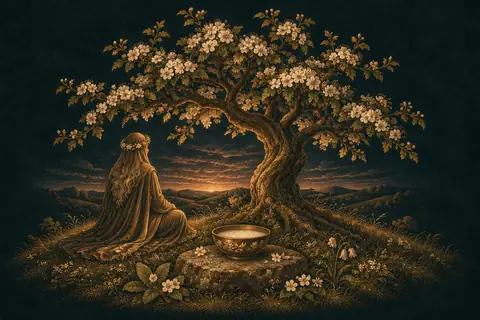
What did people in Ireland and Britain truly believe about the fairies, the fair folk?
What it is
The fairies of Irish and British tradition are not the small winged figures of picture books. A fairy, in the old belief, is one of a hidden people who live beside humans, in mounds, under hills or across water, and who keep courts, herds and tempers of their own. Country people called them the fair folk or the good neighbours, kind names used so as not to offend. The belief came with rules: leave the fairy thorn uncut, do not build across their path, take no food in their house. The banshee, the woman of the mounds whose cry is heard before a death in a family, belongs to the same people. A changeling was a fairy child left in place of a stolen human one.
The teaching
As the fairy faith of Ireland and Britain teaches it.
The hidden people
The fairies, in the old belief of Ireland and Britain, are a people, not small creatures with wings. They live beside us, unseen, in the mounds and earthen forts, under hills, in lakes and across the sea. They have their own rulers and courts, their own herds and music, wars and marriages, and they are proud, touchy and quick to repay a kindness or a slight. They may be of human size or smaller as they please.
Robert Kirk, minister of Aberfoyle, set down what his Highland people held. These Siths, or fairies, he wrote, they call the Good People, to prevent their ill attempts, for the Irish use to bless all they fear harm of; and they are said to be “of a middle nature betwixt man and angel, as were daemons thought to be of old,” with light, changeable bodies “somewhat of the nature of a condensed cloud, and best seen in twilight.” Their houses are large and fair, lit by lamps that burn without fuel, but common eyes cannot see them.
Their names
Because they are thought to hear their names, they are seldom named plainly. In Ireland they are the aos sí, the people of the mounds, but more often the Good People, the Gentry, the People of the Hills, or simply Themselves. In Scotland they are the Good Neighbours, and in Wales the Tylwyth Teg, the Fair Family. The kind names are a courtesy and a guard together.
W. B. Yeats sorted them, from the stories of country people, into the trooping fairies, who live in companies and ride out in procession, and the solitary ones: the leprechaun, the shoemaker with his crock of gold; the cluricaun, who haunts cellars; the far darrig, the red man, a teller of grim jokes; the pooka, a shape-shifter often seen as a dark horse; and the banshee, the woman of the mounds, whose keening foretells a death in the old families.
The turning year
The fairies move house at the beginning of each quarter of the year, Kirk says, travelling with all their goods, and those with the second sight meet them on the roads and are terrified; so people kept to church on the first Sunday of each quarter to hallow themselves, their corn and their cattle against the shots and stealth of these wandering tribes. In Ireland the great nights are May Eve and November Eve, Bealtaine and Samhain, when the doors of the mounds stand open and the hosts ride out.
Their paths run between the forts, and a house built across one is said never to know peace; stories tell of houses where the front and back doors were left open at night to let the host go through. A lone hawthorn in a field, the fairy thorn, is never cut, and the ring forts on the farms are left untouched by the plough.
The rules of good neighbours
The belief comes with rules, and they are practical. Speak well of the Good People and never boast of seeing them. Leave the fairy thorn and the fort alone. Do not throw out water at night without a word of warning, lest it fall on them as they pass. Leave the hearth swept and clean water out at night, and leave to them the milk that is spilt. Never eat their food or drink their wine, for whoever tastes it cannot come back. And on the road give way to a sudden gust, the fairy wind, for a host may be riding in it.
Kirk reports that the fairies take the substance, the foyson, of corn and milk and leave the husk, and that people with the second sight saw them eating at funerals and feasts, so that some would not eat meat at such gatherings. The brownie, a kinder kind, comes into a house after all are asleep and sets the kitchen in order, but must never be paid with clothes, or he leaves for good.
Iron and the other guards
Against their thefts the old protections are iron, salt, bread and holy things. Kirk writes that his people put bread, the Bible or a piece of iron in a woman's bed in childbirth, to save her from being stolen away, and that all unknown wights are frightened by nothing earthly so much as by cold iron. A horseshoe or a knife over the cradle, salt or oatmeal in the pocket, a rowan twig tied with red thread, and a coat turned inside out by one led astray in a field were all held to turn the fairy glamour aside.
Taken away, and the changeling
The fairies were believed to take people: brides and young mothers to nurse their children, musicians, fine children, and anyone who ate their food. Kirk tells of women alive in his day who said they had been taken in childbed to nurse fairy children, while a likeness of them was left behind, which ate greedily and then seemed to die. The co-walker, in the same teaching, is a person's double, every way like him, seen beside him or before him and sometimes after his death, and its coming to a house foretold his own visit.
The changeling belief is the darkest part of the fairy faith, and it must be taught as what it was. It held that a sick, wasting or strange child, or a changed wife, was not the real one but a fairy left in the stolen one's place. The tales give tests, such as brewing in eggshells until the changeling cries out its great age. But the cruel remedies of the tales were done to real people, sick children and women among them, and some died of them. The belief put a name on illness and difference, and a sick child or a changed adult needs a doctor's care.
How it is practised
The fair folk are met today in stories and in places. A reader can read one collection made from living tellers, such as Lady Gregory's or Robert Kirk's, and notice how practical the old rules are: respect for wells, thorn trees and old mounds, hospitality, a bowl of milk left out. A place that bears such a name is visited quietly and left as it was found. The changeling tales deserve a sober reading, because they were at times the excuse for cruelty to children and to the sick. Other lands tell of hidden beings of their own, such as the yōkai of Japan. The house claims no hidden people in any place.
Where it comes from
In Ireland the fairies were tied to the ancient mounds and to the Tuatha Dé Danann of the medieval tales, an old divine race driven underground. The Scottish minister Robert Kirk wrote the fullest early account, The Secret Commonwealth, in 1691. Collectors of the nineteenth century, Thomas Crofton Croker and Lady Wilde among them, wrote the stories down as they were still told. The will-o'-the-wisp, a light seen over marshes at night, was in many such tales a fairy leading walkers astray. The small winged fairy belongs to Victorian painting and the theatre. In 1917 two girls at Cottingley in Yorkshire photographed paper figures as fairies; Arthur Conan Doyle believed the pictures, and the two admitted the trick in 1983.
What is known, and what is not
The beliefs are thoroughly recorded by folklorists, and some were held in rural Ireland into the twentieth century. Nothing supports the beings themselves. Historians have shown what the changeling belief could do: in 1895 Bridget Cleary of County Tipperary was burned to death by her husband, who said she was a fairy substitute, and he was convicted of manslaughter. Scholars now read many changeling tales as a community's way of accounting for a child's illness or disability. The Cottingley photographs are admitted fakes.
Its words
 Fairy
- In Irish and British tradition, one of a hidden people living beside humans in mounds or under hills, to be treated with respect.
 Changeling
- In fairy belief, a substitute left in place of a stolen child or adult. The idea was at times an excuse for cruelty.
- Banshee
- In Irish tradition, the woman of the fairy mound whose wail is heard before a death in the family she follows. She mourns and harms no one.
- Will-o'-the-Wisp
- A pale light reported over marshes at night, in folklore a spirit that leads walkers astray; marsh gas is the usual natural guess.
- Yōkai
- The strange beings of Japanese folklore, among them river imps, mountain goblins and shape-changing foxes; some harm, some help.
Ask the Oracle further
Who were the fairies of the Irish mounds, and what were the Tuatha Dé Danann?What was a changeling among the fairies, and what harm did that belief do?
Before you practise
The Oracle tells what the traditions say of spirits and names whose account it is. It does not speak for the dead, and it cannot tell you that a spirit is with you. If you hear voices or feel commanded, please see a doctor.
Its other branches
Angels and their ordersThe jinnThe ancestorsDaimons and intelligencesThe elementalsTesting the spiritsGhosts and hauntingsMediums and SpiritualismShamans and spirit journeysDemons in the old booksThe whole artSearch the tree

