
Shamans and spirit journeys
The one who travels to the spirits for a community: a Siberian word, and a disputed idea.
What is a shaman, and how do shamans say they travel to the spirit world?
What it is
A shaman is a person who, in the belief of a community, can send the soul out or call spirits in, to find what is lost, guide the dead or plead for the sick. The word comes from the Tungus peoples of Siberia, where Russian travellers recorded it in the seventeenth century. The shaman works in a changed state brought on by drumming, song and dance, and is usually called to the work by an illness or a crisis and not by choice. Scholars use shamanism as a loose name for similar roles found from the Arctic to the Amazon, and argue about how far the comparison holds.
The teaching
As the Siberian and Arctic peoples' own account of the shaman teaches it.
The one who goes between
The shaman, as the peoples of Siberia tell it, is the one in a community who can travel to the spirits and bring something back: a sick person's lost soul, an answer, the animals for the hunt, a safe road for the dead. The word is the Evenki saman. The Sakha call a man shaman oyuun, the Buryat say böö and the Altaians kam, and one word for the woman shaman, udagan or utagan, is shared by many peoples from the Sakha to the Altai.
The shaman's world has three levels. The upper world, above the sky, is the home of the high gods and the bright spirits; the middle world is the land of the living; the lower world, under the earth or at the river's mouth, is the land of the dead. They are joined by a great tree, a pole or a river. Among the Evenki each clan has its own river, flowing from the upper world through the middle to the lower, and the clan shaman knows its course: he goes down it to its mouth, or up to its source and on by a ladder into the sky.
The call
No one chooses to be a shaman. In the Siberian accounts the spirits choose, and the sign is an illness: a long sickness of body and mind, fits, wandering, dreams that will not stop, which no ordinary cure touches. It passes only when the chosen one accepts the call. Many dread it; some young people, the old reports say, would rather die than obey, and some were afraid even to pick up a drum lest the spirits take it for consent.
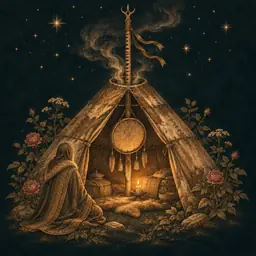
In the visions of the call the candidate is often taken apart. Sakha shamans told of spirits who cut them in pieces, counted their bones and put them together again, remade for the work. An older shaman then teaches the new one the songs, the spirits, the roads and the rules, and the people consecrate the new shaman with rites of their own; among the Buryat a birch is set up in the tent with its top through the smoke hole, joined by ribbons to birches outside, a road for the shaman's rising.
Drum, dress and helpers
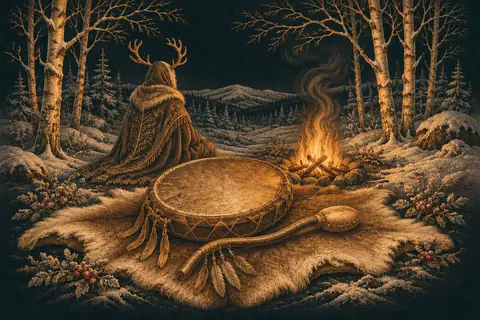
Wherever there is a shaman in Siberia there is a drum. Its hide comes from an animal, often a reindeer or a horse, which is said to become the shaman's mount: the drum carries the shaman to the other worlds, and its beating calls the spirits. The dress is a map of the shaman's power: a coat hung with iron plates and pendants, sometimes with iron bones sewn along the sleeves as a skeleton, fringes and ribbons like feathers, a cap or crown, and among the Sakha an iron circle on the breast. Some Samoyed shamans bound a cloth over their eyes, to see the spirit world by inner sight.
The shaman works with helping spirits: animal spirits, the spirits of dead shamans of the clan, and a guardian of their own. Among the Sakha each shaman was said to have an animal mother, a beast in the other world whose life was bound up with the shaman's own. The Sakha also knew white shamans, who served the bright spirits of the upper world at the spring festivals, at marriages and in healing, and black shamans, who dealt with the dark spirits and the lower world.
The journey
The shaman's work is done at night, in the dwelling, with the people gathered. The fire is fed, offerings are made, and the shaman puts on the dress and begins to drum and sing, calling the helping spirits one by one. The drumming quickens; the shaman dances, cries out in the voices of the spirits and, in the people's understanding, sets out on the journey while the body stays among them, sometimes falling still. On returning the shaman tells what was seen and what must be done: an offering to make, a fault to put right, a soul brought home.
Among the Altaians the kam who carried the people's offering to the high god Bai-Ülgen climbed a birch set up in the tent, cut with steps, each step a heaven, telling the people as he rose what he met on the way. Among the Sami of the north the noaidi beat a drum painted with the figures of the three worlds, and a small pointer moving over its skin gave the answer to a question. And the Inuit tell of the angakkuq who goes down to the bottom of the sea to the Sea Woman, Sedna, when broken rules have tangled her hair, and combs it out for her, since she has no fingers to do it herself, so that she lets the seals and whales go back to the hunters.
The burden of the gift
A shaman's power, in these accounts, is a burden as much as a gift. The shaman must keep the rules of the spirits, suffers when the work goes wrong, and is bound to serve the people and not only himself, and a shaman who turned the gift to harm was feared. The work belongs to a people: its spirits are the spirits of that land, that river and that clan, its songs are in that language, and it is learned over years from a living teacher.
How it is practised
A shaman's work belongs to a people, a language and years of training, and it is not offered here as a technique. What a reader can do is learn one tradition from its own voices: the accounts that Siberian, Sami, Inuit or Amazonian communities give of their own practitioners, in place of general books that blend them. A reader with roots in such a community asks its elders. Weekend courses that promise a spirit animal or a journey, and any retreat built round a plant brew, are outside what the house offers: the first borrows without leave, and the second carries risks to body and mind.
Where it comes from
One of the first written accounts to use the word is by the exiled Russian priest Avvakum, in the 1670s. Travellers of the eighteenth century described Siberian shamans as tricksters or as the sick, and Soviet rule later persecuted them. In 1951 the historian of religion Mircea Eliade published a study that gathered reports from many lands under one idea, the soul's flight between three worlds along a central tree or pole. The anthropologist Michael Harner turned that picture into a method for Western students in 1980. Many indigenous teachers object to the borrowing, and scholars now doubt that there was ever one shamanism.
What is known, and what is not
The roles themselves are well documented by three centuries of fieldwork. What is disputed is the general theory. Eliade's single pattern rests on selected reports and is now widely criticised, and the claim that cave paintings show a shamanism tens of thousands of years old is a hypothesis that many archaeologists reject. Whether a soul travels is a matter of belief. Studies of drumming and rhythm show that they change attention and mood, which says something about the state and nothing about what is met in it.
Its words
 Shamanism
- A loose name for traditions in which a specialist is held to send the soul out, or call spirits in, on behalf of a community.
Ask the Oracle further
Where does the word shaman come from, and what spirit world do Siberian shamans describe?What did Mircea Eliade claim about shamans and the spirits, and why do scholars now doubt it?
Before you practise
The Oracle tells what the traditions say of spirits and names whose account it is. It does not speak for the dead, and it cannot tell you that a spirit is with you. If you hear voices or feel commanded, please see a doctor.
Its other branches
Angels and their ordersThe jinnThe ancestorsDaimons and intelligencesThe elementalsTesting the spiritsGhosts and hauntingsMediums and SpiritualismThe fair folkDemons in the old booksThe whole artSearch the tree

