
The elementals
Paracelsus’s beings of earth, water, air and fire.
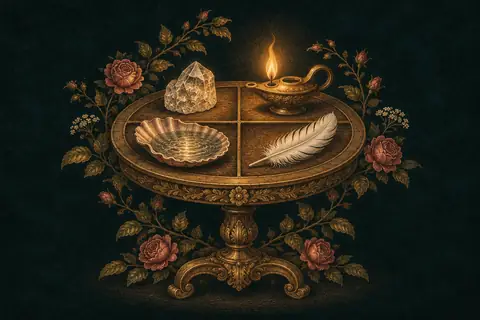
What are the elemental spirits that Paracelsus described?
What it is
The elementals are four peoples said to live in the four elements. Gnomes or pygmies live in earth and pass through rock as people pass through air. Undines or nymphs live in water, sylphs in air and salamanders in fire. As Paracelsus describes them they look human, keep households and die, but have no immortal soul, which a water woman may gain by marrying a man. They are the origin of much later fairy lore, and of the modern use of the word elemental.
The teaching
As Paracelsus's Book on Nymphs, Sylphs, Pygmies and Salamanders (1566) teaches it.
The four peoples
Each of the four elements, Paracelsus teaches, has its own people, as the dry land has ours, for every element must be inhabited by beings fitted to it. He gives each people several names. The water people are nymphs or undines. The air people are sylphs, which he also calls sylvestres, the forest people, and wind people. The earth people are pygmies or gnomes, the mountain people or little earth men. The fire people are salamanders, which he also calls vulcans, or aetnans after the burning mountain Etna.
Each people lives in its own element as we live in air, and Paracelsus calls that element its chaos. The gnomes walk through rock and walls as we walk through air, the undines live in water, and the salamanders in flame. In its own chaos each is healthy, and carried into another it would drown, stifle or burn, as we would in theirs. So the undines are found in springs and rivers, the gnomes in caves and in the deep places of mountains, the sylphs in the air and the woods, and the salamanders in fire and in burning mountains, where they can be heard shouting and hammering.
Between human, spirit and beast
They are not spirits, Paracelsus insists, and not devils, though people take them for both. They have flesh, blood and bones; they eat and drink, wear clothes, which God gives them as he gives them to us, for modesty's sake, speak, reason, marry, bear children, fall ill and die. In one thing they are like spirits: they are swift and pass through their element without hindrance. They are made in the image of human beings as human beings are made in the image of God, and the undines are the likest to us of the four.
What they lack is a soul. They are not of Adam's line and have no immortal soul, so that in their death they are like the beasts. Yet Paracelsus calls such a being a marvellous creature, to be considered above all others: a sign in nature of how wide and wonderful God's works are.
How they come to us
They do not seek us out for purposes of their own. God lets them come among people as often as is needed for us to learn of them and to see that God makes wonderful works, much as angels appear to remind us of their maker. The nymphs appear to us, but we do not appear to them; their world knows of ours only what is told by those of them who have been here, as a pilgrim tells of far countries.
Of the fire people Paracelsus says that they are often seen as glowing lights that run to and fro across meadows and fields, but that they do not live with human beings, because of their fire, and that the devil can take hold of them as he can of us. Of the gnomes he warns that they are not to be mocked in places where a person could easily be lost, and he tells that they mint coins of their own and will pay people to leave the places where they dwell.
The water wife and her soul
An undine gains a soul by marrying a man, and the children of such a marriage have souls as well. For this reason the water women seek men out, and Paracelsus treats such a marriage as a true Christian marriage, binding as any other. A husband must not provoke his water wife beside water, for there she can vanish back into her element; and even then she is not dead, and the marriage stands.
He tells three stories of them. On the Venusberg, the mountain of Venus, a company of nymphs under a queen drew young men in, and he says they should not be despised for the strange tales told of them. Melusine came from the nymphs to live among human beings; he judges that she was possessed, and tells that she turned into a serpent every Saturday. The knight of Staufenberg had a water wife and left her to marry a noble bride, and at the wedding she took her revenge and he died. Paracelsus defends her: she was of flesh and blood and no demon, and God let her be her own judge.
The monsters and the treasures
Each people can also bring forth monsters, which do not resemble their parents. From the water people come sirens and sea monks, from the air people giants, from the earth people dwarfs, and from the fire people the will-o'-the-wisps. Paracelsus reads them as he reads comets, as signs sent out of the common order: sirens foretell the fall of princes and lords or the rise of factions, giants great disasters, dwarfs poverty among the people, and the fiery lights the end of a monarchy. The giants and dwarfs of old, he adds, are gone.
The four peoples also keep the treasures of the earth. The salamanders make ready and forge the ores in the fiery depths, the gnomes guard them in the mountains until their time comes to be found by human beings, the sylphs keep the stones that lie above ground, and the undines those hidden under water. Each does this work, Paracelsus says, as people do theirs.
The elements themselves
Behind the four peoples stand the four elements of the old natural philosophy, each made of two qualities. Fire is hot and dry, air hot and moist, water cold and moist, and earth cold and dry, and each passes into its neighbour through the quality they share. In the medicine of Galen the four humours answer to them, and the four temperaments with them: the choleric to fire, the sanguine to air, the phlegmatic to water and the melancholic to earth. To learn the elementals is first to learn these four natures, their heat and cold, their dryness and moisture, their weight and lightness.
What later books added
Later writers took the four peoples further than Paracelsus did. The Comte de Gabalis has its sage teach that the elementals long for the immortality that union with a human being brings, and that the wise should forgo mortal marriage for their sake. Eliphas Lévi gave them sovereigns: Gob for the gnomes, Paralda for the sylphs, Nicksa for the undines and Djin for the salamanders. The Golden Dawn set the elements at the four quarters, air in the east, fire in the south, water in the west and earth in the north. None of this is in Paracelsus, who wrote of the four peoples as natural history and as a witness to God's works.
How it is practised
The elementals are met today mostly as a way of noticing the four elements. A reader can take one each week: the weight and patience of earth in a garden or on a hill path, moving water, wind and breath, the hearth or a candle. The exercise is attention, with a few lines written afterwards on what each element is like and which of them one's own temperament most resembles. Nothing is summoned, and the house claims no being behind any of them.
Where it comes from
The scheme is the work of Paracelsus, the Swiss physician who died in 1541. His Book on Nymphs, Sylphs, Pygmies and Salamanders was printed in 1566. He drew on German mining lore and on folk tales of water women, and gave these beings a place in nature beside animals and humans. The French satire Le Comte de Gabalis of 1670 made the four names popular, Alexander Pope borrowed its sylphs for The Rape of the Lock, and Friedrich de la Motte Fouqué's tale Undine of 1811 fixed the figure of the water spirit who seeks a soul.
What is known, and what is not
That Paracelsus wrote the treatise and fixed the four names is documented; the word gnome first appears in his writing. The beings themselves belong to folklore and literature, and no observation supports them. Paracelsus offered them as natural history, though some scholars read the book as partly allegory. Theosophists and later esoteric writers added ranks and tasks that are not in his text.
Its words
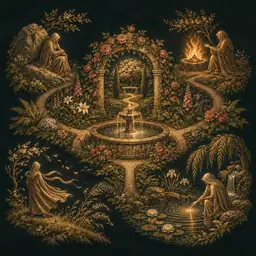 Elementals
- Paracelsus's four peoples of the elements: gnomes of earth, undines of water, sylphs of air and salamanders of fire.
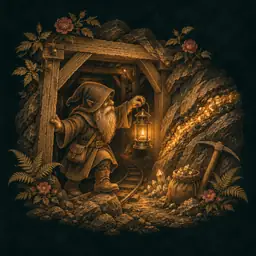 Gnome
- The earth elemental of Paracelsus: a small people who pass through rock as humans pass through air. The word is his.
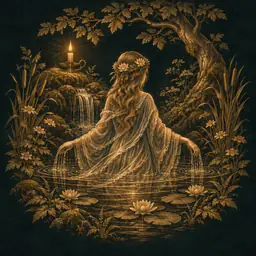 Undine
- The water elemental of Paracelsus: a being in human form that lives in springs and rivers and has no immortal soul.
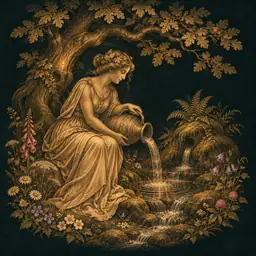 Nymph
- In Greek myth a female spirit of a spring, a tree, a mountain or the sea. Paracelsus used the word for his water people.
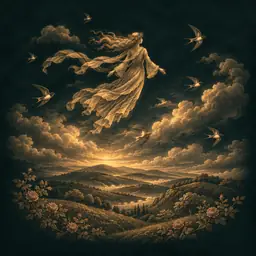 Sylph
- The air elemental of Paracelsus: a people of the air, which he also called the wood people.
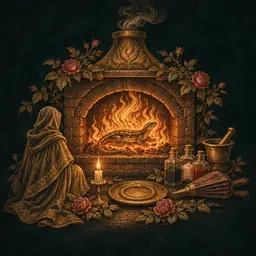 Salamander
- The fire elemental of Paracelsus, named for the lizard that old belief said could live in flames.
Ask the Oracle further
Why did Paracelsus say the elementals have no soul, and how could an undine gain one?Which of the four elementals of the spirit realm matches my own temperament?
Before you practise
The Oracle tells what the traditions say of spirits and names whose account it is. It does not speak for the dead, and it cannot tell you that a spirit is with you. If you hear voices or feel commanded, please see a doctor.
Its other branches
Angels and their ordersThe jinnThe ancestorsDaimons and intelligencesTesting the spiritsGhosts and hauntingsMediums and SpiritualismShamans and spirit journeysThe fair folkDemons in the old booksThe whole artSearch the tree

